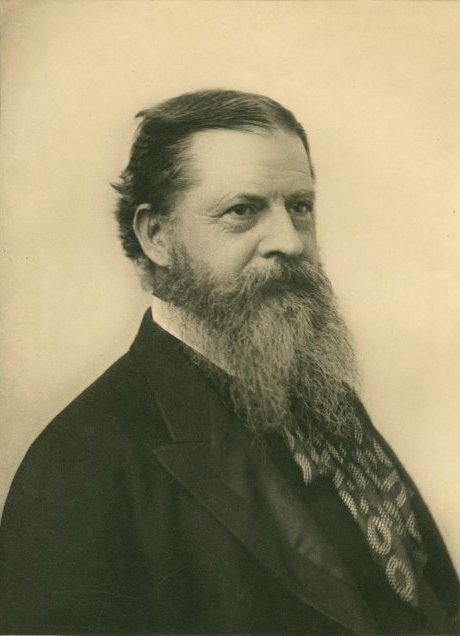
Frasi di Charles Sanders Peirce
pagina 4

Charles Sanders Peirce è stato un matematico, filosofo, semiologo, logico, scienziato e accademico statunitense.

Conosciuto per i suoi contributi, oltre che alla logica anche all'epistemologia, Peirce è stato un importante studioso, considerato fondatore del pragmatismo e uno dei padri della moderna semiotica .

Negli ultimi decenni il suo pensiero è stato fortemente rivalutato, fino a porlo tra i principali innovatori in molti campi, specialmente nella metodologia della ricerca e nella filosofia della scienza. Wikipedia  

✵ 10. Settembre 1839 – 19. Aprile 1914
Charles Sanders Peirce photo
Charles Sanders Peirce: 131 citazioni1 Mi piace

Charles Sanders Peirce frasi celebri

“L'idea non appartiene all'anima; è l'anima che appartiene all'idea.”

Charles Sanders Peirce

da Collected Papers, Vol. I, par. 216, 1931-1958

“Non si può bloccare la strada della ricerca.”

Charles Sanders Peirce

da Collected Papers, Vol. I, par. 135

“Tutte le evoluzioni che conosciamo vanno dal vago per arrivare al definito.”

Charles Sanders Peirce

da Collected Papers, Vol. VI, par. 191

Charles Sanders Peirce Frasi e Citazioni

Charles Sanders Peirce: Frasi in inglese

“Understand me well. My appeal is to observation — observation that each of you must make for himself.”

Charles Sanders Peirce

Lecture II : The Universal Categories, § 2 : Struggle, CP 5.53
Pragmatism and Pragmaticism (1903)

“Do not block the way of inquiry.”

Charles Sanders Peirce

Vol. I, par. 135
Collected Papers (1931-1958)

“All the evolution we know of proceeds from the vague to the definite.”

Charles Sanders Peirce

Vol. VI, par. 191
Collected Papers (1931-1958)

“Be it understood, then, that what we have to do, as students of phenomenology, is simply to open our mental eyes and look well at the phenomenon and say what are the characteristics that are never wanting in it, whether that phenomenon be something that outward experience forces upon our attention, or whether it be the wildest of dreams, or whether it be the most abstract and general of the conclusions of science.
The faculties which we must endeavor to gather for this work are three. The first and foremost is that rare faculty, the faculty of seeing what stares one in the face, just as it presents itself, unreplaced by any interpretation, unsophisticated by any allowance for this or for that supposed modifying circumstance. This is the faculty of the artist who sees for example the apparent colors of nature as they appear. When the ground is covered by snow on which the sun shines brightly except where shadows fall, if you ask any ordinary man what its color appears to be, he will tell you white, pure white, whiter in the sunlight, a little greyish in the shadow. But that is not what is before his eyes that he is describing; it is his theory of what ought to be seen. The artist will tell him that the shadows are not grey but a dull blue and that the snow in the sunshine is of a rich yellow. That artist's observational power is what is most wanted in the study of phenomenology. The second faculty we must strive to arm ourselves with is a resolute discrimination which fastens itself like a bulldog upon the particular feature that we are studying, follows it wherever it may lurk, and detects it beneath all its disguises. The third faculty we shall need is the generalizing power of the mathematician who produces the abstract formula that comprehends the very essence of the feature under examination purified from all admixture of extraneous and irrelevant accompaniments.”

Charles Sanders Peirce

Lecture II : The Universal Categories, § 1 : Presentness, CP 5.41 - 42
Pragmatism and Pragmaticism (1903)

“The word "God," so "capitalised" (as we Americans say), is the definable proper name, signifying Ens necessarium; in my belief Really creator of all three Universes of Experience.”

Charles Sanders Peirce

I, Ens necessarium is a latin expression which signifies "Necessary being, necessary entity"
A Neglected Argument for the Reality of God (1908)

“Effort supposes resistance.”

Charles Sanders Peirce

Vol. I, par. 320
Collected Papers (1931-1958)

Autori simili

Thomas Carlyle photo
Thomas Carlyle38
storico, saggista e filosofo scozzese None
Elbert Hubbard photo
Elbert Hubbard9
scrittore, filosofo e artista statunitense None
William James photo
William James11
psicologo e filosofo statunitense None
Ludwig Feuerbach photo
Ludwig Feuerbach54
filosofo tedesco None
Georg Wilhelm Friedrich Hegel photo
Georg Wilhelm Friedrich Hegel45
filosofo tedesco None
Helena Blavatsky photo
Helena Blavatsky1
filosofa e teosofa ucraina None
John Stuart Mill photo
John Stuart Mill51
filosofo e economista britannico None
Vasilij Vasil'evič Rozanov photo
Vasilij Vasil'evič Rozanov12
scrittore e filosofo russo None
Henry David Thoreau photo
Henry David Thoreau89
filosofo, scrittore e poeta statunitense None
Ralph Waldo Emerson photo
Ralph Waldo Emerson115
filosofo, scrittore e saggista statunitense None