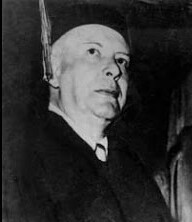
Wallace Stevens frasi celebri
Wallace Stevens Frasi e Citazioni
Wallace Stevens: Frasi in inglese
Wallace Stevens libro Harmonium
"Gubbinal"
Harmonium (1923)
“That strange flower, the sun,
Is just what you say.
Have it your way.”
Wallace Stevens libro Harmonium
"Gubbinal"
Harmonium (1923)
Contesto: p>That strange flower, the sun,
Is just what you say.
Have it your way.The world is ugly,
And the people are sad..</p
Notes Toward a Supreme Fiction (1942), It Must Change
“What is divinity if it can come
Only in silent shadows and in dreams?”
Wallace Stevens libro Harmonium
"Sunday Morning"
Harmonium (1923)
“Perhaps
The truth depends on a walk around a lake”
Notes Toward a Supreme Fiction (1942), It Must Be Abstract
Contesto: p>Perhaps
The truth depends on a walk around a lake,A composing as the body tires, a stop
To see hepatica, a stop to watch
A definition growing certain andA wait within that certainty, a rest
In the swags of pine-trees bordering the lake.
Perhaps there are times of inherent excellence</p
“Out of nothing to have come on major weather,”
Notes Toward a Supreme Fiction (1942), It Must Give Pleasure
Contesto: p>But to impose is not
To discover. To discover an order as of
A season, to discover summer and know it, To discover winter and know it well, to find
Not to impose, not to have reasoned at all,
Out of nothing to have come on major weather,It is possible, possible, possible. It must
Be possible. It must be that in time
The real will from its crude compoundings come,Seeming at first, a beast disgorged, unlike,
Warmed by a desperate milk. To find the real,
To be stripped of every fiction except one,The fiction of an absolute — Angel,
Be silent in your luminous cloud and hear
The luminous melody of proper sound.
"A High-Toned Old Christian Woman" first published in The Dial No. 73 (July 1922)
"Angel Surrounded by Paysans" (1949)
Contesto: I am one of you and being one of you
Is being and knowing what I am and know.
Yet I am the necessary angel of earth,
Since, in my sight, you see the earth again,
Cleared of its stiff and stubborn, man-locked set
And, in my hearing, you hear its tragic drone
Rise liquidly in liquid lingerings,
Like watery words awash; like meanings said
By repetitions of half-meanings. Am I not,
Myself, only half a figure of a sort,
A figure half seen, or seen for a moment, a man
Of the mind, an apparition appareled in
Apparels of such lightest look that a turn
Of my shoulders and quickly, too quickly, I am gone?
“Perhaps there are times of inherent excellence”
Notes Toward a Supreme Fiction (1942), It Must Be Abstract
Contesto: p>Perhaps
The truth depends on a walk around a lake,A composing as the body tires, a stop
To see hepatica, a stop to watch
A definition growing certain andA wait within that certainty, a rest
In the swags of pine-trees bordering the lake.
Perhaps there are times of inherent excellence</p
“We agree in principle. That's clear.”
"A High-Toned Old Christian Woman" (1922)
Contesto: We agree in principle. That's clear. But take
The opposing law and make a peristyle,
And from the peristyle project a masque
Beyond the planets. Thus, our bawdiness,
Unpurged by epitaph, indulged at last,
Is equally converted into palms,
Squiggling like saxophones. And palm for palm,
Madame, we are where we began.
“Style is not something applied. It is something that permeates.”
"Two or Three Ideas" (1951); later published in Opus Posthumous (1959)
Contesto: Style is not something applied. It is something that permeates. It is of the nature of that in which it is found, whether the poem, the manner of a god, the bearing of a man. It is not a dress.
Notes Toward a Supreme Fiction (1942), It Must Be Abstract
Contesto: p>As a man and woman meet and love forthwith.
Perhaps there are moments of awakening,
Extreme, fortuitous, personal, in whichWe more than awaken, sit on the edge of sleep,
As on an elevation, and behold
The academies like structures in a mist.</p
“If there must be a god in the house, let him be one
That will not hear us when we speak: a coolness”
"Less and Less Human, O Savage Spirit"
Transport to Summer (1947)
Contesto: p> If there must be a god in the house, must be,
Saying things in the room and on the stair,Let him move as the sunlight moves on the floor,
Or moonlight, silently, as Plato's ghostOr Aristotle's skeleton. Let him hang out
His stars on the wall. He must dwell quietly.He must be incapable of speaking, closed,
As those are: as light, for all its motion, is;As color, even the closest to us, is;
As shapes, though they portend us, are.It is the human that is the alien,
The human that has no cousin in the moon.It is the human that demands his speech
From beasts or from the incommunicable mass.If there must be a god in the house, let him be one
That will not hear us when we speak: a coolnessA vermillioned nothingness, any stick of the mass
Of which we are too distantly a part.</p
“If there must be a god in the house, must be,
Saying things in the room and on the stair,”
"Less and Less Human, O Savage Spirit"
Transport to Summer (1947)
Contesto: p> If there must be a god in the house, must be,
Saying things in the room and on the stair,Let him move as the sunlight moves on the floor,
Or moonlight, silently, as Plato's ghostOr Aristotle's skeleton. Let him hang out
His stars on the wall. He must dwell quietly.He must be incapable of speaking, closed,
As those are: as light, for all its motion, is;As color, even the closest to us, is;
As shapes, though they portend us, are.It is the human that is the alien,
The human that has no cousin in the moon.It is the human that demands his speech
From beasts or from the incommunicable mass.If there must be a god in the house, let him be one
That will not hear us when we speak: a coolnessA vermillioned nothingness, any stick of the mass
Of which we are too distantly a part.</p
“Does not see these separate figures one by one,
And yet see only one”
Notes Toward a Supreme Fiction (1942), It Must Be Abstract
Contesto: p>What chieftain, walking by himself, crying
Most miserable, most victorious,Does not see these separate figures one by one,
And yet see only one, in his old coat,
His slouching pantaloons, beyond the town,Looking for what was, where it used to be?</p
Notes Toward a Supreme Fiction (1942), It Must Be Abstract
Notes Toward a Supreme Fiction (1942), It Must Change
Notes Toward a Supreme Fiction (1942), It Must Be Abstract
“I heard them cry — the peacocks.
Was it a cry against the twilight
Or against the leaves themselves”
Wallace Stevens libro Harmonium
"Domination of Black"
Harmonium (1923)
Contesto: I heard them cry — the peacocks.
Was it a cry against the twilight
Or against the leaves themselves
Turning in the wind,
Turning as the flames
Turned in the fire,
Turning as the tails of the peacocks
Turned in the loud fire,
Loud as the hemlocks
Full of the cry of the peacocks?
Or was it a cry against the hemlocks?
Notes Toward a Supreme Fiction (1942), It Must Change
Wallace Stevens libro Harmonium
"The Snow Man"
Harmonium (1923)
Contesto: p>One must have a mind of winter
To regard the frost and the boughs
Of the pine-trees crusted with snow;And have been cold a long time
To behold the junipers shagged with ice,
The spruces rough in the distant glitterOf the January sun; and not to think
Of any misery in the sound of the wind,
In the sound of a few leaves,Which is the sound of the land
Full of the same wind
That is blowing in the same bare placeFor the listener, who listens in the snow,
And, nothing himself, beholds
Nothing that is not there and the nothing that is.</p
“Soldier, there is a war between the mind
And sky, between thought and day and night.”
Notes Toward a Supreme Fiction (1942), It Must Give Pleasure
Contesto: Soldier, there is a war between the mind
And sky, between thought and day and night. It is
For that the poet is always in the sun, Patches the moon together in his room
To his Virgilian cadences, up down,
Up down. It is a war that never ends.
Notes Toward a Supreme Fiction (1942), It Must Be Abstract
Contesto: p>Begin, ephebe, by perceiving the idea
Of this invention, this invented world,
The inconceivable idea of the sun.You must become an ignorant man again
And see the sun again with an ignorant eye
And see it clearly in the idea of it.Never suppose an inventing mind as source
Of this idea nor for that mind compose
A voluminous master folded in his fire.</p
“These are not things transformed.
Yet we are shaken by them as if they were.”
Notes Toward a Supreme Fiction (1942), It Must Give Pleasure
Contesto: p>The difficultest rigor is forthwith,
On the image of what we see, to catch from that
Irrational moment its unreasoning,
As when the sun comes rising, when the sea
Clears deeply, when the moon hangs on the wall Of heaven-haven. These are not things transformed.
Yet we are shaken by them as if they were.
We reason about them with a later reason.</p
“The casual is not Enough. The freshness of transformation is”
Notes Toward a Supreme Fiction (1942), It Must Change
Contesto: p>The casual is not Enough. The freshness of transformation isThe freshness of a world. It is our own,
It is ourselves, the freshness of ourselves,
And that necessity and that presentationAre rubbings of a glass in which we peer.</p
“The seraph
Is satyr in Saturn, according to his thoughts.”
Notes Toward a Supreme Fiction (1942), It Must Change
Contesto: The bees came booming as if they had never gone,
As if hyacinths had never gone. We say
This changes and that changes. Thus the constant Violets, doves, girls, bees and hyacinths
Are inconstant objects of inconstant cause
In a universe of inconstancy. This meansNight-blue is an inconstant thing. The seraph
Is satyr in Saturn, according to his thoughts.
Wallace Stevens libro Harmonium
"Valley Candle"
Harmonium (1923)
Contesto: My candle burned alone in an immense valley.
Beams of the huge night converged upon it,
Until the wind blew.
Then beams of the huge night
Converged upon its image,
Until the wind blew.
“It must be visible or invisible,
Invisible or visible or both:
A seeing and unseeing in the eye.”
Notes Toward a Supreme Fiction (1942), It Must Be Abstract
Contesto: p>It must be visible or invisible,
Invisible or visible or both:
A seeing and unseeing in the eye.The weather and the giant of the weather,
Say the weather, the mere weather, the mere air:
An abstraction blooded, as a man by thought.</p


