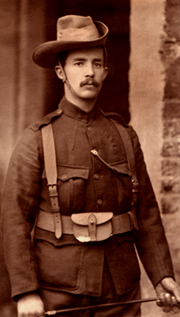
Robert Erskine Childers Frasi e Citazioni
Robert Erskine Childers: Frasi in inglese
A 1915 letter written to his aunt in regards to his wife Molly Childers. Cited in " Erskine Childers " by Jim Ring, Faber and Faber, London , (1996), pg. 432.
Literary Years and War (1900-1918)
Both above from a speech regarding the Anglo-Irish Treaty (1921) given on 21 December 1921 at University College Dublin. Cited in "Great Irish Speeches" by Michael McLoughlin, Poolbeg, London (1997), pp. 103-107.
Literary Years and War (1900-1918), Last Years: Ireland (1919-1922)
Written aboard HMS Engadine in 1914, cited in " The Riddle Of Erskine Childers " By Andrew Boyle, Hutchinson, London, (1977), pg. 200.
Literary Years and War (1900-1918)
"The H.A.C. in South Africa", by Erskine Childers and Basil Williams, Smith & Elder, (London, 1903), p. 72.
Literary Years and War (1900-1918)
“What the devil do you mean Carruthers?”
Origine: Literary Years and War (1900-1918), The Riddle Of The Sands (1903), p. 154.
The Daily News, 1919, as cited in "The Riddle of Erskine Childers" By Andrew Boyle, Hutchinson, London, (1977), pg. 260.
Literary Years and War (1900-1918), Last Years: Ireland (1919-1922)
"Written aboard HMS Engadine in 1916, cited in " The Riddle Of Erskine Childers " By Andrew Boyle , Hutchinson, London, (1977), pg. 205.
Literary Years and War (1900-1918)
“…to feel oneself a martyr, as everybody knows, is a pleasurable thing…”
Origine: Literary Years and War (1900-1918), The Riddle Of The Sands (1903), p. 1.
Origine: Literary Years and War (1900-1918), The Riddle Of The Sands (1903), p. 35.
Origine: Literary Years and War (1900-1918), The Riddle Of The Sands (1903), p. 217.
Origine: Literary Years and War (1900-1918), The Riddle Of The Sands (1903), p. 276.
“I am a birth, domicile, and deliberate choice of citizenship an Irishman…”
His own words from his last military trial on 17 November 1922, cited in The Freeman's Journal Newspaper, 27 November 1922.
Literary Years and War (1900-1918), Last Years: Ireland (1919-1922)
His own words from his last military trial on 17 November 1922.
Literary Years and War (1900-1918), Last Years: Ireland (1919-1922)
From a letter to the editor, where Childers questions the reasons behind the recent raid of his Dublin home. Irish Times , 19 April 1920.
Literary Years and War (1900-1918), Last Years: Ireland (1919-1922)
“The treaty, though it has good points, is a vast trap.”
The Illustrated London News, 31 December 1921.
Literary Years and War (1900-1918), Last Years: Ireland (1919-1922)
"War and the Arme Blanche", by Erskine Childers, Edward Arnold, (London, 1910), p. 231.
Literary Years and War (1900-1918)
“Take a step or two forward lads….. it will be easier that way.”
His last words to the firing squad, lined up before him holding rifles, at his execution. Cited in " The Riddle of Erskine Childers " By Andrew Boyle, Hutchinson, London (1977), pg. 25.
Literary Years and War (1900-1918), Last Years: Ireland (1919-1922)
“…. death stills the bitterest controversy.”
In conversation with Desmond Ryan, cited in "Unique Dictator" by Desmond Ryan, Arthur Barker Limited, London (1936), p. 213.
Literary Years and War (1900-1918), Last Years: Ireland (1919-1922)
Robert Erskine's last jail cell words to his son, also named Erskine, in November 1922. His son would become President of Ireland 52 years later. Cited in " The Riddle of Erskine Childers " By Andrew Boyle, Hutchinson, London (1977), pg. 320.
Literary Years and War (1900-1918), Last Years: Ireland (1919-1922)
Taken from a 1922, conversation between Childers and Brennan in regards to Arthur Griffith's decision to sign the Anglo-Irish Treaty (1921), cited in "Allegiance" by Robert Brennan, Browne & Nolan, Dublin (1950), pp. 254-55.
Literary Years and War (1900-1918), Last Years: Ireland (1919-1922)
The Daily News, 19 April 1920.
Literary Years and War (1900-1918), Last Years: Ireland (1919-1922)
Origine: Literary Years and War (1900-1918), The Riddle Of The Sands (1903), p. 91.
"German Influence on British Cavalry", by Erskine Childers, Edward Arnold, (London, 1911), p. 215.
Literary Years and War (1900-1918)
Speaking in elegy regarding the recent death of Michael Collins. From " Poblacht na-Eireann (War News ) No. 47 " Thursday 24 August 1922.
Literary Years and War (1900-1918), Last Years: Ireland (1919-1922)
Literary Years and War (1900-1918), Last Years: Ireland (1919-1922)
"In the Ranks of the C.I.V." By Erskine Childers, Smith & Elder and Co. (London, 1901), p. 20.
Literary Years and War (1900-1918)
"The H.A.C. in South Africa", by Erskine Childers and Basil Williams, Smith & Elder, (London, 1903), p. 193.
Literary Years and War (1900-1918)
"In the Ranks of the C.I.V.", by Erskine Childers, Smith & Elder and Co. (London, 1901), p. 127.
Literary Years and War (1900-1918)
A statement in reply to King George V's recent speech in Belfast. At the time, Childers had a formal role as Minister Of Propaganda for Sinn Fein. Chicago Tribune, 23 June 1921.
Literary Years and War (1900-1918), Last Years: Ireland (1919-1922)
A 1920 private letter to Admiral Herbert Fisher, cited in " Herbert Fisher (1865-1940) A Biography" By David Ogg , E&A, London, (1948), pg. 101.
Literary Years and War (1900-1918), Last Years: Ireland (1919-1922)


