“L'arte non è ciò che vedi tu, ma ciò che consenti agli altri di vedere.”
da Figures in Motion
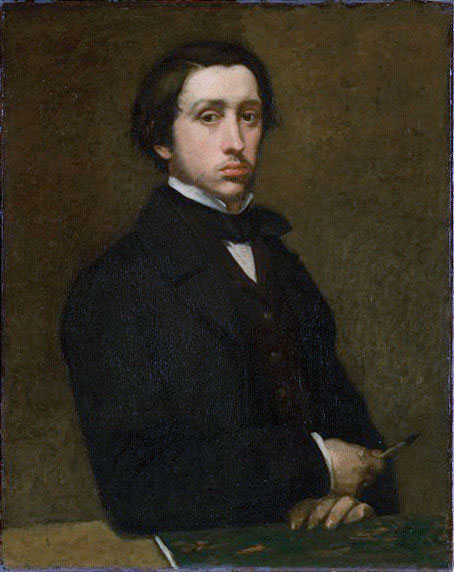
Hilaire German Edgar Degas /i'lɛʁ ʒɛʁ'mɑ̃ ɛd'gaʁ də'ga/ è stato un pittore e scultore francese.
La maggior parte delle opere di Degas possono essere attribuite al grande movimento dell'Impressionismo, nato in Francia negli anni sessanta del diciannovesimo secolo in reazione alla pittura accademica dell'epoca. Gli artisti che ne facevano parte come Claude Monet, Paul Cézanne, Pierre-Auguste Renoir, Alfred Sisley, Mary Cassatt, Berthe Morisot, Camille Pissarro, stanchi di essere regolarmente rifiutati al Salone Ufficiale si erano riuniti in una società anonima per mostrare la loro arte al pubblico. In genere le caratteristiche principali dell'arte impressionista sono il nuovo uso della luce e i soggetti all'aperto. Gli impressionisti riuscirono a rivoluzionare la pittura, accorgendosi che l'occhio umano non riceve dalla realtà un'immagine dettagliata, ma un insieme di colori che poi la mente rielabora in forme distinte.
Così la prima impressione visiva divenne fondamento e scopo dell'impressionismo. Infatti questi artisti, lavoravano “en plein air” , ciò consentiva di riportare subito sulla tela la realtà visiva percepita. La tecnica pittorica consisteva in rapide pennellate di colore, non fissando i dettagli, ma dando un effetto cromatico – luminoso dell'insieme. Nella scelta dei temi prevalsero le situazioni in cui le vibrazioni luminose erano più percepibili perché accentuate dal movimento. Queste caratteristiche non sono sempre applicabili a Degas: anche se lui fu uno dei principali animatori delle mostre impressioniste, non trova un giusto posto nel movimento che asseriva la libertà di dipingere. Ai dipinti all'aperto egli preferiva «ciò che non si vede più nella memoria». Dirà un giorno a Pissarro: «Voi avete bisogno di una vita naturale; io di una fittizia.»
Anche se Degas fece parte ufficialmente degli impressionisti, non era però a loro unito per i tratti distintivi della pittura. La sua situazione d'eccezionalità non sfuggì ai critici di allora: anche se il suo modernismo imbarazzante veniva messo in evidenza, fu il meno controverso degli artisti francesi dell'epoca.
“L'arte non è ciò che vedi tu, ma ciò che consenti agli altri di vedere.”
da Figures in Motion
Hokusai n'est pas seulement un artiste parmi d'autres dans le monde flottant, c'est une île, un continent, un monde a lui seul.
Origine: Da Terrasse, Dégas à travers ses mots, p. 42; citato in Gian Carlo Calza, Stile Giappone, Einaudi, Torino, 2002, p. 130. ISBN 8806161288
Quote in a letter (27 November, 1858) to Degas' friend and painter Gustave Moreau; as quoted in More unpublished Letters of Degas, Theodore Reff, Art Bulletin LI, No. 3., Sept. 1969, pp. 282-283
1855 - 1875
Quote from Degas' Notebook of 1869; as quoted in Impressionism and Post Impressionism 1874 – 1904, 'Sources and Documents', Linda Nochlin, Englewood Cliffs, New Yersey, 1966, p. 62
1855 - 1875
Degas in 1883, as quoted by Colin B. Bailey, in The Annenberg Collection: Masterpieces of Impressionism and Post-impressionism, publish. Metropolitan Museum of Art, New York, 2009, p. 4 <br class="br">note 5: 20 June 1887, - Corot’s biographer Alfred Robaut https://fr.wikipedia.org/wiki/Alfred_Robaut told this story (1905. Vol. 1. P. 336) <br class="br">1876 - 1895
Quote of Degas, in his talk with the visiting Mallarmé, 1880's; as cited in Berthe Morisot, the first lady of Impressionism, by Margaret Sehnan; Sutton Publishing (ISBN 0 7509 2339 3), 1996, p. 234
1876 - 1895
Il faut avoir une haute idée, non pas de ce qu'on fait, mais de ce qu'on pourra faire un jour; sans quoi ce n'est pas la peine de travailler.
"Mad About Drawing" (p. 64)
posthumous quotes, Degas Dance Drawing' (1935)
J'ai vraiment, un vrai bagage dans la tête. S'il y avait pour cela, comme il y a partout ici, des compagnies d'assurance, voilà un ballot je ferais assurer de suite.
Quote from a letter to James Tissot, (New Orleans, 1873), as cited in Marilyn Brown, Degas and the Business of Art: A Cotton Office in New Orleans (Penn State Press, 1994)
1855 - 1875
posthumous quotes, The Shop-Talk of Edgar Degas', (1961)
posthumous quotes, The Shop-Talk of Edgar Degas', (1961)
"Methods of Work" (p. 64)
posthumous quotes, Degas: An Intimate Portrait' (1927)
“Drawing is not the same as form; it is a way of seeing form.”
Le dessin n'est pas la forme, il est la manière de voir la forme.
"Drawing Is Not the Same As Form..." (p. 82)
posthumous quotes, Degas Dance Drawing' (1935)
Quoted by Julian Barnes, 'The Artist As Voyeur' (1996), from The Grove Book of Art Writing, ed. Martin Gayford and Karen Wright (Grove Press, 2000)
quotes, undated
quote on his journey through America during 1872
Quote from his letter, Louisiana, America 1872; as cited in The private lives of the Impressionists, Sue Roe, Harpen Collins Publishers, New York 2006, p. 113-114
1855 - 1875
Quoted in Degas' letter to Daniel Halévy, 31 Jan 1892, from Degas Letters, ed. Marcel Guerin, trans. Marguerite Kay (1947)
1876 - 1895
Quote from History of Impressionism, Rev. ed. John Rewald, Museum of Modern Art, 1961, p. 89
posthumous quotes, Degas Dance Drawing' (1935)
"The Crime and the Punishment" (p. 47)
posthumous quotes, Degas: An Intimate Portrait' (1927)
Quote of Degas in 1883, as cited by Colin B. Bailey, in The Annenberg Collection: Masterpieces of Impressionism and Post-impressionism, publish. Metropolitan Museum of Art, New York, 2009, p. 30 note 10
Degas confided this to Pierre-George Jeanniot
1876 - 1895
a remark to E. Rouart [son of Henri Rouart in 1904; as quoted in Renoir – his life and work, Francois Fosca, Book Club Associates /Thames and Hudson Ltd, London 1975, p. 274
1896 - 1917
“We were created to look at one another, weren't we.”
Quote of Degas, as cited in Walter Sickert The Complete writing on art ed Anna Robins OUP, Oxford 2002 ISBN 0199261695
quotes, undated
Quote of Degas in conversation with George Moore, later quoted by Moore in Impressions and Opinions (1891)
1876 - 1895
posthumous quotes, The Shop-Talk of Edgar Degas', (1961)
“Everybody has talent at twenty-five. The difficult thing is to have it at fifty.”
posthumous quotes, The Shop-Talk of Edgar Degas', (1961)
"The Crime and the Punishment" (p. 48)
posthumous quotes, Degas: An Intimate Portrait' (1927)
Quote in Gegas letter to his friend James Tissot, New Orleans, 18 February 1873; as quoted in 'Impressionism: A Centenary Exhibition', Anne Distel, Michel Hoog, Charles S. Moffett, the Metropolitan Museum of Art, (New York, N.Y.) 1975, p. 99 <br class="br">Degas is referring to his painting 'Cotton Merchants in New Orleans' [Cotton Merchants in New Orleans https://www.harvardartmuseums.org/art/299832, (1873) <br class="br">1855 - 1875
C'est très bien de copier ce qu'on voit, c'est beaucoup mieux de dessiner ce que l'on ne voit plus que dans son mémoire. C'est une transformation pendant laquelle l'ingéniosité collabore avec la mémoire. Vous ne reproduisez que ce qui vous a frappé, c'est-à-dire le nécessaire.
Quoted in Maurice Sérullaz, L'univers de Degas (H. Scrépel, 1979), p. 13
quotes, undated
"Recollections of Degas by Berthe Morisot" (p. 84)
posthumous quotes, Degas Dance Drawing' (1935)
Quote from Degas' Notebook entry c. 1860's; as quoted in Artists on Art: From the XIV to the XX Century, ed. Robert Goldwater (Pantheon, 1945)
1855 - 1875
Quote from The private lives of the Impressionists, Sue Roe, Harpen Collins Publishers, New York 2006, p. 34
quotes, undated
"The Crime and the Punishment" (p. 46)
posthumous quotes, Degas: An Intimate Portrait' (1927)
“Boredom soon overcomes me when I am contemplating nature.”
Notebook entry (1858), The Notebooks of Edgar Degas, ed. Theodore Reff (1976)
1855 - 1875


