“L'arte non è ciò che vedi tu, ma ciò che consenti agli altri di vedere.”
da Figures in Motion
Hilaire German Edgar Degas /i'lɛʁ ʒɛʁ'mɑ̃ ɛd'gaʁ də'ga/ è stato un pittore e scultore francese.
La maggior parte delle opere di Degas possono essere attribuite al grande movimento dell'Impressionismo, nato in Francia negli anni sessanta del diciannovesimo secolo in reazione alla pittura accademica dell'epoca. Gli artisti che ne facevano parte come Claude Monet, Paul Cézanne, Pierre-Auguste Renoir, Alfred Sisley, Mary Cassatt, Berthe Morisot, Camille Pissarro, stanchi di essere regolarmente rifiutati al Salone Ufficiale si erano riuniti in una società anonima per mostrare la loro arte al pubblico. In genere le caratteristiche principali dell'arte impressionista sono il nuovo uso della luce e i soggetti all'aperto. Gli impressionisti riuscirono a rivoluzionare la pittura, accorgendosi che l'occhio umano non riceve dalla realtà un'immagine dettagliata, ma un insieme di colori che poi la mente rielabora in forme distinte.
Così la prima impressione visiva divenne fondamento e scopo dell'impressionismo. Infatti questi artisti, lavoravano “en plein air” , ciò consentiva di riportare subito sulla tela la realtà visiva percepita. La tecnica pittorica consisteva in rapide pennellate di colore, non fissando i dettagli, ma dando un effetto cromatico – luminoso dell'insieme. Nella scelta dei temi prevalsero le situazioni in cui le vibrazioni luminose erano più percepibili perché accentuate dal movimento. Queste caratteristiche non sono sempre applicabili a Degas: anche se lui fu uno dei principali animatori delle mostre impressioniste, non trova un giusto posto nel movimento che asseriva la libertà di dipingere. Ai dipinti all'aperto egli preferiva «ciò che non si vede più nella memoria». Dirà un giorno a Pissarro: «Voi avete bisogno di una vita naturale; io di una fittizia.»
Anche se Degas fece parte ufficialmente degli impressionisti, non era però a loro unito per i tratti distintivi della pittura. La sua situazione d'eccezionalità non sfuggì ai critici di allora: anche se il suo modernismo imbarazzante veniva messo in evidenza, fu il meno controverso degli artisti francesi dell'epoca.
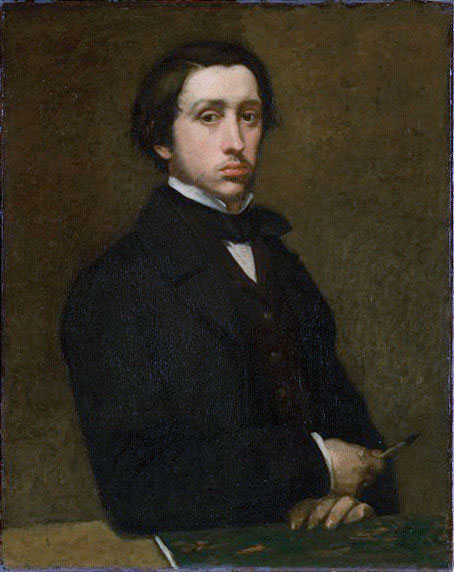
“L'arte non è ciò che vedi tu, ma ciò che consenti agli altri di vedere.”
da Figures in Motion
Hokusai n'est pas seulement un artiste parmi d'autres dans le monde flottant, c'est une île, un continent, un monde a lui seul.
Origine: Da Terrasse, Dégas à travers ses mots, p. 42; citato in Gian Carlo Calza, Stile Giappone, Einaudi, Torino, 2002, p. 130. ISBN 8806161288
In Degas by Himself, Drawings, Paintings, Writings, ed. Richard Kendall 2000, p. 299
quotes, undated
“Drawing is not what you see but what you must make others see.”
posthumous quotes, The Shop-Talk of Edgar Degas', (1961)
“Art is vice. You don't marry it legitimately, you rape it.”
posthumous quotes, The Shop-Talk of Edgar Degas', (1961)
“Only when he no longer knows what he is doing does the painter do good things.”
Quoted in Artists on Art: From the XIV to the XX Century, ed. Robert Goldwater (Pantheon, 1945)
quotes, undated
“I should like to be famous and unknown.”
Je voudrais être illustre et inconnu.
Degas said this to Henri Rouart, as cited by Antoine Terrasse, in Degas (Chartwell Books, 1982)
quotes, undated
Quote in Degas' letter to the sculptor Paul-Albert Bartolomé, January 1886; as cited in 'Performing Fine Arts: Dance as a Source of Inspiration in Impressionism, by Johannis Tsoumas http://rupkatha.com/dance-in-impressionism/ <br class="br">1876 - 1895
quote from Georges Jeanniot, in Souvenirs sur Degas (Memories of Degas, 1933)
quotes, undated
posthumous quotes, The Shop-Talk of Edgar Degas', (1961)
Quote from Degas' working notes; as quoted in The private lives of the Impressionists, Sue Roe, Harpen Collins Publishers, New York 2006, p. 34
quotes, undated
“What a pity we allowed ourselves to be called Impressionists.”
Comme nous avons mal fait de nous laisser appeler Impressionistes.
Quoted by Walter Sickert in 'Post-Impressionists,' Fortnightly Review (January 1911)
1896 - 1917
“He [ Corot ] is always the strongest, he has foreseen everything.”
Degas in 1883, as quoted by Colin B. Bailey, in The Annenberg Collection: Masterpieces of Impressionism and Post-impressionism, publish. Metropolitan Museum of Art, New York, 2009, p. 2 <br class="br">Degas made this remark about Corot to Pissarro at the preview exhibition of the 'Jules Paton sale' in Paris, 24 April 1883 and overheard by Corot's biographer Alfred Robaut https://fr.wikipedia.org/wiki/Alfred_Robaut. <br class="br">1876 - 1895
Quote from Degas' Notebook (undated); as quoted in Impressionism: A Centenary Exhibition, Anne Distel, Michel Hoog, Charles S. Moffett, the Metropolitan Museum of Art, (New York, N.Y.) 1975, pp. 81-82
quotes, undated
Quote of Degas, as cited by Walter Sickert, in 'Post-Impressionism and Cubism', Pall Mall Gazette (1914-03-11).
According to Sickert, Degas had said this quote to him in 1885
1876 - 1895
Quote from Degas' letter to Cornelie Morisot (mother of Berthe Morisot), Spring 1873; as cited in The private lives of the Impressionists, Sue Roe, Harpen Collins Publishers, New York 2006, p. 119
1855 - 1875
"As He Grows Old" (p. 87)
posthumous quotes, Degas: An Intimate Portrait' (1927)
“There is a kind of success that is indistinguishable from panic.”
Quoted by Daniel Halévy, Degas Parle (1960) [My Friend Degas, trans. and ed. Mina Curtiss, Wesleyan University Press, 1964], p. 119
quotes, undated
“Make a drawing. Start it all over again, trace it. Start it and trace it again.”
posthumous quotes, The Shop-Talk of Edgar Degas', (1961)
Une peinture, c'est d'abord un produit de l'imagination de l'artiste, ce ne doit jamais être une copie. Si, ensuite, on peut y ajouter deux ou trois accents de nature, evidemment ca ne fait pas de mal.
Quoted by Maurice Sérullaz, L'univers de Degas (H. Scrépel, 1979), p. 13
quotes, undated
"Some of Degas' Views on Art" (p. 56)
Degas hated to paint outdoor and even to see landscape-paintings, like for instance the 'draughty' ones of Monet
posthumous quotes, Degas: An Intimate Portrait' (1927)
Quote from The private lives of the Impressionists, Sue Roe, Harpen Collins Publishers, New York 2006, p. 53
quotes, undated
“I'm glad to say I haven't found my style yet. I'd be bored to death.”
"Technical Details" (p. 70)
posthumous quotes, Degas: An Intimate Portrait' (1927)
remark in a conversation with the writer Moore, ca. 1875; as quoted in The private lives of the Impressionists, Sue Roe, Harpen Collins Publishers, New York 2006, p. 117
1855 - 1875
“I always suspect an artist who is successful before he is dead.”
John Murray Gibbon, Pagan Love (1922), ch. xiv
Misattributed
"Early Encounters" (p. 20)
Quoted by Vollard who came to invite Degas for dinner, that evening
posthumous quotes, Degas: An Intimate Portrait' (1927)
quote on his journey through America during 1872
Quote in Degas' letter to his friend Tissot, Lousiana, America 1872; as cited in The private lives of the Impressionists, Sue Roe, Harpen Collins Publishers, New York 2006, p. 113-114
1855 - 1875
“I will not admit that a woman can draw like that.”
Je n'admets pas qu'une femme puisse dessiner comme ca.
Quoted in Forbes Watson, Mary Cassatt (1932)
this quote is referring to some etchings by Cassatt, which Degas admired
quotes, undated
Quoted by George Moore, in Impressions and Opinions (1891)
1876 - 1895
“You need the natural life; I, the artificial.”
À vous il faut la vie naturelle, à moi la vie factice.
Degas, quoted by George Moore, Impressions and Opinions (1891)
These words were spoken, Moore states, to 'a landscape painter'
1876 - 1895
But the stranger said, 'No, I'm not interested in politics.'
Vollard, Degas and others were talking about the revolution of 1847. Somebody remarked to Degas that he must have been quite young at that time. Than Degas start to quote his father.
Origine: posthumous quotes, Degas: An Intimate Portrait' (1927), p. 40
Quote from Degas' Notebooks; Clarendon Press, Oxford 1976, nos 30 & 34 circa 1877; as quoted in The private lives of the Impressionists, Sue Roe, Harpen Collins Publishers, New York 2006, p. 182
quotes, undated


