“Bisogna sempre guastare un po' il quadro per finirlo.”
Origine: Citato in Focus n. 93, p. 176.
Ferdinand Victor Eugène Delacroix, più semplicemente noto come Eugène Delacroix , fu un artista e pittore francese, considerato fin dall'inizio della sua carriera il principale esponente del movimento romantico del suo paese.
La suggestiva pennellata tipica di Delacroix e il suo studio sugli effetti ottici ottenibili per mezzo del colore influenzarono profondamente l'opera degli impressionisti, mentre la sua passione per i temi esotici fu fonte di ispirazione per gli artisti del movimento simbolista. Abile litografo, Delacroix realizzò illustrazioni per diverse opere di Shakespeare, Sir Walter Scott e Goethe.
Contrariamente al suo principale rivale Ingres, che ricercava nelle proprie opere il perfezionismo tipico dello stile neoclassico, Delacroix prese spunto dall'arte di Rubens e dei pittori del Rinascimento veneziano, ponendo maggiore enfasi sul colore e sul movimento piuttosto che sulla nitidezza dei profili e sulla perfezione delle forme. Le opere della sua maturità furono caratterizzate dalle tematiche romantiche, che lo spinsero a viaggiare in Nordafrica in cerca di esotismo, invece di avvicinarsi ai modelli classici greci e romani.
Amico ed erede spirituale di Théodore Géricault, Delacroix fu ispirato anche da Byron, con cui condivise la forte fascinazione per le "sublimi forze" della natura e le loro manifestazioni spesso violente.
Delacroix tuttavia non cadde mai nel sentimentalismo né nell'ampollosità, e il suo modello di romanticismo fu quello di un individualista. Citando le parole di Baudelaire, "Delacroix amò appassionatamente la passione, ma fu freddamente determinato ad esprimere la passione stessa nel modo più chiaro possibile."
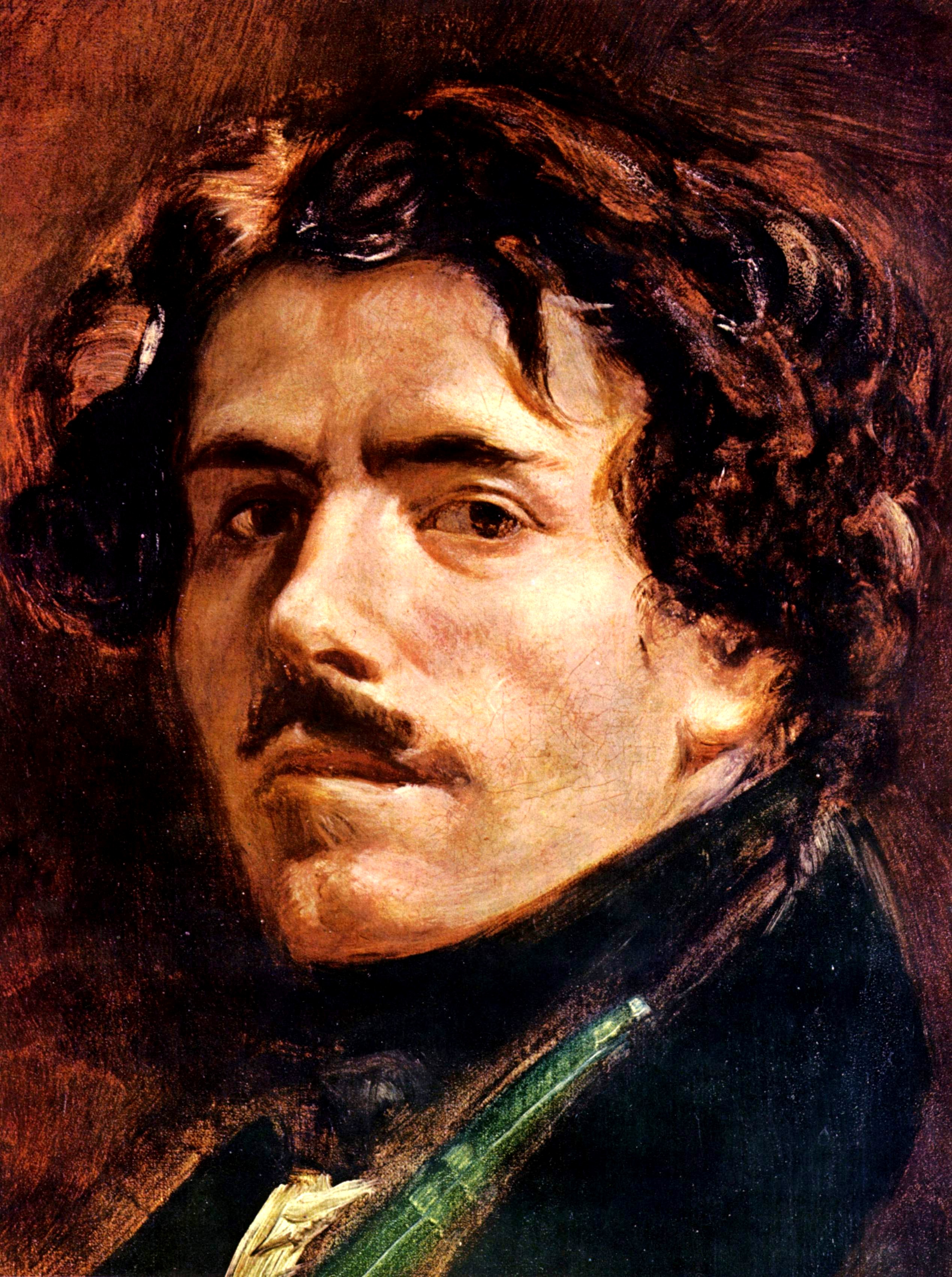
“Bisogna sempre guastare un po' il quadro per finirlo.”
Origine: Citato in Focus n. 93, p. 176.
“Tutta la natura porta un fardello e attende di essere consolata.”
Origine: Citato in Focus n. 70, p. 130.
Origine: Da Journal, 1824; citato in Velázquez, I Classici dell'arte, a cura di Elena Ragusa, Rizzoli/Skira, Milano, 2003, pp. 183-188.
19 January 1847 (p. 55)
1831 - 1863, Delacroix' 'Journal' (1847 – 1863)
Quote, 29 April 1824 (p. 35)
1815 - 1830, Delacroix' 'Journal' (1822 – 1824)
23 April 1849 (p. 97)
1831 - 1863, Delacroix' 'Journal' (1847 – 1863)
Quote from his letter to Madame de Forget, Dieppe, 13 September 1852; as quoted in Letters of the great artists – from Blake to Pollock, Richard Friedenthal, Thames and Hudson, London, 1963, p. 68
Delacroix's quote refers to his stay at the coast at Dieppe
1831 - 1863
21 September 1854 (p. 256)
1831 - 1863, Delacroix' 'Journal' (1847 – 1863)
quote on Hamlet, in a letter to Victor Hugo, 1828; as quoted in Letters of the great artists – from Blake to Pollock -, Richard Friedenthal, Thames and Hudson, London, 1963, p. 67
1815 - 1830
13 January 1857 (p. 337)
1831 - 1863, Delacroix' 'Journal' (1847 – 1863)
15 April 1851, as quoted in Artists on Art – from the 14th – 20th centuries, ed. by Robert Goldwater and Marco Treves; Pantheon Books, 1972, London, pp. 230 – 231
1831 - 1863, Delacroix' 'Journal' (1847 – 1863)
13 January 1857 (p. 334)
1831 - 1863, Delacroix' 'Journal' (1847 – 1863)
Quote from a letter to Léon Peisse, 15 July 1949; as cited in Letters of the great artists – from Blake to Pollock, Richard Friedenthal, Thames and Hudson, London, 1963, p. 68
this quote refers to Delacroix's refusal to use the line as boundary of the form in his painting art, as a too sharp dividing force in the picture - in contrast to the famous classical painter in Paris then, Ingres
1831 - 1863
Quote from Delacroix' letter to Théophile Silvestre, Paris, 31 December 1858; as quoted in Eugene Delacroix – selected letters 1813 – 1863, ed. and translation Jean Stewart, art Works MFA publications, Museum of Fine Art Boston, 2001, p. 352
1831 - 1863
“Curiously enough, the Sublime is generally achieved through want of proportion.”
25 January 1857 (p. 345)
1831 - 1863, Delacroix' 'Journal' (1847 – 1863)
Quote in Delacroix's Journal of 3 August, 1855; as quoted in Artists on Art – from the 14th – 20th centuries, ed. by Robert Goldwater and Marco Treves; Pantheon Books, 1972, London, p. 236
1831 - 1863
13 January 1857 (p. 338)
1831 - 1863, Delacroix' 'Journal' (1847 – 1863)
quote in 1854, on the Italian Renaissance artist [[w:Michelangelo|Michelangelo, as cited in Artists on Art – from the 14th – 20th centuries, ed. by Robert Goldwater and Marco Treves; Pantheon Books, 1972, London, p. 235
1831 - 1863
16 January 1860 (p. 391)
1831 - 1863, Delacroix' 'Journal' (1847 – 1863)
Quote in Delacroix's Journal of 1850; as cited in Artists on Art – from the 14th – 20th centuries, ed. by Robert Goldwater and Marco Treves; Pantheon Books, 1972, London, pp. 230 – 231
1831 - 1863
“Nature creates unity even in the parts of a whole.”
25 January 1857 (p. 346)
1831 - 1863, Delacroix' 'Journal' (1847 – 1863)
Quote from entry of Delacroix's Journal, 14 March, 1847; as cited in Selected writings on Art and Artists, transl. P. E. Charvet – Cambridge University Press, Archive, 1981, p. 150, note 44
This visit of Delacroix was the beginning of an important friendship
1831 - 1863
Quote in a letter to his friend J. B. Pierret, 18 September 1818, from the Forest of Boixe; as quoted in Eugene Delacroix – selected letters 1813 – 1863”, ed. and translation Jean Stewart, art Works MFA publications, Museum of Fine Art Boston, 2001, p. 41
1815 - 1830


