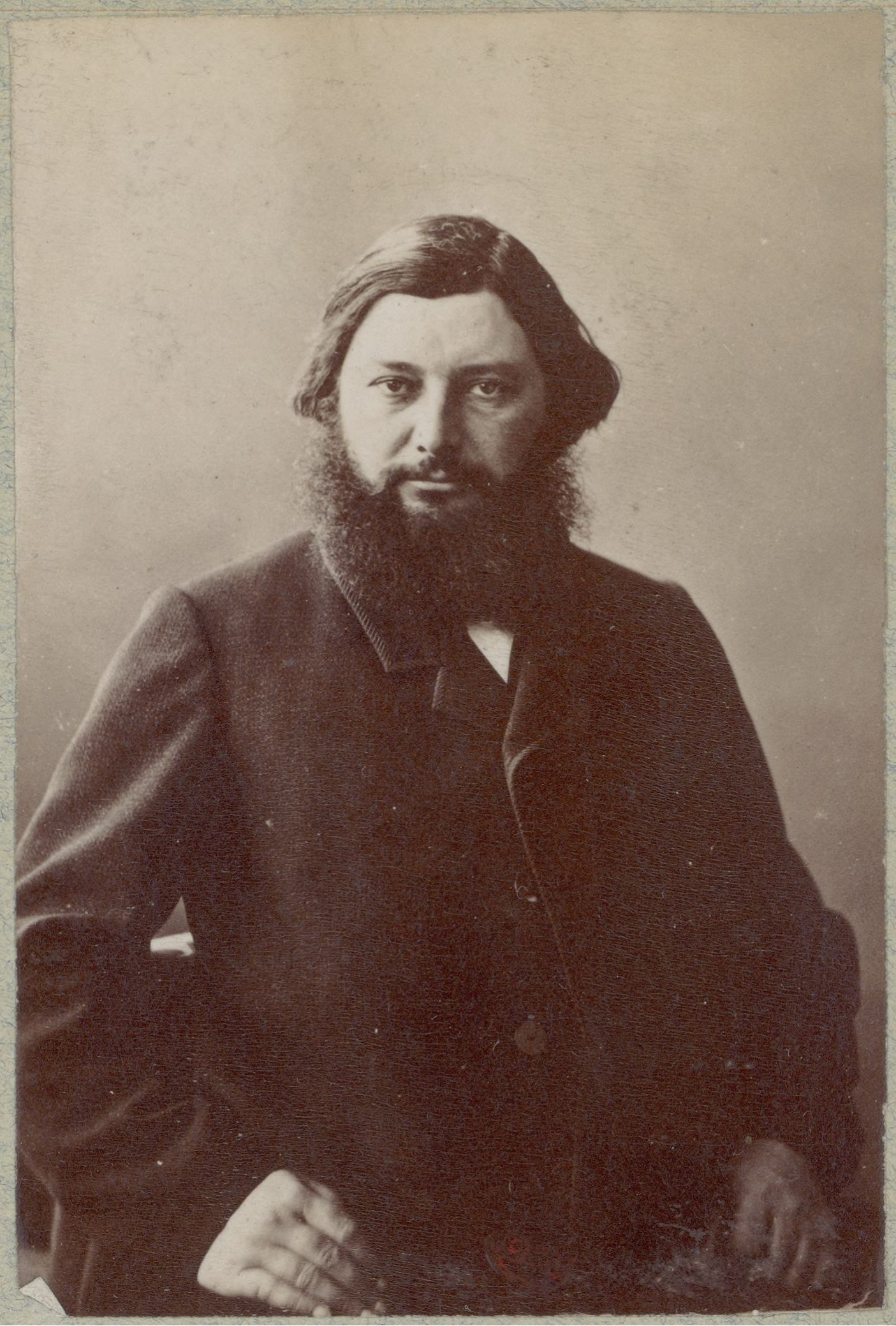
Gustave Courbet frasi celebri
Un object abstrait, non visible, n'est pas du domaine de la peinture. L'imagination dans l'art consiste à savoir trouver l'expression la plus complète d'une chose existante, mais jamais à supposer ou à créer cette chose même. Le beau est dans la nature, et se rencontre dans la réalité sous les formes les plus diverses. Dès qu'on le trouve, il appartient à l'art, ou plutôt à l'artiste qui sait l'y voir. Le beau, comme la verité est une chose relative au temps où l'on vit et à l'individu apte à le concevoir. L'expression du beau est en raison directe de la puissance de perception acquise par l'artiste. Il ne peut pas y avoir d'écoles, il n'y a que des peintres.
Origine: Citato in Lionello Venturi, Storia della critica d'arte, Einaudi, Torino, 1966.
Gustave Courbet: Frasi in inglese
“I have never seen an angel. Show me an angel, and I'll paint one.”
Courbet, c 1860's, later quoted by Vincent van Gogh in a letter to brother Theo (July, 1885); in The letters of Vincent van Gogh, ed. Ronal de Leeuw - Penguin, New York, 1996, p. 302
1860s
Courbet wrote this 'Realist manifesto' for the introduction to the catalogue of his independent, personal exhibition at the Pavilion of Realism in Paris, outside the 1855 Universal Exhibition. His text is echoing the tone of the period's political manifestos of those days
1840s - 1850s, Realist Manifesto', 1851/1855
1860s, Realist Manifesto' - an open letter, 1861
Quote in Courbet's letter to Victor Hugo, 28 November 1864; as cited in Chu, Letters, p. 249; quoted in 'Paysages de Mer - Courbet's The Wave', by Anthony White https://www.ngv.vic.gov.au/essay/paysages-de-mer-courbets-the-wave/ <br class="br">1860s
In a letter, (1850) to his friend Francis Wey; as quoted in 'Gustave Courbet', by Georges Riat, Parkstone International, 15 Sep 2015,
1840s - 1850s
Quote, 1850's explaining to Champfleury and the writer Francis Wey; as cited on Wikipedia; Masanès, Fabrice 2006, p. 31
Courbet explains in his quote the start of his painting 'Stone-Breakers' [painted in 1849-50 / destroyed in the Allied Bombing of Dresden in 1945]; this painting was inspired by a scene Courbet witnessed on the roadside.
1840s - 1850s
version in original French: * Attendu que la colonne Vendôme est un monument dénué de toute valeur artistique, tendant à perpétuer par son expression les idées de guerre et de conquête qui étaient dans la dynastie impériale, mais que réprouve le sentiment d'une nation républicaine, [le citoyen Courbet] émet le vœu que le gouvernement de la Défense nationale veuille bien l'autoriser à déboulonner cette colonne.
Quote in Courbet's official letter (4 September 1870), to the Government of National Defense - proposing that the column in the Place Vendôme in Paris, erected by Napoleon I - to honour the victories of the French Army - be taken down.
1870s
1860s, Realist Manifesto' - an open letter, 1861
Remark to Champfleury, (End of 1849); as quoted in Gustave Courbet, by Georges Riat, Parkstone International, 15 Sep 2015,
1840s - 1850s
Quote from a letter to his parents (30th April 1870); as cited in 'Courbet Speaks', 'Courbet-dossier', Musée-dOrsay http://www.musee-orsay.fr/en/collections/courbet-dossier/courbet-speaks.html <br class="br">1870s
1840s - 1850s, Realist Manifesto', 1851/1855
Quote from Courbet's letter to his parents (1841); as quoted in Image of the Sea: Oceanic Consciousness in the Romantic Century, Howard F. Isham, publisher: Peter Lang, 2004, Chapter 'Waterworlds', p. 307
reporting his experiences of a boat-trip with a friend over the Seine to the port of Le Havre; he made also a sketchbook of this trip in the Summer of 1841
1840s - 1850s
Quote from his letter (10 March 1845); as cited in 'Gustave Courbet', by Georges Riat, Parkstone International, 2015
very soon after this letter Courbet attacked a canvas of eight feet high and ten feet wide
1840s - 1850s
Quote from Courbet's letter to Victor Hugo, 1864; as cited by Sarah Faunce and Linda Nochlin, in Courbet Reconsidered; exhibition catalogue, The Brooklyn Museum, 1988, p. 188
1860s
1840s - 1850s, Realist Manifesto', 1851/1855
1860s, Realist Manifesto' - an open letter, 1861
Quote from an article in 'Le Messager de l'Assemblée' (25th & 26th February 1851); as cited in 'Posterity', Musée-dOrsay http://www.musee-orsay.fr/en/collections/courbet-dossier/biography.html <br class="br">1840s - 1850s
“.. [ I ] painted the very people who had been present at the interment, all the townspeople.”
from Courbet on Wikipedia
Courbet pictured with his painting 'A Burial at Ornans' (1849/50) the funeral of his grand uncle which he attended in September 1848. People who attended the funeral became the models for the painting; no professional models
1840s - 1850s
1860s, Realist Manifesto' - an open letter, 1861
1860s, Realist Manifesto' - an open letter, 1861
In his letter (Paris, January 1846); as quoted in 'Gustave Courbet', by Georges Riat, Parkstone International, 2015,
1840s - 1850s
1860s, Realist Manifesto' - an open letter, 1861
Quote in an open letter ('Credo'), (Paris, end of December 1861), published in the 'Courier du Dimanche', (addressed to prospective students); as quoted in Letters of Gustave Courbet, transl. & ed. Petra ten-Doesschate Chu, University of Chicago Press 1992, pp. 203-204
1860s
Quote from a letter of Courbet to Bruyas, (December 1854); as cited in 'Courbet Speaks', 'Courbet-dossier', Musée-dOrsay http://www.musee-orsay.fr/en/collections/courbet-dossier/courbet-speaks.html <br class="br">1840s - 1850s
1860s, Realist Manifesto' - an open letter, 1861
“They continue to be the rage. The salon where they are is jammed with people.”
Quote in a letter to his sister Juliette Courbet, 11 May 1870; as cited in Chu, Letters, p. 375; quoted in 'Paysages de Mer - Courbet's The Wave', by Anthony White https://www.ngv.vic.gov.au/essay/paysages-de-mer-courbets-the-wave/ <br class="br">Courbet wrote to his sister about his two marine paintings exhibited at the 1870 Paris Salon <br class="br">1870s
Quote from a letter to his parents, (June 1848); as cited 'Gustave Courbet', by Georges Riat, Parkstone International, 2015,
1840s - 1850s
1860s, Realist Manifesto' - an open letter, 1861
In a letter of Gustave Courbet (1869); in Letters of Gustave Courbet, 1992, University of Chicago Press, transl. Petra Ten-Doesschate Chu, ISBN 0226116530
1860s


