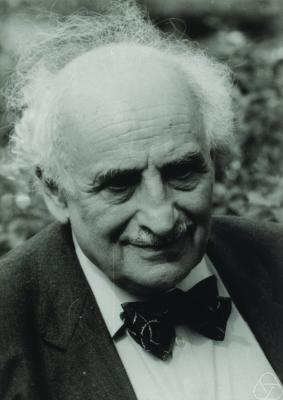
Freudenthal (1988) "Ontwikkelingsonderzoek"; As cited Els Feijs (2005) Constructing a Learning Environment that Promotes Reinvention
Hans Freudenthal: 27 citazioni0 Mi piace
Hans Freudenthal: Frasi in inglese
Norbert Wiener (2008)
Origine: The Concept and the Role of the Model in Mathematics and Natural and Social Sciences (1961), p. ix
Origine: Realistic models in probability (1968), p. 1
Origine: Realistic models in probability (1968), p. 1
Norbert Wiener (2008)
“Educational technique needs a philosophy, which is a matter of faith rather than of science.”
Hans Freudenthal (1977) Weeding and Sowing: Preface to a Science of Mathematical Education. p. 33
Origine: The Concept and the Role of the Model in Mathematics and Natural and Social Sciences (1961), p. 79; Part of the article "Models in applied probability", published earlier in Synthese, 12 (1960), p. 204-210.
Origine: Mathematics as an Educational Task (1973), p. v;As cited in: Ben Wilbrink (2013)
Origine: Didactical Phenomenology of Mathematical Structures (1983), p. 47
Origine: Mathematics as an Educational Task (1973), p. 75-76; As cited in: Anne Birgitte Fyhn (2007, p. 6)
Hans Freudenthal (1978). Weeding and Sowing. Preface to a Science of Mathematical Education; As cited in: Ben Wilbrink (2013) " Hans Freudenthal Aantekeningen bij zijn publicaties http://www.benwilbrink.nl/literature/freudenthal.htm".
Origine: Mathematics as an Educational Task (1973), p. 476-477
Origine: The Concept and the Role of the Model in Mathematics and Natural and Social Sciences (1961), p. 80; Cited in: Lev D. Beklemishev (2000) Provability, Computability and Reflection. p. 9
Norbert Wiener (2008)
Origine: Mathematics as an Educational Task (1973), p. 403
Origine: The Concept and the Role of the Model in Mathematics and Natural and Social Sciences (1961), p. 79; Partly cited in: Norman L. Johnson and Samuel Kotz (1977) Urn Models and Their Application: an. Approach to Modern Discrete Probability Theory http://dis.unal.edu.co/~gjhernandezp/sim/hide/Urn%20Models%20and%20Their%20Application%20-%20An%20approach%20to%20modern%20discrete%20probability%20theory_Norman%20L.Johnson(Wiley%201977%20413s).pdf, John Wiley & Sons.
“Angles are measured by arcs, such that 360° and 2π correspond to each other.”
Origine: Mathematics as an Educational Task (1973), p. 477
Origine: Mathematics as an Educational Task (1973), p. 133
“Horizontal mathematising leads from the world of life to the world of symbols.”
Origine: Revisiting Mathematics Education (1991), p. 41
Origine: The Concept and the Role of the Model in Mathematics and Natural and Social Sciences (1961), p. ix
Origine: Revisiting Mathematics Education (1991), p. 68
Origine: Revisiting Mathematics Education (1991), p. 48; As cited in: Anne Birgitte Fyhn (2007, p. 14)
Hans Freudenthal (1977), Weeding and Sowing: Preface to a Science of Mathematical Education, p. 56
Origine: Mathematics as an Educational Task (1973), p. 63; As cited in: Anne Birgitte Fyhn (2007) Angles as Tool for Grasping Space http://munin.uit.no/bitstream/handle/10037/994/thesis.pdf?sequence=1. p. 2
Origine: Mathematics as an Educational Task (1973), p. 363
Rather than behaving anti-didactically, one should recognise that the learner is entitled to recapitulate in a fashion of mankind. Not in the trivial matter of an abridged version, but equally we cannot require the new generation to start at the point where their predecessors left off.
Origine: The Concept and the Role of the Model in Mathematics and Natural and Social Sciences (1961), p. ix


