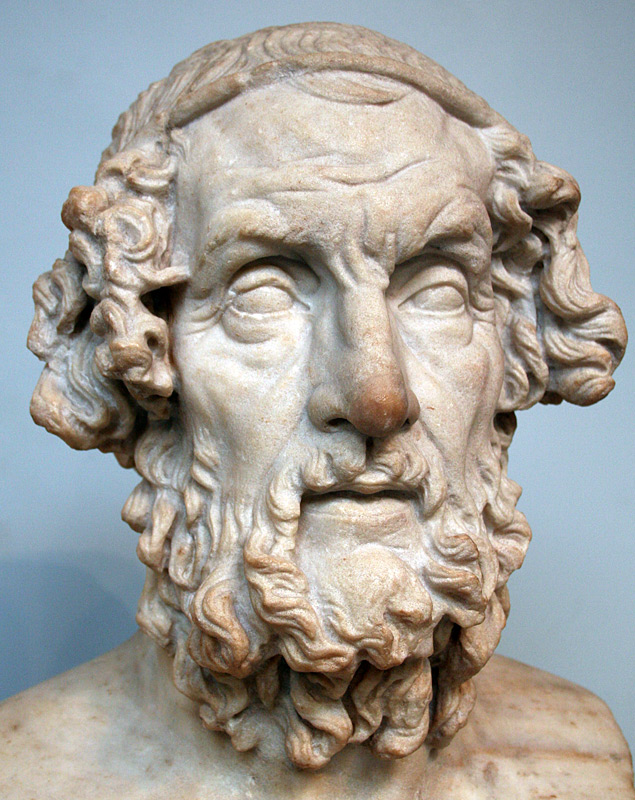
Omero frasi celebri
Odissea
Odissea
“Tutti gli uomini hanno bisogno degli dèi.”
citato in AA.VV., Il libro delle religioni, traduzione di Anna Carbone, Gribaudo, 2017, p. 12. ISBN 9788858015810
Omero: Frasi in inglese
Homér Iliad
IV. 164–165 (tr. Robert Fagles); spoken by Agamemnon.
Iliad (c. 750 BC)
Homér Iliad
V. 440–442 (tr. Samuel Butler).
Iliad (c. 750 BC)
Homér Odissea
XIX. 592–594 (tr. Robert Fagles).
Odyssey (c. 725 BC)
Homér Iliad
XXIV. 522–526 (tr. Robert Fagles).
Iliad (c. 750 BC)
“As when in harp and song adept, a bard
Unlab'ring strains the chord to a new lyre.”
Homér Odissea
XXI. 406–407 (tr. William Cowper).
Odyssey (c. 725 BC)
Homér Iliad
IX. 498–500 (tr. Alexander Pope).
Iliad (c. 750 BC)
“Oh but if Zeus's lightning blinded us those days,
it's Zeus who drives us, hurls us on today!”
Homér Iliad
XV. 724–725 (tr. Robert Fagles).
Iliad (c. 750 BC)
“Bear up, old heart! You've borne worse, far worse…”
Homér Odissea
XX. 18 (tr. Robert Fagles).
: Bear up, my soul, a little longer yet;
A little longer to thy purpose cling!
Origine: Odyssey (c. 725 BC), P. S. Worsley's translation:
“They remembered bed and took the gift of sleep.”
Homér Odissea
XVI. 481 (tr. Robert Fagles).
Odyssey (c. 725 BC)
Homér Iliad
XI. 514–515 (tr. Samuel Butler).
Iliad (c. 750 BC)
“If any man obeys the gods, they listen to him also.”
Homér Iliad
I. 218 (tr. Richmond Lattimore).
Iliad (c. 750 BC)
“Ashamed to decline the challenge, yet fearing to accept it.”
Homér Iliad
VII. 93 (tr. Samuel Butler).
Iliad (c. 750 BC)
Homér Odissea
XXIV. 485–486 (tr. Robert Fagles).
Odyssey (c. 725 BC)
“There can be no covenants between men and lions, wolves and lambs can never be of one mind.”
Homér Iliad
XXII. 262–263 (tr. Samuel Butler); Achilles to Hector.
Iliad (c. 750 BC)
Homér Iliad
XXI. 462–466 (tr. R. Lattimore); Apollo to Poseidon.
Iliad (c. 750 BC)
Homér Iliad
VIII. 551–555 (tr. Robert Fagles).
Alexander Pope's translation:
: As when the moon, refulgent lamp of night,
O'er heaven's clear azure spreads her sacred light,
When not a breath disturbs the deep serene,
And not a cloud o'ercasts the solemn scene;
Around her throne the vivid planets roll,
And stars unnumbered gild the glowing pole,
O'er the dark trees a yellower verdure shed,
And tip with silver every mountain's head;
Then shine the vales, the rocks in prospect rise,
A flood of glory bursts from all the skies.
Iliad (c. 750 BC)
Homér Iliad
XIII, 130–131 (tr. R. Lattimore).
Iliad (c. 750 BC)
“And you, old sir, we are told you prospered once.”
Homér Iliad
XXIV. 543 (tr. R. Lattimore); Achilles to Priam.
Iliad (c. 750 BC)
Homér Iliad
IX. 408–409 (tr. Robert Fagles).
Iliad (c. 750 BC)
Homér Odissea
VIII. 329–331 (tr. Alexander Pope).
Odyssey (c. 725 BC)
“Well then, what shall I go through first,
what shall I save for last?”
Homér Odissea
IX. 14 (tr. Robert Fagles)
Odyssey (c. 725 BC)
Homér Iliad
XIII. 358–360 (tr. Robert Fagles).
Iliad (c. 750 BC)
Homér Odissea
VII. 216–218 (tr. P. S. Worsley).
Odyssey (c. 725 BC)
“For a guest remembers all his days the hospitable man who showed him kindness.”
Homér Odissea
XV. 54–55 (tr. G. H. Palmer).
Odyssey (c. 725 BC)
Homér Iliad
V. 407–409 (tr. Samuel Butler).
Iliad (c. 750 BC)
Homér Iliad
XVI. 671–673 (tr. R. Lattimore). Cf. Virgil, Aeneid, VI.278.
Iliad (c. 750 BC)
“No more entreating of me, you dog, by knees or parents.”
Homér Iliad
XXII. 345 (tr. R. Lattimore); Achilles to Hector.
Iliad (c. 750 BC)
“Not iron, trust me,
the heart within my breast. I am all compassion.”
Homér Odissea
V. 190–191 (tr. Robert Fagles).
Odyssey (c. 725 BC)


