Questa traduzione è in attesa di revisione. È corretto?
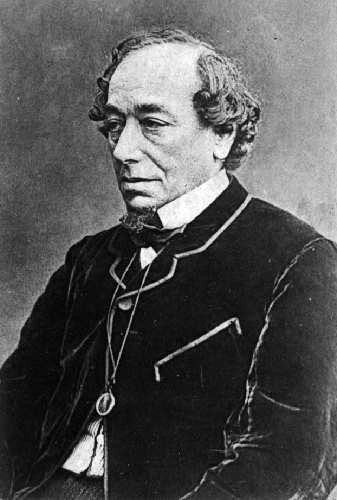
Benjamin Disraeli: 322 citazioni7 Mi piace
Benjamin Disraeli frasi celebri
“In realtà, noi siamo una nazione di bottegai.”
Origine: Citato in Focus, n. 46, p. 172.
citato in Nicola Martella, Offensiva intorno a Gesù, vol II, Punto a croce 2000
Origine: Citato in Curzio Nitoglia, Per padre il diavolo: un'introduzione al problema ebraico secondo la tradizione cattolica, Barbarossa, 2002, p. 208.
Benjamin Disraeli Frasi e Citazioni
“La gioventù è un agire da sciocchi, la maturità una lotta, la vecchiaia un rimpianto.”
Origine: Citato in Focus, n. 115, p. 170.
“La delusione della maturità segue l'illusione della gioventù.”
Origine: Citato in Focus n. 67, p. 169.
“[Ultime parole famose, nel 1858] Il canale di Suez? Assolutamente impossibile da realizzare.”
Origine: Citato in Focus n. 97, p. 188.
“Quel che è delitto fra la moltitudine è soltanto un vizio fra i pochi.”
da Tancred, or the New Crusade, 1847
“Tutto è razza e non c'è altra verità.”
1847, vol. I, p. 169; citato in Losurdo 2005, p. 267
“Un governo conservatore è ipocrisia organizzata.”
dal discorso alla Camera dei Comuni del 17 marzo 1845
“Un politico usa i dati come un ubriaco il lampione: non per la luce ma per il sostegno.”
Origine: Citato in La settimana enigmistica, n. 4102, pag. 12
Benjamin Disraeli: Frasi in inglese
Bk. V, Ch. 5.
Books, Coningsby (1844), Tancred (1847)
Part 1, Chapter 21.
Books, Coningsby (1844), Contarini Fleming (1832)
Book II, Chapter 6.
Books, Coningsby (1844), Vivian Grey (1826)
“Be amusing: never tell unkind stories; above all, never tell long ones.”
Upon being asked to offer the young son of a member of Parliament advice, cited in Wilfrid Meynell, Benjamin Disraeli: An Unconventional Biography (1903), p. 83.
Sourced but undated
Origine: Letter to Sir William Miles (11 June 1860), quoted in William Flavelle Monypenny and George Earle Buckle, The Life of Benjamin Disraeli, Earl of Beaconsfield. Volume II. 1860–1881 (London: John Murray, 1929), pp. 23–24
Variante: The question is this— Is man an ape or an angel? My Lord, I am on the side of the angels. I repudiate with indignation and abhorrence these new fanged theories.
Variante: Is man an ape or an angel? Now, I am on the side of the angels!
Origine: Speech at Oxford Diocesan Conference (25 November 1864), quoted in William Flavelle Monypenny and George Earle Buckle, The Life of Benjamin Disraeli, Earl of Beaconsfield. Volume II. 1860–1881 (1929), p. 108
“[I]n speaking of Italy, romance has omitted for once to exaggerate.”
Origine: Letter to Isaac Disraeli (2 September 1826), quoted in William Flavelle Monypenny and George Earle Buckle, The Life of Benjamin Disraeli, Earl of Beaconsfield. Volume I. 1804–1859 (1929), p. 104
Origine: Letter to Queen Victoria (18 November 1875), quoted in William Flavelle Monypenny and George Earle Buckle, The Life of Benjamin Disraeli, Earl of Beaconsfield. Volume II. 1860–1881 (1929), p. 783
Addressing the House of Commons after the assassination of Abraham Lincoln (1 May 1865).
1860s
Contesto: There are rare instances when the sympathy of a nation approaches those tenderer feelings which are generally supposed to be peculiar to the individual, and to be the happy privilege of private life, and this is one. Under any circumstances we should have bewailed the catastrophe at Washington; under any circumstances we should have shuddered at the means by which it was accomplished. But in the character of the victim, and even in the accessories of his last moments, there is something so homely and innocent, that it takes the question, as it were, out of all the pomp of history and the ceremonial of diplomacy; it touches the heart of nations, and appeals to the domestic sentiment of mankind.
Whatever the various and varying opinions in this House, and in the country generally, on the policy of the late President of the United States, all must agree that in one of the severest trials which ever tested the moral qualities of man he fulfilled his duty with simplicity and strength. …When such crimes are perpetrated the public mind is apt to fall into gloom and perplexity, for it is ignorant alike of the causes and the consequences of such deeds. But it is one of our duties to reassure them under unreasoning panic and despondency. Assassination has never changed the history of the world. I will not refer to the remote past, though an accident has made the most memorable instance of antiquity at this moment fresh in the minds and memory of all around me. But even the costly sacrifice of a Caesar did not propitiate the inexorable destiny of his country.
“Nationality is the principle of political independence. Race is the principle of physical analogy,”
Speech http://hansard.millbanksystems.com/commons/1848/aug/09/supply-navy-estimates in the House of Commons (9 August 1848). <br class="br">1840s <br class="br">Contesto: The hon. Gentleman has said, in a most extraordinary manner, that our security for peace at the present day is the desire of nations to keep at home. There is a great difference between nationality and race. Nationality is the principle of political independence. Race is the principle of physical analogy, and you have at this moment the principle of race&mdash; not at all of nationality&mdash; adopted by Germany, the very country to which the hon. Member for the West Riding referred.
1860s
Variante: The question is this— Is man an ape or an angel? My Lord, I am on the side of the angels. I repudiate with indignation and abhorrence these new fanged theories.
Variant: Is man an ape or an angel? Now, I am on the side of the angels!
Speech at Oxford Diocesan Conference (25 November 1864), quoted in William Flavelle Monypenny and George Earle Buckle, The Life of Benjamin Disraeli, Earl of Beaconsfield. Volume II. 1860–1881 (London: John Murray, 1929), p. 108.
Lord George Bentinck: A Political Biography (1852), Chapter X http://www.gutenberg.org/files/20007/20007-h/20007-h.htm#link2HCH0010. Variations of the bolded portion of this quote have been incorrectly challenged as misattributions based on the seemingly anachronistic reference to communism (which was not yet an important political force at the time), the negative language toward Jews, and the use of such variations by antisemitic agitators who failed to provide an accurate citation to the work in which it appears. See Paul F. Boller, John George, They Never Said It: A Book of Fake Quotes, Misquotes, and Misleading Attributions (1990). <br class="br">1850s <br class="br">Contesto: But existing society has chosen to persecute this race which should furnish its choice allies, and what have been the consequences?<br>They may be traced in the last outbreak of the destructive principle in Europe. An insurrection takes place against tradition and aristocracy, against religion and property. Destruction of the Semitic principle, extirpation of the Jewish religion, whether in the Mosaic or in the Christian form, the natural equality of man and the abrogation of property, are proclaimed by the secret societies who form provisional governments, and men of Jewish race are found at the head of every one of them. The people of God co-operate with atheists; the most skilful accumulators of property ally themselves with communists; the peculiar and chosen race touch the hand of all the scum and low castes of Europe! And all this because they wish to destroy that ungrateful Christendom which owes to them even its name, and whose tyranny they can no longer endure.
Origine: Speech http://hansard.millbanksystems.com/commons/1848/feb/22/expenditure-of-the-country in the House of Commons (22 February 1848).
Origine: Books, Coningsby (1844), Endymion (1880), Ch. 52.
“Success is the child of audacity.”
The Rise of Iskander ch. 4 (1833).
Books
Origine: Speech http://hansard.millbanksystems.com/commons/1845/apr/11/maynooth-college in the House of Commons (11 April 1845).
Origine: Election address; letter to the Lord Lieutenant of Ireland, the Duke of Marlborough (8 March 1880), quoted in The Times (9 March 1880), p. 8
Origine: Speech in the House of Lords on the agricultural depression (28 March 1879), reported in The Times (29 March 1879), p. 8
Origine: Speech in the Guildhall, London (10 November 1878), quoted in The Times (11 November 1878), p. 10. William Gladstone had written in The North American Review: "It is [America] alone who, at a coming time, can, and probably will, wrest from us that commercial primacy...We have no more title against her than Venice, or Genoa, or Holland, has had against us" ('Kin beyond Sea', The North American Review Vol. 127, No. 264 (Sep. - Oct., 1878), p. 180)
Origine: Speech in the Guildhall, London (10 November 1878), quoted in The Times (11 November 1878), p. 10
It is ignorant, & brutal,—& surely most mischievous.
Origine: Letter to Lord Salisbury (13 December 1875), quoted in Michael Bentley, Lord Salisbury's World: Conservative Environments in Late-Victorian Britain (2001), p. 224, n. 10
Origine: Speech to the Conservatives of Manchester (3 April 1872), cited in The World's Best Orations from the Earliest Period to the Present Time, Vol. 1 (eds. David Josiah Brewer, Edward Archibald Allen, William Schuyler), pp. 309-338
Speech https://api.parliament.uk/historic-hansard/commons/1868/apr/03/adjourned-debate#column_917 in the House of Commons (3 April 1868)
Origine: Speech in Edinburgh (30 October 1867), quoted in The Chancellor of the Exchequer in Scotland; Being Two Speeches Delivered by Him in the City of Edinburgh on 29th and 30th October, 1867 (1867), pp. 36-37
Origine: Speech http://hansard.millbanksystems.com/commons/1852/dec/16/ways-and-means-financial-statement in the House of Commons (16 December 1852)
Origine: Speech to the Conservatives of Manchester (3 April 1872), quoted in Selected Speeches of the Late Right Honourable the Earl of Beaconsfield, Volume II, ed. T. E. Kebbel (1882), pp. 511-512
Origine: Speech to the Conservatives of Manchester (3 April 1872), quoted in Selected Speeches of the Late Right Honourable the Earl of Beaconsfield, Volume II, ed. T. E. Kebbel (1882), p. 507


