“We are more than a people…. We are of a pure blood.”
Verk, edited by Kletzkin, xi. 277.
Isacco Leyb Peretz, conosciuto in yiddish come Yitskhok Leybush Perets e in polacco come Icchok Lejbusz Perec o Izaak Lejb Perec , è stato uno scrittore polacco autore di racconti brevi e drammi in lingua yiddish.
È considerato, insieme a Mendele Moicher Sforim e a Sholem Aleichem, uno dei tre grandi classici della letteratura yiddish. Tra i tre, fu l'unico ad avere un contatto così stretto con la lingua e la letteratura polacca, al punto da poter tradurre lui stesso alcune delle sue opere in quella lingua, e, nel caso ad esempio del racconto L'anima, aggiungere addirittura un finale non presente nella versione in yiddish. Scrisse anche in ebraico e fu un vero poliglotta avendo una perfetta conoscenza del russo, del tedesco e del francese.
Nonostante questa sua grande apertura verso il mondo letterario europeo, o forse proprio in virtù di essa, Peretz non fu mai un rivoluzionario universalista e rimase piuttosto freddo rispetto alle tesi più radicali del movimento dell'Illuminismo ebraico , e soprattutto del socialismo internazionalista e dell'allora nascente movimento operaio. Più che all'abbattimento delle classi e al radicalismo sociale, Peretz mirava al riscatto di quelle classi povere, ed emarginate legate agli chassidim, con l'obiettivo però non di eliminarle, livellando socialmente e culturalmente le loro differenze, ma al contrario di dar loro pari dignità in una società multiculturale, dove proprio quelle differenze potessero essere considerate un valore più che un ostacolo all'integrazione.
Questo suo forte legame con la tradizione ebraica e il suo rispetto per i valori di quella tradizione, spesso così controversi in una società in evoluzione, fanno di lui un rappresentante emblematico di quel mondo yiddish così ricco e variegato nel quadro culturale dell'Europa orientale dell'epoca, che verrà annientato qualche decennio dopo la sua morte proprio da quei radicalismi sociali e politici che hanno caratterizzato il Novecento. Wikipedia
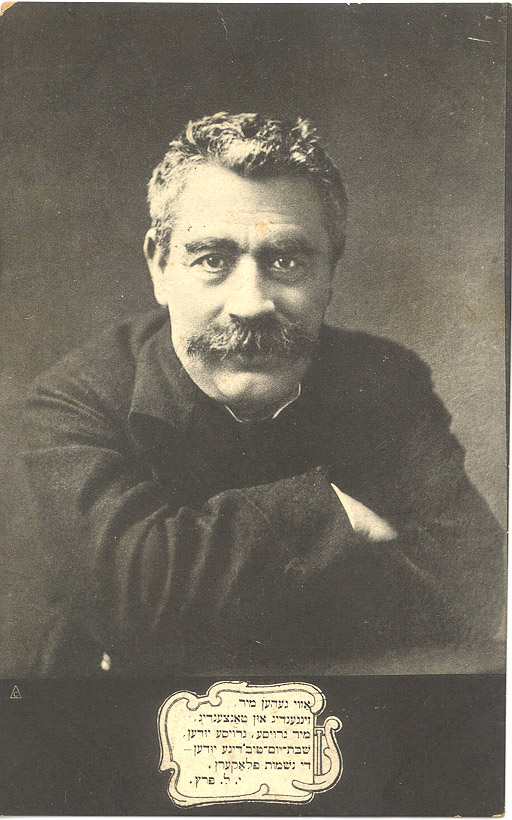
“We are more than a people…. We are of a pure blood.”
Verk, edited by Kletzkin, xi. 277.
“Nobody ever stubs his toe against a mountain. It's the little temptations that bring a man down.”
All for a Pinch of Snuff, c. 1910. Quoted in M. Samuel. Prince of the Ghetto. Alfred A. Knopf, 1948, p. 64.
“Who tells the truth needs no fancy phrases.”
Yohanan Melameds Maaselach, 1904. Alle Verk, vi. 181.
Sewing the Wedding Gown, 1906. Nine One-Act Plays from Yiddish. Translated by Bessie F. White, Boston, John W. Luce & Co., 1932, p. 127.
“A stranger's rose is but a thorn.”
In Alien Lands, translated by Leah W. Leonard.
“In this world it is very dangerous to be weak.”
Shreib a Feleton, 1895. Alle Verk, xii. 77.
"I Am a Rainworm", 1900, translated by Jacob Robbins. J. Leftwich. Golden Peacock. Sci-Art, 1939, p. 83.
The Day, 1906. Alle Verk, xii. 319. S. Liptzin. Peretz. Yivo, 1947, p. 18.
“To be of the eternal, you must be of the earth.”
Der Dichter, 1910. Alle Verk, x. 19.
Mesiras Nefesh, c. 1910. Alle Verk, vii. 142. M. Samuel. Prince of the Ghetto. Alfred A. Knopf, 1948, p. 22.
“If the husband sits on a chair in the Garden of Eden, his wife is his footstool.”
Sholom Bayis, 1889. S. Liptzin. Peretz. Yivo, 1947, p. 153.
“One God, one Law, one people, and one land.”
Der Dichter, 1910. Alle Verk, x. 21.
“Children… constitute man's eternity.”
Der Dichter, 1910. S. Liptzin. Peretz. Yivo, 1947, p. 321.
“At the Throne of Glory it is not the nobly-born that are beloved, but the nobly-risen.”
Drei Matones, c. 1910. Alle Verk, vii. 18.
Advice to the Estranged, S. Liptzin. Peretz. Yivo, 1947, p. 348.
“The bigger the merchant the smaller the Jew.”
"Fir Dores Fir Tzavoes", 1901. Alle Verk, iv. 237.
“Many refined people will not kill a fly, but eat an ox.”
Taanis Gedanken, 1896. Alle Verk, xii. 77.
“Prosperity may be found in small as in big business.”
Fir Dores Fir Tzavoes, 1901. Alle Verk, iv. 237.
Mesiras Nefesh, quoted in M. Samuel. Prince of the Ghetto. Alfred A. Knopf, 1948, p. 22.
“Human lips are now forbidden to utter His name, for being the only God, He needs no name.”
Der Dichter, 1910. Alle Verk, x. 23.
“Rather a stone, but to be alone!”
Oich a Feleton, 1894. Alle Verk, xii. 64.
Sewing the Wedding Gown, 1906. Nine One-Act Plays from Yiddish. Translated by Bessie F. White, Boston, John W. Luce & Co., 1932, p. 126.
Quoted in Jewish Affairs (Johannesburg), June 1952, p. 28. See Alle Verk, xii. 318.
Verk, edited by Kletzkin, xi. 277f.
“The worst dog gets the best bone.”
Mesiras Nefesh, c. 1910. Alle Verk, vii. 155.
“The song that from the heart would spring
Is dead for want of echoing.”
In Alien Lands, translated by Leah W. Leonard.
“A letter depends on how you read it, a melody on how you sing it.”
A Gilgul fun a Nign, 1901. Alle Verk, vi. 33.
Quoted in M. Samuel. Prince of the Ghetto. Alfred A. Knopf, 1948, p. 162.


