da Selected Writings, trad. inglese, Cambridge University Press, Cambridge 1972
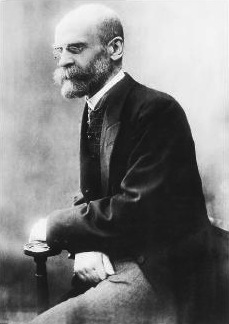
Émile Durkheim: 50 citazioni1 Mi piace
Émile Durkheim frasi celebri
da La divisione del lavoro sociale
da De la division du travail social, Prefazione alla II edizione, pp. III-IV
Origine: Citato in Raymond Aron, Le tappe del pensiero sociologico, CDE, Milano 1984.
da La divisione del lavoro sociale
Origine: Citato in AA.VV., Il libro della sociologia, traduzione di Martina Dominici, Gribaudo, 2018, p. 24. ISBN 9788858015827
Origine: Citato in AA.VV., Il libro della sociologia, traduzione di Martina Dominici, Gribaudo, 2018, p. 37. ISBN 9788858015827
Émile Durkheim: Frasi in inglese
“Every society is a moral society.”
Origine: The Division of Labor in Society (1893), p. 228
Contesto: Every society is a moral society. In certain respects, this character is even more pronounced in organised societies. Because the individual is not sufficient unto himself, it is from society that he receives everything necessary to him, as it is for society that he works.
Origine: On Suicide: A Study in Sociology
Origine: The Division of Labor in Society (1893), p. 40
Origine: Rules of Sociological Method, 1895, p. 3
Attributed from postum publications
Origine: Jeffrey Eisenach et al. (1993), Readings in renewing American civilization, p. 54
Émile Durkheim libro The Elementary Forms of the Religious Life
Origine: The Elementary Forms of the Religious Life, 1912, p. 10
Émile Durkheim libro Suicide
Suicide (1897)
Origine: The Division of Labor in Society (1893), p. 41.
Origine: The Division of Labor in Society (1893), p. 54
Émile Durkheim libro The Elementary Forms of the Religious Life
Origine: The Elementary Forms of the Religious Life, 1912, p. 434
Émile Durkheim libro Suicide
Suicide (1897)
Origine: Rules of Sociological Method, 1895, p. 64
Origine: The Division of Labor in Society (1893), p. 39; Second paragraph
“Solidarity can grow only in inverse ratio to personality.”
Origine: The Division of Labor in Society (1893), p. 129 (in 1933 edition)
Origine: Rules of Sociological Method, 1895, p. 75
Origine: The Division of Labor in Society (1893), p. 153
[Le principe de la morale, p. 189] … We no longer think that the exclusive duty of man is to realize in himself the qualities of man in general; but we believe he must have those pertaining to his function. … The categorical imperative of the moral conscience is assuming the following form: Make yourself usefully fulfill a determinate function.
Origine: The Division of Labor in Society (1893), pp. 42-43.
Origine: The Division of Labor in Society (1893), p. 376
Origine: Rules of Sociological Method, 1895, p. 10
Sociology and philosophy (1911), D. Pocock, trans. (1974), p. 51.
Preface
The Division of Labor in Society (1893)
Émile Durkheim (1903/1961, p. 102); Quoted in: Kenneth Allan (2012). Explorations in Classical Sociological Theory: Seeing the Social World: Seeing the Social World p. 151
“There is no sociology worthy of the name which does not possess a historical character.”
Émile Durkheim, Debate on Explanation in History and Sociology (1908).


