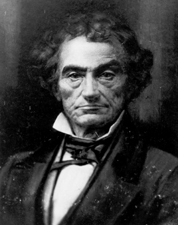
"The Power of a State Developed by Mental Culture", an address to the Mercantile Library Association (18 November 1844), published in The Works of Rufus Choate : Memoir, Lectures and Addresses (1862), edited by Samuel Gilman Brown.
Rufus Choate: 11 citazioni0 Mi piace
Rufus Choate: Frasi in inglese
“A book is the only immortality.”
As quoted in Part of a Man's Life (1905) by Thomas Wentworth Higginson.
Speech at the dedication of the Peabody Institute (29 September 1854).
Letter to the Whig Convention, Worcester (1 October 1855).
“Neither irony nor sarcasm is argument.”
As quoted in Dictionary of American Maxims (1955) by David George Plotkin
As quoted in Lifetime Speaker's Encyclopedia (1962) edited by Jacob Morton Braude, p. 50.
Variante: Neither irony or sarcasm is argument.
"The Importance of Illustrating New-England History by a Series of Romances like the Waverley Novels", a lecture delivered at Salem, Massachusetts (1833).
Speech before the New England Society (22 December 1843)
Possibly related to :
The Americans equally detest the pageantry of a king and the supercilious hypocrisy of a bishop.
Junius, Letter xxxv (19 December 1769)
It established a religion without a prelate, a government without a king.
George Bancroft on Calvinism, in History of the United States (1834), Vol. III, Ch. vi.
Oh, we are weary pilgrims; to this wilderness we bring
A Church without a bishop, a State without a King
Anonymous poem "The Puritans' Mistake", published by Oliver Ditson (1844).
Letter to the Maine Whig Committee (1856). Six years earlier, Choate gave a lecture in Providence which was reviewed by Franklin J. Dickman in the Journal of December 14, 1849. Unless Choate used the words "glittering generalities", and Dickman made reference to them, it would seem as if Dickman must have the credit of originating the catchword. Dickman wrote: "We fear that the glittering generalities of the speaker have left an impression more delightful than permanent". Reported in Bartlett's Familiar Quotations, 10th ed. (1919).
“The final end of government is not to exert restraint but to do good.”
Speech in the Senate (2 July 1841).
“The courage of New England was the "courage of conscience."”
It did not rise to that insane and awful passion, the love of war for itself.
Address at Ipswich Centennial (1834).


