intervista all'Harvard Magazine, in Reuben Hersh, Cos'è davvero la matematica – Baldini Castoldi Dalai, traduzione di Rosalba Giomi
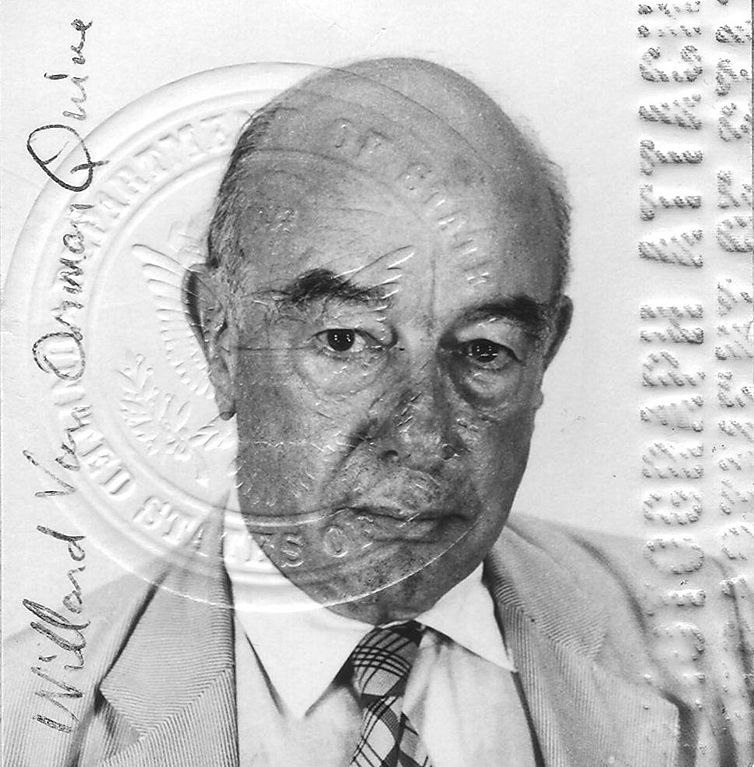
Willard Van Orman Quine: 29 citazioni1 Mi piace
Willard Van Orman Quine frasi celebri
in risposta all'amico e maestro Rudolf Carnap; citato in Gloria Origgi, La stoffa del reale è intessuta di fatti convenzioni http://lgxserver.uniba.it/lei/rassegna/001231a.htm, Il Sole 24 ore
Two dogmas of empiricism, Philosophical Review, 1951, poi in From a Logical Point of View, Cambridge, Mass., Harvard University press, 1953, 2a ed. 1961, tr. it. Due dogmi dell'empirismo, in Il problema del significato, Roma, Ubaldini, 1966
Questa traduzione è in attesa di revisione. È corretto?
Willard Van Orman Quine: Frasi in inglese
"On What There Is"
From a Logical Point of View: Nine Logico-Philosophical Essays (1953)
“We cannot stem linguistic change, but we can drag our feet.”
Quiddities: An Intermittently Philosophical Dictionary (1987), p. 231
1980s and later
Contesto: We cannot stem linguistic change, but we can drag our feet. If each of us were to defy Alexander Pope and be the last to lay the old aside, it might not be a better world, but it would be a lovelier language.
Response to being quoted William Shakespeare's statement from Hamlet: "There are more things in heaven and earth… than are dreamt of in your philosophy." As quoted in When God is Gone Everything Is Holy: The Making Of A Religious Naturalist (2008) by Chet Raymo
1980s and later
“Our argument is not flatly circular, but something like it.”
Willard van Orman Quine Two Dogmas of Empiricism
"Two Dogmas of Empiricism", p. 26
From a Logical Point of View: Nine Logico-Philosophical Essays (1953)
Contesto: Our argument is not flatly circular, but something like it. It has the form, figuratively speaking, of a closed curve in space.
"Natural Kinds", in Ontological Relativity and Other Essays (1969), p. 126; originally written for a festschrift for Carl Gustav Hempel, this appears in a context explaining why induction tends to work in practice, despite theoretical objections. The hyphen in "praise-worthy" is ambiguous, since it falls on a line break in the source.
1960s
"On What There Is", p. 4. a humorous comment on the idea "unactualized possible".
From a Logical Point of View: Nine Logico-Philosophical Essays (1953)
“"Yields falsehood when preceded by its quotation" yields falsehood when preceded by its quotation.”
Quine's paradox, in "The Ways of Paradox" in "The Ways of Paradox and other Essays" (1976)
1970s
Theories and Things, Cambridge, MA: Harvard University Press. 1981
1980s and later
“Necessity resides in the way we talk about things, not in the things we talk about.”
Ways of Paradox and Other Essays (1976), p. 174
1970s
“A fancifully fancyless medium of unvarnished news.”
Willard van Orman Quine libro Word and Object
A mocking title for the 'protocol language' imagined by some of the logical positivists, in "Word and Object (1960), section 1
1960s
"Two dogmas of Empiricism", p. 26
From a Logical Point of View: Nine Logico-Philosophical Essays (1953)
From a Logical Point of View: Nine Logico-Philosophical Essays (1953)
“Logic chases truth up the tree of grammar.”
Philosophy of Logic (1970)
1970s
"On What There Is"
From a Logical Point of View: Nine Logico-Philosophical Essays (1953)
“Set theory in sheep's clothing.”
Referring to Second-order logic, in Philosophy of Logic (1970)
1970s
“Another effect is a shift toward pragmatism.”
Les Deux Dogmes de l'empirisme
Willard van Orman Quine Two Dogmas of Empiricism
"Two Dogmas of Empiricism", p. 26
From a Logical Point of View: Nine Logico-Philosophical Essays (1953)
Les Deux Dogmes de l'empirisme
Willard van Orman Quine Two Dogmas of Empiricism
"Two Dogmas of Empiricism"
From a Logical Point of View: Nine Logico-Philosophical Essays (1953)
Willard van Orman Quine Two Dogmas of Empiricism
"Two Dogmas of Empiricism"
From a Logical Point of View: Nine Logico-Philosophical Essays (1953)
Willard van Orman Quine Two Dogmas of Empiricism
"Two Dogmas of Empiricism"
From a Logical Point of View: Nine Logico-Philosophical Essays (1953)
Willard van Orman Quine Two Dogmas of Empiricism
"Two dogmas of Empiricism"
From a Logical Point of View: Nine Logico-Philosophical Essays (1953)
Quine's response in 1988 when asked his philosophy of life. (He invented the word "agid".) It makes up the entire Chapter 54 in Quine in Dialogue (2008).
1980s and later


