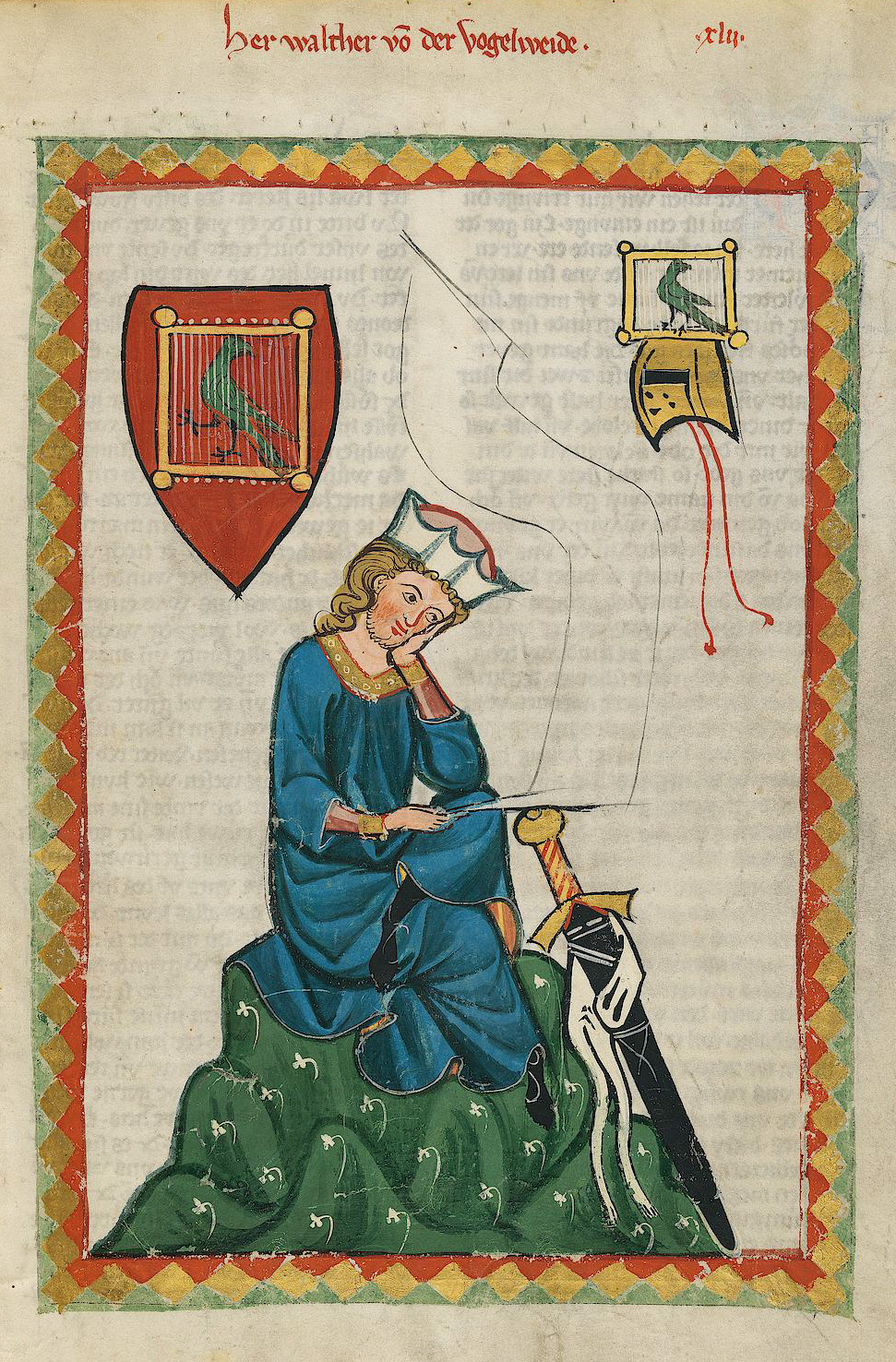
George Saintsbury The Flourishing of Romance and the Rise of Allegory (Edinburgh: Blackwood, 1923) p. 258.
Praise
Walther von der Vogelweide: 18 citazioni0 Mi piace
Walther von der Vogelweide: Frasi in inglese
Ingeborg Glier, in Boris Ford (ed.) Medieval Literature: The European Inheritance (Harmondsworth: Penguin, 1983) p. 184.
Praise
Wer kan den hêrren von dem knehte gescheiden,
swâ er ir gebeine blôzez fünde,
het er ir joch lebender künde?
"Swer âne vorhte, hêrre got", line 10; translation by I. G. Colvin, from James Bruce Ross and Mary Martin McLaughlin (eds.) The Portable Medieval Reader (Harmondsworth: Penguin, 1977) p. 194.
“That which they call love, it is nothing except the pain of longing.”
Daz si da heizent minne,
Deis niewan senede leit.
"Friuntlîchen lac", line 19; translation from Gale Sigal Erotic Dawn-Songs of the Middle Ages (Gainesville: University Press of Florida, 1996) p. 36.
“Those who drown out the good singing –
there's many more of them
than those who want to hear it.”
Die daz rehte singen stoerent,
der ist ungelîche mêre
danne die ez gerne hoerent.
"Owê, hovelîchez singen", line 17; translation from Frederick Goldin German and Italian Lyrics of the Middle Ages (New York: Anchor, 1973) p. 127.
“The world is beautiful outside: white, green, and red; but inside it is black and dark as death.”
Diu welt ist ûzen schoene wîz grüen unde rôt
und innân swarzer varwe vinster sam der tôt.
"Owe war sint verswunden alliu mîniu jâr", line 37; translation from George Fenwick Jones Walther von der Vogelweide (New York: Twayne, 1968) p. 136.
“For five hundred years after Walther's death – until Goethe – no German lyric poet was his equal.”
Frederick Goldin German and Italian Lyrics of the Middle Ages (New York: Anchor, 1973) p. 101.
Praise
“He who has a good woman's love is ashamed of every ill deed.”
Swer guotes wîbes minne hât,
der schamt sich aller missetât.
"Waz sol ein man, der niht engert", line 11; translation from Henry John Chaytor The Troubadours (Cambridge: Cambridge University Press, 1912) p. 128.
A. T. Hatto, in Gottfried von Strassburg (trans. A. T. Hatto) Tristan (Harmondsworth: Penguin, 1975) p. 368.
Praise
“For many call Thee Father, who
Will not own me as brother too.”
Dich heizet vater maniger vil,
swer mîn ze bruoder niht enwil.
"Swer âne vorhte, hêrre got", line 4; translation by I. G. Colvin, from James Bruce Ross and Mary Martin McLaughlin (eds.) The Portable Medieval Reader (Harmondsworth: Penguin, 1977) p. 194.
Under der linden<br>an der heide,<br>dâ unser zweier bette was,<br>dâ mugt ir vinden<br>schône beide<br>gebrochen bluomen unde gras. <br class="br">"Under der linden", line 1; translation by Raymond Oliver. http://colecizj.easyvserver.com/pgvogund.htm
Liebe machet schoene wîp:
desn mac diu schoene niht getuon, sin machet niemer lieben lîp.
"Herzeliebez vrowelîn", line 17; translation from Frederick Goldin German and Italian Lyrics of the Middle Ages (New York: Anchor, 1973) p. 121.
"Sît willekomen herre wirt" dem gruoze muoz ich swîgen,<br>"sît willekomen herre gast", sô muoz ich sprechen oder nîgen.<br>wirt unde heim sint zwêne unschamelîche namen,<br>gast unde herberge muoz man sich dicke schamen. <br class="br">"'Sît willekomen herre wirt' dem gruoze muoz ich swîgen", line 1; translation by Tim Chilcott. http://colecizj.easyvserver.com/pgvb3908.htm
Laurie Magnus A General Sketch of European Literature in the Centuries of Romance (London: Kegan Paul, Trench, Trubner & Co., 1918) pp. 27-28.
Praise
H. G. Atkins, in Edgar Prestage (ed.) Chivalry (London: Kegan Paul, Trench, Trubner & Co., 1928) pp. 99-100.
Praise
Owê war sint verswunden alliu mîniu jâr<br>ist mir mîn leben getroumet oder ist ez wâr. <br class="br">"Owe war sint verswunden alliu mîniu jâr", line 1; translation by Graeme Dunphy. http://www.dunphy.de/ac/Walther.html
Jâ leider desn mac niht gesîn,<br>daz guot und weltlich êre<br>und gotes hulde mêre<br>zesamene in ein herze komen. <br class="br">"Ich saz ûf eime steine", line 16; translation by Roon Lewald. http://episcopal.wordpress.com/2008/04/05/cross-overs-in-poetry/
Mir ist verspert der sælden tor<br>dâ stên ich als ein weise vor<br>mich hilfet niht swaz ich dar an geklopfe. <br class="br">"Mir ist verspert der sælden tor", line 1; translation by Tim Chilcott. http://colecizj.easyvserver.com/pgvb3901.htm


