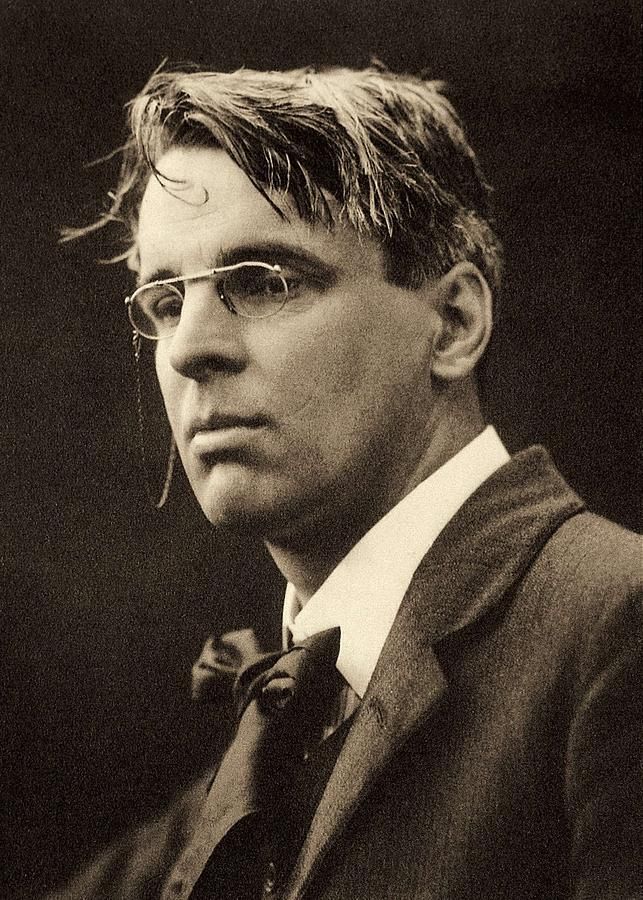
William Butler Yeats frasi celebri
But I being poor, have only my dreams, I have spread my dreams under your feet, tread softly because you tread on my dreams.
Origine: Da He Wishes for the Cloths of Heaven; citato in Equilibrium.
libro Fiabe Irlandesi
“Correggendo le mie opere, correggo me stesso.”
Origine: Citato in Marguerite Yourcenar, Taccuini di appunti, in Memorie di Adriano, traduzione di Lidia Storoni Mazzolani, Giulio Einaudi editore, Torino, 1988, p. 299. ISBN 88-06-60011-7
William Butler Yeats Frasi e Citazioni
Incipit di alcune opere, Fiabe irlandesi, The Fairies (I folletti)
“Se guardi nel buio a lungo, c'è sempre qualcosa.”
Origine: Citato in Luca Goldoni, Vita da bestie, ed. BUR, 2001.
Origine: Da Autobiografia; citato in Thomas R. Nevin, Simone Weil: Ritratto di un'ebrea che si volle esiliare, traduzione di Giulia Boringhieri, Bollati Boringhieri, Torino, 1997, p. 420. ISBN 88-339-1056-3
vv. 27 – 33
Incipit di alcune opere, Under Ben Bulben (Sotto il Ben Bulben)
“Molte volte l'uomo vive e muore fra le sue due eternità.”
Incipit di alcune opere, Under Ben Bulben (Sotto il Ben Bulben)
Incipit di alcune opere, Under Ben Bulben (Sotto il Ben Bulben)
William Butler Yeats: Frasi in inglese
Down By The Salley Gardens http://poetry.poetryx.com/poems/1476/ <br class="br">Crossways (1889) <br class="br">Contesto: p>Down by the salley gardens my love and I did meet;<br>She passed the salley gardens with little snow-white feet.<br>She bid me take love easy, as the leaves grow on the tree;<br>But I, being young and foolish, with her would not agree.In a field by the river my love and I did stand,<br>And on my leaning shoulder she laid her snow-white hand.<br>She bid me take life easy, as the grass grows on the weirs;<br>But I was young and foolish, and now am full of tears.</p
“Till the wilderness cried aloud,
A secret between you two,
Between the proud and the proud.”
Against Unworthy Praise http://poetry.poetryx.com/poems/1433/ <br class="br">The Green Helmet and Other Poems (1910) <br class="br">Contesto: p>O heart, be at peace, because<br>Nor knave nor dolt can break<br>What's not for their applause<br>Being for a woman's sake.<br>Enough if the work has seemed,<br>So did she your strength renew,<br>A dream that a lion had dreamed<br>Till the wilderness cried aloud,<br>A secret between you two,<br>Between the proud and the proud.What, still you would have their praise!<br>But here's a haughtier text,<br>The labyrinth of her days<br>That her own strangeness perplexed;<br>And how what her dreaming gave<br>Earned slander, ingratitude,<br>From self-same dolt and knave;<br>Aye, and worse wrong than these.<br>Yet she, singing upon her road,<br>Half lion, half child, is at peace.</p
W.B. Yeats libro The Winding Stair and Other Poems
Origine: The Winding Stair and Other Poems (1933), Vacillation http://poetry.poetryx.com/poems/1751/, IV <br class="br">Contesto: My fiftieth year had come and gone,<br>I sat, a solitary man,<br>In a crowded London shop,<br>An open book and empty cup<br>On the marble table-top.<br>While on the shop and street I gazed<br>My body of a sudden blazed;<br>And twenty minutes more or less<br>It seemed, so great my happiness,<br>That I was blessed and could bless.
The Folly Of Being Comforted http://poetry.poetryx.com/poems/1623/ <br class="br">In The Seven Woods (1904) <br class="br">Contesto: One that is ever kind said yesterday:<br>'Your well-belovéd's hair has threads of grey,<br>And little shadows come about her eyes;<br>Time can but make it easier to be wise<br>Though now it seems impossible, and so<br>All that you need is patience.'<br>Heart cries, 'No,<br>I have not a crumb of comfort, not a grain.<br>Time can but make her beauty over again:<br>Because of that great nobleness of hers<br>The fire that stirs about her, when she stirs,<br>Burns but more clearly. O she had not these ways<br>When all the wild summer was in her gaze.'<br>O heart! O heart! if she'd but turn her head,<br>You'd know the folly of being comforted.
Down By The Salley Gardens http://poetry.poetryx.com/poems/1476/ <br class="br">Crossways (1889) <br class="br">Contesto: p>Down by the salley gardens my love and I did meet;<br>She passed the salley gardens with little snow-white feet.<br>She bid me take love easy, as the leaves grow on the tree;<br>But I, being young and foolish, with her would not agree.In a field by the river my love and I did stand,<br>And on my leaning shoulder she laid her snow-white hand.<br>She bid me take life easy, as the grass grows on the weirs;<br>But I was young and foolish, and now am full of tears.</p
“Imitate him if you dare,
World-besotted traveller; he
Served human liberty.”
W.B. Yeats libro The Winding Stair and Other Poems
Swift's Epitaph http://poetry.poetryx.com/poems/1586/. <br class="br">The Winding Stair and Other Poems (1933) <br class="br">Contesto: Swift has sailed into his rest;<br>Savage indignation there<br>Cannot lacerate his breast.<br>Imitate him if you dare,<br>World-besotted traveller; he<br>Served human liberty.
“Come near, come near, come near — Ah, leave me still
A little space for the rose-breath to fill!”
To The Rose Upon The Rood Of Time
The Rose (1893)
Contesto: Come near, come near, come near — Ah, leave me still
A little space for the rose-breath to fill!
Lest I no more hear common things that crave;
The weak worm hiding down in its small cave,
The field-mouse running by me in the grass,
And heavy mortal hopes that toil and pass;
But seek alone to hear the strange things said
By God to the bright hearts of those long dead,
And learn to chaunt a tongue men do not know.
Come near; I would, before my time to go,
Sing of old Eire and the ancient ways:
Red Rose, proud Rose, sad Rose of all my days.
Never Give All The Heart http://poetry.poetryx.com/poems/1545/ <br class="br">In The Seven Woods (1904) <br class="br">Contesto: Never give all the heart, for love<br>Will hardly seem worth thinking of<br>To passionate women if it seem<br>Certain, and they never dream<br>That it fades out from kiss to kiss;<br>For everything that's lovely is<br>but a brief, dreamy, kind of delight.<br>O never give the heart outright,<br>For they, for all smooth lips can say,<br>Have given their hearts up to the play.<br>And who could play it well enough<br>If deaf and dumb and blind with love?<br>He that made this knows all the cost,<br>For he gave all his heart and lost.
King and No King http://poetry.poetryx.com/poems/1521/ <br class="br">The Green Helmet and Other Poems (1910) <br class="br">Contesto: I that have not your faith, how shall I know<br>That in the blinding light beyond the grave<br>We’ll find so good a thing as that we have lost?<br>The hourly kindness, the day’s common speech,<br>The habitual content of each with each<br>When neither soul nor body has been crossed.
“Only the dead can be forgiven;
But when I think of that my tongue's a stone.”
W.B. Yeats libro The Winding Stair and Other Poems
I, st. 4 <br class="br">The Winding Stair and Other Poems (1933), A Dialogue of Self and Soul http://poetry.poetryx.com/poems/1397/ <br class="br">Contesto: My Soul. Such fullness in that quarter overflows<br>And falls into the basin of the mind<br>That man is stricken deaf and dumb and blind,<br>For intellect no longer knows<br>Is from the Ought, or knower from the Known —<br>That is to say, ascends to Heaven;<br>Only the dead can be forgiven;<br>But when I think of that my tongue's a stone.
“Labour is blossoming or dancing where
The body is not bruised to pleasure soul.”
W.B. Yeats libro The Tower
Among School Children http://poetry.poetryx.com/poems/1437/, st. 8 <br class="br">The Tower (1928) <br class="br">Contesto: Labour is blossoming or dancing where<br>The body is not bruised to pleasure soul.<br>Nor beauty born out of its own despair,<br>Nor blear-eyed wisdom out of midnight oil.<br>O chestnut-tree, great-rooted blossomer,<br>Are you the leaf, the blossom or the bole?<br>O body swayed to music, O brightening glance,<br>How can we know the dancer from the dance?
“Now his wars on God begin;
At stroke of midnight God shall win.”
Parnell's Funeral and Other Poems http://worldebooklibrary.com/eBooks/WorldeBookLibrary.com/ytpafu.htm (1935). Supernatural Songs http://worldebooklibrary.com/eBooks/WorldeBookLibrary.com/ytpafu.htm#1_0_7 <br class="br">Contesto: p>Then he struggled with the mind;<br>His proud heart he left behind. Now his wars on God begin;<br>At stroke of midnight God shall win.</p
W.B. Yeats libro The Winding Stair and Other Poems
I, st. 3 <br class="br">The Winding Stair and Other Poems (1933), A Dialogue of Self and Soul http://poetry.poetryx.com/poems/1397/ <br class="br">Contesto: My Soul. Why should the imagination of a man<br>Long past his prime remember things that are<br>Emblematical of love and war?<br>Think of ancestral night that can,<br>If but imagination scorn the earth<br>And intellect is wandering<br>To this and that and t'other thing,<br>Deliver from the crime of death and birth.
“The shallowest people on the ridge of the earth.”
Letter to Katharine Tynan (30 August 1888)
Contesto: I hate journalists. There is nothing in them but tittering jeering emptiness. They have all made what Dante calls the Great Refusal, — that is they have ceased to be self-centered, have given up their individuality.... The shallowest people on the ridge of the earth.
“All that sternness amid charm,
All that sweetness amid strength?”
Peace http://poetry.poetryx.com/poems/1564/ <br class="br">The Green Helmet and Other Poems (1910) <br class="br">Contesto: Ah, that Time could touch a form<br>That could show what Homer's age<br>Bred to be a hero's wage.<br>'Were not all her life but a storm,<br>Would not painters pain a form<br>Of such noble lines,' I said,<br>'Such a delicate high head,<br>All that sternness amid charm,<br>All that sweetness amid strength?<br>Ah, but peace that comes at length,<br>Came when Time had touched her form.
“Speech after long silence; it is right”
W.B. Yeats libro The Winding Stair and Other Poems
After Long Silence http://poetry.poetryx.com/poems/1432/ <br class="br">The Winding Stair and Other Poems (1933) <br class="br">Contesto: Speech after long silence; it is right,<br>All other lovers being estranged or dead,<br>Unfriendly lamplight hid under its shade,<br>The curtains drawn upon unfriendly night,<br>That we descant and yet again descant<br>Upon the supreme theme of Art and Song:<br>Bodily decrepitude is wisdom; young<br>We loved each other and were ignorant.
Ego Dominus Tuus http://poetry.poetryx.com/poems/1478/, st. 4 <br class="br">The Wild Swans at Coole (1919) <br class="br">Contesto: We have lit upon the gentle, sensitive mind<br>And lost the old nonchalance of the hand;<br>Whether we have chosen chisel, pen or brush,<br>We are but critics, or but half create,<br>Timid, entangled, empty and abashed,<br>Lacking the countenance of our friends.
“What matter that no cannon had been turned
Into a ploughshare?”
W.B. Yeats libro The Tower
I, st. 3 <br class="br">The Tower (1928), Nineteen Hundred And Nineteen http://poetry.poetryx.com/poems/1547/ <br class="br">Contesto: All teeth were drawn, all ancient tricks unlearned,<br>And a great army but a showy thing;<br>What matter that no cannon had been turned<br>Into a ploughshare?
To The Rose Upon The Rood Of Time
The Rose (1893)
Contesto: Come near, come near, come near — Ah, leave me still
A little space for the rose-breath to fill!
Lest I no more hear common things that crave;
The weak worm hiding down in its small cave,
The field-mouse running by me in the grass,
And heavy mortal hopes that toil and pass;
But seek alone to hear the strange things said
By God to the bright hearts of those long dead,
And learn to chaunt a tongue men do not know.
Come near; I would, before my time to go,
Sing of old Eire and the ancient ways:
Red Rose, proud Rose, sad Rose of all my days.
“I am content to live it all again
And yet again,”
W.B. Yeats libro The Winding Stair and Other Poems
II, st. 3 <br class="br">The Winding Stair and Other Poems (1933), A Dialogue of Self and Soul http://poetry.poetryx.com/poems/1397/ <br class="br">Contesto: I am content to live it all again<br>And yet again, if it be life to pitch<br>Into the frog-spawn of a blind man's ditch,<br>A blind man battering blind men;<br>Or into that most fecund ditch of all,<br>The folly that man does<br>Or must suffer, if he woos<br>A proud woman not kindred of his soul.
“I loved long and long,
And grew to be out of fashion
Like an old song.”
O Do Not Love Too Long http://poetry.poetryx.com/poems/1549/ <br class="br">In The Seven Woods (1904) <br class="br">Contesto: Sweetheart, do not love too long:<br>I loved long and long,<br>And grew to be out of fashion<br>Like an old song.<br>All through the years of our youth<br>Neither could have known<br>Their own thought from the other's<br>We were so much at one.<br>But O, in a minute she changed--<br>O do not love too long,<br>Or you will grow out of fashion<br>Like an old song.
“He that sings a lasting song
Thinks in a marrow-bone.”
A Prayer For Old Age http://poetry.poetryx.com/poems/1423/, st. 1. <br class="br">A Full Moon in March (1935) <br class="br">Contesto: God guard me from those thoughts men think<br>In the mind alone;<br>He that sings a lasting song<br>Thinks in a marrow-bone.
“A pity beyond all telling
Is hid in the heart of love”
The Pity Of Love http://poetry.poetryx.com/poems/1670/; in recent years a statement which might have originated as a misquotation of the first lines of this has been attributed to Oscar Wilde: "To give and not expect return, that is what lies at the heart of love." — no occurrence prior to 1999 has yet been located. <br class="br">The Rose (1893) <br class="br">Contesto: A pity beyond all telling<br>Is hid in the heart of love:<br>The folk who are buying and selling,<br>The clouds on their journey above,<br>The cold wet winds ever blowing,<br>And the shadowy hazel grove<br>Where mouse-grey waters are flowing,<br>Threaten the head that I love.
Lines Written In Dejection http://poetry.poetryx.com/poems/1524/, st. 1 <br class="br">The Wild Swans at Coole (1919) <br class="br">Contesto: When have I last looked on<br>The round green eyes and the long wavering bodies<br>Of the dark leopards of the moon?<br>All the wild witches, those most noble ladies,<br>For all their broom-sticks and their tears,<br>Their angry tears, are gone.
A Drinking Song http://poetry.poetryx.com/poems/1399/ <br class="br">The Green Helmet and Other Poems (1910)
“We make out of the quarrel with others, rhetoric, but of the quarrel with ourselves, poetry.”
Per Amica Silentia Lunae (1918): Anima Hominis, part v


