Giamblico libro Vita di Pitagora
36, p. 103
Vita di Pitagora
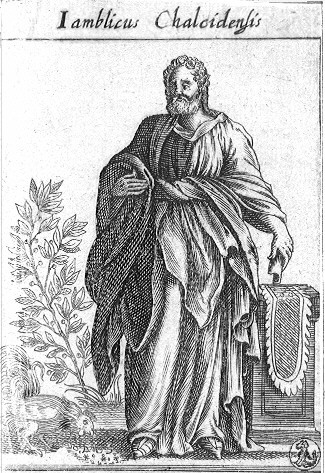
Giamblico di Calcide è stato un filosofo siro di lingua greca vissuto in età romana.
La sua opera contribuì a definire la direzione in cui si evolse la filosofia neoplatonica. Fu anche il biografo del mistico, filosofo e matematico greco Pitagora.
A parte il suo contributo filosofico il suo Protreptico è importante per lo studio dei sofisti, grazie alla conservazione di circa dieci pagine di un sofista altrimenti sconosciuto noto come Anonimo di Giamblico. Wikipedia
Giamblico libro Vita di Pitagora
36, p. 103
Vita di Pitagora
Giamblico libro Vita di Pitagora
110, p. 163
Vita di Pitagora
Giamblico libro Vita di Pitagora
40-41, p. 107
Vita di Pitagora
Giamblico libro Vita di Pitagora
37-38, p. 105
Vita di Pitagora
Giamblico libro Vita di Pitagora
15, p. 89
Vita di Pitagora
Giamblico libro Vita di Pitagora
12, p. 87
Vita di Pitagora
Giamblico libro Vita di Pitagora
46, p. 111
Vita di Pitagora
Giamblico libro Vita di Pitagora
227-228, p. 251
Vita di Pitagora
Giamblico libro Vita di Pitagora
168-169, p. 211
Vita di Pitagora
Giamblico libro Vita di Pitagora
58, pp. 119-121
Vita di Pitagora
Giamblico libro Vita di Pitagora
54, p. 117
Vita di Pitagora
Giamblico libro Vita di Pitagora
186, p. 223
Vita di Pitagora
Giamblico libro Vita di Pitagora
107-108, pp. 161-163
Vita di Pitagora
Giamblico libro Vita di Pitagora
185, pp. 221-223
Vita di Pitagora
Giamblico libro Vita di Pitagora
89, p. 147
Vita di Pitagora
Giamblico libro Vita di Pitagora
102, p. 157
Vita di Pitagora
Giamblico libro Vita di Pitagora
109, p. 163
Vita di Pitagora
“Tutto quanto essi stabiliscono sul fare e il non fare, mira alla divinità.”
Giamblico libro Vita di Pitagora
86
Vita di Pitagora
Origine: Citato in Erica Joy Mannucci, La cena di Pitagora, Carocci, Roma, 2008, p. 18. ISBN 978-88-430-4574-7
Origine: Life of Pythagoras, Ch. 1 : Importance of the Subject
Contesto: Since wise people are in the habit of invoking the divinities at the beginning of any philosophic consideration, this is all the more necessary on studying that one which is justly named after the divine Pythagoras. Inasmuch as it emanated from the divinities it could not be apprehended without their inspiration and assistance. Besides, its beauty and majesty so surpasses human capacity, that it cannot be comprehended in one glance. Gradually only can some details of it be mastered when, under divine guidance we approach the subject with a quiet mind. Having therefore invoked the divine guidance, and adapted ourselves and our style to the divine circumstances, we shall acquiesce in all the suggestions that come to us. Therefore we shall not begin with any excuses for the long neglect of this sect, nor by any explanations about its having been concealed by foreign disciplines, or mystic symbols, nor insist that it has been obscured by false and spurious writings, nor make apologies for any special hindrances to its progress. For us it is sufficient that this is the will of the Gods, which all enable us to undertake tasks even more arduous than these. Having thus acknowledged our primary submission to the divinities, our secondary devotion shall be to the prince and father of this philosophy as a leader.
Origine: Life of Pythagoras, Ch. 2 : Youth, Education, Travels
Contesto: After his father's death, though he was still but a youth, his aspect was so venerable, and his habits so temperate that he was honored and even reverenced by elderly men, attracting the attention of all who saw and heard him speak, creating the most profound impression. That is the reason that many plausibly asserted that he was a child of the divinity. Enjoying the privilege of such a renown, of an education so thorough from infancy, and of so impressive a natural appearance he showed that he deserved all these advantages by deserving them, by the adornment of piety and discipline, by exquisite habits, by firmness of soul, and by a body duly subjected to the mandates of reason. An inimitable quiet and serenity marked all his words and actions, soaring above all laughter, emulation, contention, or any other irregularity or eccentricity; his influence at Samos was that of some beneficent divinity. His great renown, while yet a youth, reached not only men as illustrious for their wisdom as Thales at Miletus, and Bias at Prione, but also extended to the neighboring cities. He was celebrated everywhere as the "long-haired Samian," and by the multitude was given credit for being under divine inspiration.
Origine: Life of Pythagoras, Ch. 1 : Importance of the Subject
Contesto: Since wise people are in the habit of invoking the divinities at the beginning of any philosophic consideration, this is all the more necessary on studying that one which is justly named after the divine Pythagoras. Inasmuch as it emanated from the divinities it could not be apprehended without their inspiration and assistance. Besides, its beauty and majesty so surpasses human capacity, that it cannot be comprehended in one glance. Gradually only can some details of it be mastered when, under divine guidance we approach the subject with a quiet mind. Having therefore invoked the divine guidance, and adapted ourselves and our style to the divine circumstances, we shall acquiesce in all the suggestions that come to us. Therefore we shall not begin with any excuses for the long neglect of this sect, nor by any explanations about its having been concealed by foreign disciplines, or mystic symbols, nor insist that it has been obscured by false and spurious writings, nor make apologies for any special hindrances to its progress. For us it is sufficient that this is the will of the Gods, which all enable us to undertake tasks even more arduous than these. Having thus acknowledged our primary submission to the divinities, our secondary devotion shall be to the prince and father of this philosophy as a leader.
On the Monad
The Theology of Arithmetic
Contesto: Likewise, they call it "Chaos," which is Hesiod's first generator, because Chaos gives rise to everything else, as the monad does. It is also thought to be both "mixture" and "blending," "obscurity" and "darkness" thanks to the lack of articulation and distinction of everything which ensues from it.
Anatolius says that it is called "matrix" and "matter," on the grounds that without it there is no number.
The mark which signifies the monad is the source of all things.
Origine: Life of Pythagoras, Ch. 1 : Importance of the Subject
Contesto: Since wise people are in the habit of invoking the divinities at the beginning of any philosophic consideration, this is all the more necessary on studying that one which is justly named after the divine Pythagoras. Inasmuch as it emanated from the divinities it could not be apprehended without their inspiration and assistance. Besides, its beauty and majesty so surpasses human capacity, that it cannot be comprehended in one glance. Gradually only can some details of it be mastered when, under divine guidance we approach the subject with a quiet mind. Having therefore invoked the divine guidance, and adapted ourselves and our style to the divine circumstances, we shall acquiesce in all the suggestions that come to us. Therefore we shall not begin with any excuses for the long neglect of this sect, nor by any explanations about its having been concealed by foreign disciplines, or mystic symbols, nor insist that it has been obscured by false and spurious writings, nor make apologies for any special hindrances to its progress. For us it is sufficient that this is the will of the Gods, which all enable us to undertake tasks even more arduous than these. Having thus acknowledged our primary submission to the divinities, our secondary devotion shall be to the prince and father of this philosophy as a leader.
Origine: Life of Pythagoras, Ch. 2 : Youth, Education, Travels
“Wait for the appointed hour.”
As quoted in The Lives of the Sophists by Eunapius ( online exerpt http://www.goddess-athena.org/Encyclopedia/Friends/Iamblichus/index.htm)
On the Monad
The Theology of Arithmetic
Contesto: The Pythagoreans called the monad "intellect" because they thought that intellect was akin to the One; for among the virtues, they likened the monad to moral wisdom; for what is correct is one. And they called it "being," "cause of truth," "simple," "paradigm," "order," "concord," "what is equal among the greater and the lesser," "the mean between intensity and slackness," "moderation in plurality," "the instant now in time," and moreover they call it "ship," "chariot," "friend," "life," "happiness."
“It is irreverent to the Gods to give you this demonstration, but for your sakes it shall be done.”
As quoted in The Lives of the Sophists by Eunapius
Origine: Anonymous of Iamblichus, p. 149
Life of Pythagoras
On the dyad
The Theology of Arithmetic


