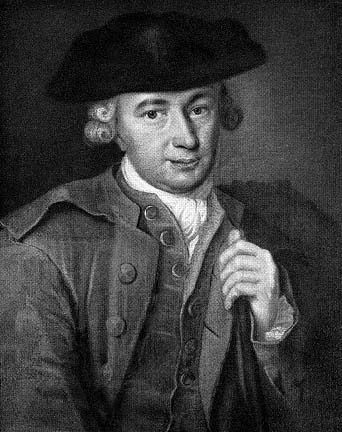
Frasi di Johann Georg Hamann

Johann Georg Hamann è stato un filosofo prussiano, tra le più importanti personalità del Contro-Illuminismo, fu il principale sostenitore dello Sturm und Drang e il maestro di Herder e di Jacobi. Amico di Immanuel Kant, fu tuttavia suo avversario nell'ambito intellettuale.

La sfiducia nella ragione e, di conseguenza, l'opposizione all'Illuminismo, lo portarono alla conclusione che solo la fede in Dio fosse l'unica soluzione per vagliare le problematiche filosofiche. Hamann fu profondamente influenzato dagli scritti di Hume sui limiti del pensiero umano tanto che in un suo famoso saggio, i Sokratische Denkwürdigkeiten , usò proprio la figura di Socrate come archetipo dell'uomo che dichiara di non avere conoscenze certe e di non sapere nulla. Con tale esempio egli volle criticare la dipendenza dell'Illuminismo dalla ragione umana, che, come affermava già Hume, si basa solo su conoscenze probabili e non certe.

Soprannominato dai suoi contemporanei il "Mago del Nord" ; mentore di Herder, ebbe una grandissima influenza sul pensiero di numerosi filosofi del suo tempo e del secolo seguente, da Goethe a Jacobi, da Hegel a Kierkegaard. Wikipedia  

✵ 27. Agosto 1730 – 21. Giugno 1788
Johann Georg Hamann photo
Johann Georg Hamann: 25 citazioni0 Mi piace

Johann Georg Hamann frasi celebri

“La poesia è la lingua madre della razza umana; così come il giardinaggio è più antico dell'agricoltura, la pittura della scrittura, il canto della declamazione, le similitudini dei sillogismi, lo scambio del commercio.”

Johann Georg Hamann

Capitolo nono, Lo Sturm und Drang e Herder, p. 239
Citato in René Wellek, Storia della critica moderna, I. Dall'Illuminismo al Romanticismo.

Johann Georg Hamann Frasi e Citazioni

“Lucifero del secolo.”

Johann Georg Hamann

Capitolo nono, Lo Sturm und Drang e Herder, p. 240
Citato in René Wellek, Storia della critica moderna, I. Dall'Illuminismo al Romanticismo.

“[…] la Natura e la Sacra Scrittura sono i materiali dello spirito bello che crea e imita.”

Johann Georg Hamann

Capitolo nono, Lo Sturm und Drang e Herder, p. 239
Citato in René Wellek, Storia della critica moderna, I. Dall'Illuminismo al Romanticismo.

“I sensi e le passioni parlano e comprendono soltanto immagini. Nelle immagini è l'intero tesoro dell'umana conoscenza e felicità.”

Johann Georg Hamann

Capitolo nono, Lo Sturm und Drang e Herder, p. 239
Citato in René Wellek, Storia della critica moderna, I. Dall'Illuminismo al Romanticismo.

“[…] genere naturale di profezia.”

Johann Georg Hamann

Capitolo nono, Lo Sturm und Drang e Herder, p. 239
Citato in René Wellek, Storia della critica moderna, I. Dall'Illuminismo al Romanticismo.

“Nessun gioco di prestigio estetico può rimpiazzare il sentimento immediato.”

Johann Georg Hamann

Capitolo nono, Lo Sturm und Drang e Herder, p. 241
Citato in René Wellek, Storia della critica moderna, I. Dall'Illuminismo al Romanticismo.

“Il genio sonda tutte le cose, anche le cose più profonde di Dio.”

Johann Georg Hamann

Capitolo nono, Lo Sturm und Drang e Herder, p. 240
Citato in René Wellek, Storia della critica moderna, I. Dall'Illuminismo al Romanticismo.

Johann Georg Hamann: Frasi in inglese

“Let us assume that we invited an unknown person to a game of cards. If this person answered us, “I don’t play,” we would either interpret this to mean that he did not understand the game, or that he had an aversion to it which arose from economic, ethical, or other reasons. Let us imagine, however, that an honorable man, who was known to possess every possible skill in the game, and who was well versed in its rules and its forbidden tricks, but who could like a game and participate in it only when it was an innocent pastime, were invited into a company of clever swindlers, who were known as good players and to whom he was equal on both scores, to join them in a game. If he said, “I do not play,” we would have to join him in looking the people with whom he was talking straight in the face, and would be able to supplement his words as follows: “I don’t play, that is, with people such as you, who break the rules of the game, and rob it of its pleasure. If you offer to play a game, our mutual agreement, then, is that we recognize the capriciousness of chance as our master; and you call the science of your nimble fingers chance, and I must accept it as such, it I will, or run the risk of insulting you or choose the shame of imitating you.” … The opinion of Socrates can be summarized in these blunt words, when he said to the Sophists, the leaned men of his time, “I know nothing.””

Johann Georg Hamann

Therefore these words were a thorn in their eyes and a scourge on their backs.
Socratic Memorabilia, J. Flaherty, trans. (Baltimore: 1967), pp. 165-167.

“Poetry is the mother-tongue of the human race.”

Johann Georg Hamann

Sämtliche Werken, ed. Josef Nadler (Vienna: Verlag Herder, 1949-1957), vol. II, p. 197.

“Through a vicious circle of pure reason skepsis itself becomes dogma.”

Johann Georg Hamann

Briefwechsel, ed. Arthur Henkel (1955-1975), vol. V, p. 432.

Autori simili

Immanuel Kant photo
Immanuel Kant63
filosofo tedesco None
Joseph Joubert photo
Joseph Joubert39
filosofo e aforista francese None
Johann Gottfried Herder photo
Johann Gottfried Herder4
filosofo e teologo tedesco None
Thomas Hobbes photo
Thomas Hobbes29
filosofo britannico None
Baruch Spinoza photo
Baruch Spinoza118
filosofo olandese None
François de La  Rochefoucauld photo
François de La Rochefoucauld195
scrittore, filosofo e aforista francese None
Baltasar Gracián photo
Baltasar Gracián107
gesuita, scrittore e filosofo spagnolo None
John Locke photo
John Locke13
filosofo e fisico britannico None
Michel De Montaigne photo
Michel De Montaigne92
filosofo, scrittore e politico francese None
Friedrich Schiller photo
Friedrich Schiller53
poeta, filosofo e drammaturgo tedesco None