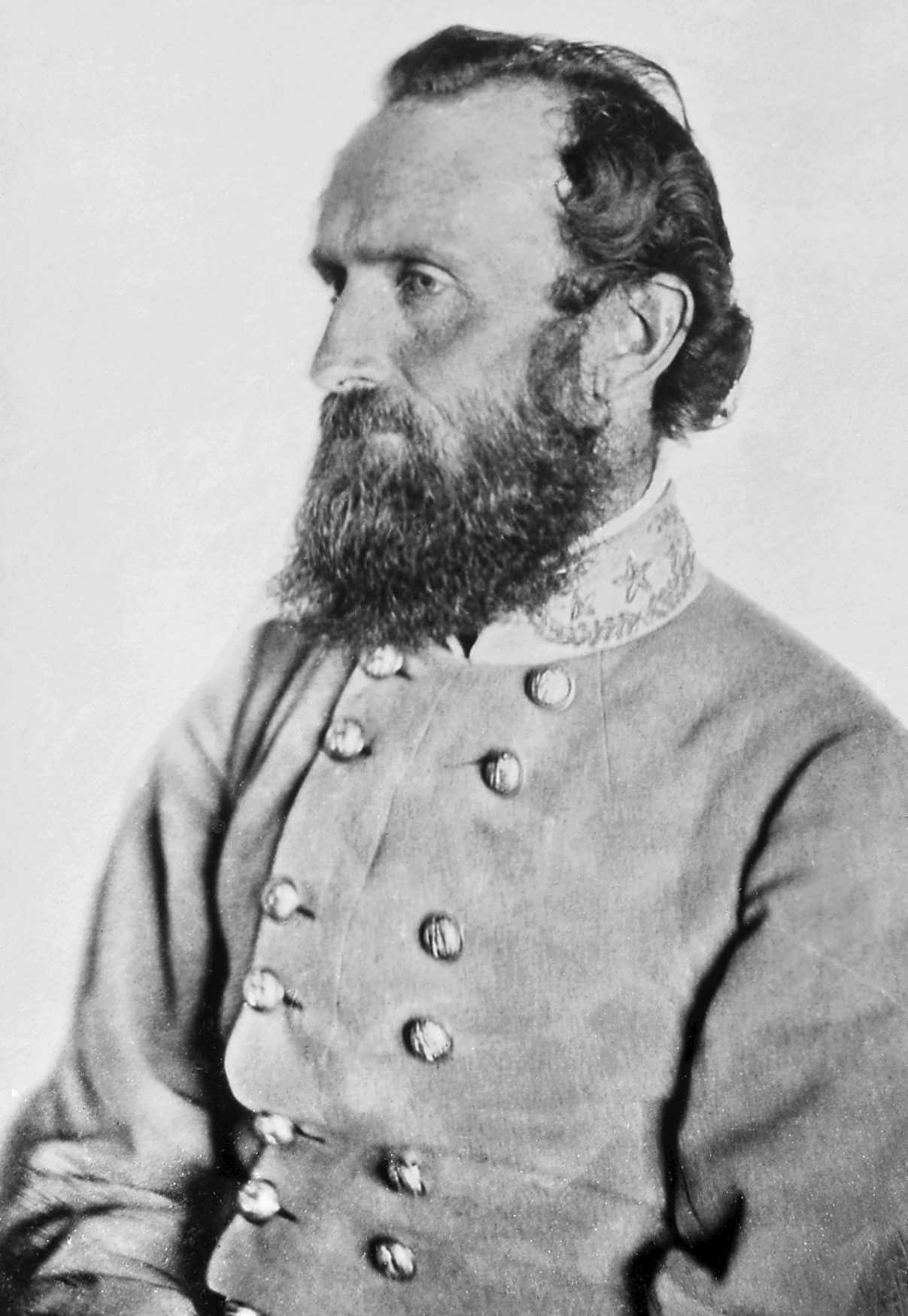
Thomas Jonathan Jackson Frasi e Citazioni
Thomas Jonathan Jackson: Frasi in inglese
“I have seen enough of it to make me look upon it as the sum of all evils.”
Comments to his pastor (April 1861) as quoted in Memoirs of Stonewall Jackson by His Widow Mary Anna Jackson (1895) http://books.google.com/books?id=bG2vg5cH004C, Ch. IX : War Clouds — 1860 - 1861, p. 141; This has sometimes been paraphrased as "War is the sum of all evils." Before Jackson's application of the term "The sum of all evils" to war, it had also been applied to slavery by abolitionist Cassius Marcellus Clay in The Writings of Cassius Marcellus Clay : Including Speeches and Addresses (1848), p. 445; to death by Georg Christian Knapp in Lectures on Christian Theology (1845), p. 404; and it had also been used, apparently in relation to arrogance in a translation of "Homily 24" in The Homilies of S. John Chrysostom on the First Epistle of St. Paul the Apostle to the Corinthians (1839), p. 331 <!-- earliest use thus far found ~ Kalki 2008·01·21 --> <br class="br">Contesto: If the general government should persist in the measures now threatened, there must be war. It is painful enough to discover with what unconcern they speak of war and threaten it. They do not know its horrors. I have seen enough of it to make me look upon it as the sum of all evils.
As quoted in Battles and Leaders of the Civil War (1884 - 1888) edited by Robert Underwood Clarence C. Buel, Vol. II, p. 297
Contesto: Always mystify, mislead, and surprise the enemy, if possible; and when you strike and overcome him, never let up in the pursuit so long as your men have strength to follow; for an army routed, if hotly pursued, becomes panic-stricken, and can then be destroyed by half their number. The other rule is, never fight against heavy odds, if by any possible maneuvering you can hurl your own force on only a part, and that the weakest part, of your enemy and crush it. Such tactics will win every time, and a small army may thus destroy a large one in detail, and repeated victory will make it invincible.
Misattributed, Jackson's personal book of maxims
Contesto: It is man's highest interest not to violate, or attempt to violate, the rules which Infinite Wisdom has laid down. The means by which men are to attain great elevation may be classed in three divisions — physical, mental, and moral. Whatever relates to health, belongs to the first; whatever relates to the improvement of the mind, belongs to the second. The formation of good manners and virtuous habits constitutes the third.
Misattributed, Jackson's personal book of maxims
As quoted in Stonewall Jackson and the American Civil War (1904) by George Francis Robert Henderson http://www.gutenberg.org/etext/12233, Ch. 25 : The Soldier and the Man, p. 481 <br class="br">Contesto: War means fighting. The business of the soldier is to fight. Armies are not called out to dig trenches, to throw up breastworks, to live in camps, but to find the enemy and strike him; to invade his country, and do him all possible damage in the shortest possible time. This will involve great destruction of life and property while it lasts; but such a war will of necessity be of brief continuance, and so would be an economy of life and property in the end. To move swiftly, strike vigorously, and secure all the fruits of victory is the secret of successful war.
“Good-breeding is opposed to selfishness, vanity, or pride.”
Misattributed, Jackson's personal book of maxims
Contesto: Good-breeding is opposed to selfishness, vanity, or pride. Never weary your company by talking too long or too frequently.
To Col. Sam Fulkerson, who reported on the weariness of their troops and suggested that they should be given an hour or so to rest from a forced march in the night. (24 May 1862); as quoted in Mighty Stonewall (1957) by Frank E. Vandiver, p. 250
Contesto: I yield to no man in sympathy for the gallant men under my command; but I am obliged to sweat them tonight, so that I may save their blood tomorrow. The line of hills southwest of Winchester must not be occupied by the enemy's artillery. My own must be there and in position by daylight. … You shall however have two hours rest.
Origine: Life and Letters of General Thomas J. Jackson (1891), Ch. 22 : The Last Happy Days — Chancellorsville — 1863, p. 429
Contesto: We must make this campaign an exceedingly active one. Only thus can a weaker country cope with a stronger; it must make up in activity what it lacks in strength. A defensive campaign can only be made successful by taking the aggressive at the proper time. Napoleon never waited for his adversary to become fully prepared, but struck him the first blow.
“War means fighting. The business of the soldier is to fight.”
As quoted in Stonewall Jackson and the American Civil War (1904) by George Francis Robert Henderson http://www.gutenberg.org/etext/12233, Ch. 25 : The Soldier and the Man, p. 481 <br class="br">Contesto: War means fighting. The business of the soldier is to fight. Armies are not called out to dig trenches, to throw up breastworks, to live in camps, but to find the enemy and strike him; to invade his country, and do him all possible damage in the shortest possible time. This will involve great destruction of life and property while it lasts; but such a war will of necessity be of brief continuance, and so would be an economy of life and property in the end. To move swiftly, strike vigorously, and secure all the fruits of victory is the secret of successful war.
“If the general government should persist in the measures now threatened, there must be war.”
Comments to his pastor (April 1861) as quoted in Memoirs of Stonewall Jackson by His Widow Mary Anna Jackson (1895) http://books.google.com/books?id=bG2vg5cH004C, Ch. IX : War Clouds — 1860 - 1861, p. 141; This has sometimes been paraphrased as "War is the sum of all evils." Before Jackson's application of the term "The sum of all evils" to war, it had also been applied to slavery by abolitionist Cassius Marcellus Clay in The Writings of Cassius Marcellus Clay : Including Speeches and Addresses (1848), p. 445; to death by Georg Christian Knapp in Lectures on Christian Theology (1845), p. 404; and it had also been used, apparently in relation to arrogance in a translation of "Homily 24" in The Homilies of S. John Chrysostom on the First Epistle of St. Paul the Apostle to the Corinthians (1839), p. 331 <!-- earliest use thus far found ~ Kalki 2008·01·21 --> <br class="br">Contesto: If the general government should persist in the measures now threatened, there must be war. It is painful enough to discover with what unconcern they speak of war and threaten it. They do not know its horrors. I have seen enough of it to make me look upon it as the sum of all evils.
“Make it a rule never to accuse without due consideration any body or association of men.”
Misattributed, Jackson's personal book of maxims
“You may be whatever you resolve to be.”
This statement, attributed to Jackson, is inscribed on the Jackson Arch barracks entrance at the Virginia Military Institute in Lexington, Virginia, where Jackson was a teacher in mathematics prior to the American Civil War.
Misattributed, Jackson's personal book of maxims
“Resolve to perform what you ought; perform without fail what you resolve.”
Misattributed, Jackson's personal book of maxims
Misattributed, Jackson's personal book of maxims
“Endeavor to do well with everything you undertake.”
Misattributed, Jackson's personal book of maxims
“Wrong no man by doing injuries, or omitting the benefits that are your duty.”
Misattributed, Jackson's personal book of maxims
Letter to his pastor after the First Battle of Bull Run (22 July 1861); as quoted in The Religious Development of the Negro in Virginia (1914) by Joseph Brummell Earnest, p. 84
“Duty is ours; consequences are God's.”
Though this was a favorite motto of Jackson, and reported as among his last words, it did not originate with him, and was used by others at least as early as in a speech by abolitionist John Jay (8 October 1856)
Misattributed
“Always look people in the face when addressing them, and generally when they address you.”
Misattributed, Jackson's personal book of maxims
“Spare no effort to suppress selfishness, unless that effort would entail sorrow.”
Misattributed, Jackson's personal book of maxims
“Avoid extremes; forbear resenting injuries as much as you think they deserve.”
Misattributed, Jackson's personal book of maxims
“The only true rule for cavalry is to follow the enemy as long as he retreats.”
Statement to Colonel Thomas T. Munford (13 June 1862); as quoted in Stonewall Jackson and the American Civil War (1904) by George Francis Robert Henderson http://www.gutenberg.org/etext/12233 Vol. I, Ch. XI p. 392
“Be not disturbed at trifles, nor at accidents, common or unavoidable.”
Misattributed, Jackson's personal book of maxims
Words on his deathbed (9 - 10 May 1863); as quoted in "Stonewall Jackson's Last Days" by Joe D. Haines, Jr. in America's Civil War http://www.historynet.com/magazines/american_civil_war/3031406.html
“I am more afraid of King Alcohol than of all the bullets of the enemy.”
As quoted in Personal Reminiscences, Anecdotes, and Letters of Gen. Robert E. Lee (1874) by John William Jones, p. 171
Speaking to Captain John D. Imboden (24 July 1861), as quoted in Stonewall Jackson As Military Commander (2000) by John Selby, p. 25; sometimes quoted as "My religious beliefs teach me..."
As quoted in Shenandoah Valley Pioneers and Their Descendants : A History of Frederick County, Virginia (illustrated) from its formation in 1738 to 1908 (1989) by T. K. Cartmell, p. 322
Farewell address to his brigade, as he left to receive his promotion to Major General (4 October 1861)
Speech to cadets at the Virginia Military Institute (March 1861); as quoted in Mighty Stonewall (1957) by Frank E. Vandiver, p. 131; this has sometimes been paraphrased as "When war does come, my advice is to draw the sword and throw away the scabbard."
Misattributed, Jackson's personal book of maxims


