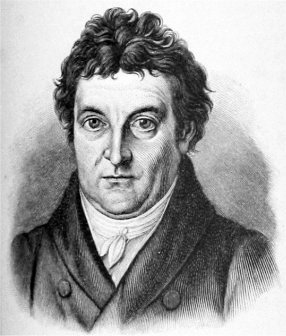
Johann Gottlieb Fichte frasi celebri
Nicolao Merker
La missione del dotto, Citazioni sull'opera
La missione del dotto, lezione I, 1794
“Vivere veramente significa pensare veramente e conoscere la verità.”
Introduzione alla vita beata
Origine: La missione del dotto, p. 12
Origine: La missione del dotto, p. 18
Frasi sull'et di Johann Gottlieb Fichte
Origine: La missione del dotto, p. 50
dalle Lezioni sulla missione del dotto, 1794
“Chiamo società la relazione reciproca degli esseri razionali.”
Origine: La missione del dotto, p. 22
“L'intellettuale è tale solo se considerato all'interno della società.”
Origine: La missione del dotto, p. 37
Nicolao Merker
La missione del dotto, Citazioni sull'opera
Johann Gottlieb Fichte Frasi e Citazioni
da Fondamento dell'intera dottrina della scienza, 1794 – GA, I/2 p. 394
“L'essenza interna ed assoluta di Dio viene alla luce come bellezza.”
Introduzione alla vita beata
Introduzione alla vita beata
Origine: La missione del dotto, p. 7
Origine: La missione del dotto, p. 12
Origine: La missione del dotto, p. 13
Origine: La missione del dotto, p. 13
Origine: La missione del dotto, p. 16
Origine: La missione del dotto, p. 17
Origine: La missione del dotto, p. 17
“Noi siamo ancora al basso grado della semi-umanità, ovvero alla schiavitù.”
Origine: La missione del dotto, p. 32
Origine: La missione del dotto, p. 33-34
Origine: La missione del dotto, p. 39
“Nell'uomo esiste uno stimolo al sapere, e in particolare a ciò che gli torna utile.”
Origine: La missione del dotto, p. 58
da una lettera alla moglie del 26 maggio 1794; citato nell'introduzione, p. IX
La missione del dotto, Citazioni sull'opera
da Discorsi alla nazione tedesca, IX discorso; citato in William Boyd, Storia dell'educazione occidentale, traduzione di Trieste Valdi, Armando Armando Editore, 1966
dalle Lezioni sulla missione del dotto, 1794
da Lo Stato di tutto il popolo, a cura di Nicolao Merker, Roma 1978
“L'Io puro oppone nell'Io ad un io divisibile un non-io divisibile.”
dalla Dottrina della scienza, 1794
“L'umanità respinge il cieco caso e il potere del destino. Essa ha in mano il proprio destino.”
citato in Roger Garaudy, Karl Marx
“L'uomo può ciò che egli deve; e se dice: "Io non posso", segno è che non vuole.”
da Contributo per rettificare i giudizi del pubblico sulla Rivoluzione francese, 1793
III; 1943, p. 141
La missione del dotto
Johann Gottlieb Fichte: Frasi in inglese
XIII.
Outline of the Doctrine of Knowledge (1810)
Contesto: I know now that I shall. But all Actual Knowledge brings with it, by its formal nature, its schematised apposition; — although I now know of the Schema of God, yet I am not yet immediately this Schema, but I am only a Schema of the Schema. The required Being is not yet realised.
I shall be. Who is this I? Evidently that which is, — the Ego gives in Intuition, the Individual. This shall be.
What does its Being signify? It is given as a Principle in the World of Sense. Blind Instinct is indeed annihilated, and in its place there now stands the clearly perceived Shall. But the Power that at first set this Instinct in motion remains, in order that the Shall my now set it (the Power) in motion, and become its higher determining Principle. By means of this Power, I shall therefore, within its sphere, — the World of Sense, — produce and make manifest that which I recognise as my true Being in the Supersensuous World.
Origine: The Way Towards The Blessed Life or the Doctrine of Religion 1806, P. 4
Origine: The Way Towards The Blessed Life or the Doctrine of Religion 1806, P. 3
XIII.
Outline of the Doctrine of Knowledge (1810)
Contesto: I know now that I shall. But all Actual Knowledge brings with it, by its formal nature, its schematised apposition; — although I now know of the Schema of God, yet I am not yet immediately this Schema, but I am only a Schema of the Schema. The required Being is not yet realised.
I shall be. Who is this I? Evidently that which is, — the Ego gives in Intuition, the Individual. This shall be.
What does its Being signify? It is given as a Principle in the World of Sense. Blind Instinct is indeed annihilated, and in its place there now stands the clearly perceived Shall. But the Power that at first set this Instinct in motion remains, in order that the Shall my now set it (the Power) in motion, and become its higher determining Principle. By means of this Power, I shall therefore, within its sphere, — the World of Sense, — produce and make manifest that which I recognise as my true Being in the Supersensuous World.
XI.
Outline of the Doctrine of Knowledge (1810)
Contesto: There is but One Principle that proceeds from God; and thus, in consequence of the unity of the Power, it is possible for each Individual to schematise his World of Sense in accordance with the law of that original harmony; — and every Individual, under the condition of being found on the way towards the recognition of the Imperative, must so schematise it. I might say: — Every Individual can and must, under the given condition, construct the True World of Sense, — for this indeed has beyond the universal and formal laws above deduced, no other Truth and Reality than this universal harmony.
I.
Outline of the Doctrine of Knowledge (1810)
Contesto: The Doctrine of Knowledge, apart from all special and definite knowing, proceeds immediately upon Knowledge itself, in the essential unity in which it recognises Knowledge as existing; and it raises this question in the first place — How this Knowledge can come into being, and what it is in its inward and essential Nature?
The following must be apparent: — There is but One who is absolutely by and through himself, — namely, God; and God is not the mere dead conception to which we have thus given utterance, but he is in himself pure Life. He can neither change nor determine himself in aught within himself, nor become any other Being; for his Being contains within it all his Being and all possible Being, and neither within him nor out of him can any new Being arise.
XIV.
Outline of the Doctrine of Knowledge (1810)
Contesto: Thus then does the Doctrine of Knowledge, which in its substance is the realisation of the absolute Power of intelligising which has now been defined, end with the recognition of itself as a mere Schema in a Doctrine of Wisdom, although indeed a necessary and indispensable means to such a Doctrine: — a Schema, the sole aim of which is, with the knowledge thus acquired, — by which knowledge alone a Will, clear and intelligible to itself and reposing upon itself without wavering or perplexity, is possible, — to return wholly into Actual Life; — not into the Life of blind and irrational Instinct which we have laid bare in all its nothingness, but into the Divine Life which shall become visible to us.
III.
Outline of the Doctrine of Knowledge (1810)
Contesto: This Being out of God cannot, by any means, be a limited, completed, and inert Being, since God himself is not such a dead Being, but, on the contrary, is Life; — but it can only be a Power, since only a Power is the true formal picture or Schema of Life. And indeed it can only be the Power of realising that which is contained in itself — a Schema.
XIII.
Outline of the Doctrine of Knowledge (1810)
Contesto: The Power is given as an Infinite; — hence that which in the World of Thought is absolutely One — that which I shall — becomes in the World of Intuition an infinite problem for my Power, which I have to solve in all Eternity.
This Infinitude, which is properly a mere indefiniteness, can have place only in Intuition, but by means in my true Essential Being, which, as the Schema of God, is as simple and unchangeable as himself. How then can this simplicity and unchangeableness be produced within the yet continuing Infinitude, which is expressly consecrated by the absolute Shall addressed to me as an Individual?
If, in the onflow of Time, the Ego, in every successive moment, had to determine itself by a particular act, through the conception of what it shall, — then in its original Unity, it was assuredly indeterminate, and only continuously determinable in an Infinite Time. But such an act of determination could only become possible in Time, in opposition to some resisting power. This resisting power, which was thus to be conquered by the act of determination, could be nothing else than the Sensuous Instinct; and hence the necessity of such a continuous self-determination in Time would be the sure proof that the Instinct was not yet thoroughly abolished; which abolition we have made a condition of entering upon the Life in God.
“I am only a Schema of the Schema.”
XIII.
Outline of the Doctrine of Knowledge (1810)
Contesto: I know now that I shall. But all Actual Knowledge brings with it, by its formal nature, its schematised apposition; — although I now know of the Schema of God, yet I am not yet immediately this Schema, but I am only a Schema of the Schema. The required Being is not yet realised.
I shall be. Who is this I? Evidently that which is, — the Ego gives in Intuition, the Individual. This shall be.
What does its Being signify? It is given as a Principle in the World of Sense. Blind Instinct is indeed annihilated, and in its place there now stands the clearly perceived Shall. But the Power that at first set this Instinct in motion remains, in order that the Shall my now set it (the Power) in motion, and become its higher determining Principle. By means of this Power, I shall therefore, within its sphere, — the World of Sense, — produce and make manifest that which I recognise as my true Being in the Supersensuous World.
I.
Outline of the Doctrine of Knowledge (1810)
Contesto: The Doctrine of Knowledge, apart from all special and definite knowing, proceeds immediately upon Knowledge itself, in the essential unity in which it recognises Knowledge as existing; and it raises this question in the first place — How this Knowledge can come into being, and what it is in its inward and essential Nature?
The following must be apparent: — There is but One who is absolutely by and through himself, — namely, God; and God is not the mere dead conception to which we have thus given utterance, but he is in himself pure Life. He can neither change nor determine himself in aught within himself, nor become any other Being; for his Being contains within it all his Being and all possible Being, and neither within him nor out of him can any new Being arise.
Αs translated by William Smith, in The Popular Works of Johann Gottlieb Fichte (1889), Vol. I, Lecture IV, p. 188.
The Vocation of the Scholar (1794)
Contesto: Upon the progress of knowledge the whole progress of the human race is immediately dependent: he who retards that, hinders this also. And he who hinders this, —what character does he assume towards his age and posterity? Louder than with a thousand voices, by his actions he proclaims into the deafened ear of the world present and to come —"As long as I live at least, the men around me shall not become wiser or better; — for in their progress I too, notwithstanding all my efforts to the contrary, should be dragged forward in some direction; and this I detest I will not become more enlightened, — I will not become nobler. Darkness and perversion are my elements, and I will summon all my powers together that I may not be dislodged from them."
Johann Gottlieb Fichte libro The Vocation of Man
Origine: The Vocation of Man (1800), P. Preuss, trans. (1987), p. 12
"The Vocation of the Scholar" (1794), as translated by William Smith, in The Popular Works of Johann Gottlieb Fichte (1889), Vol. I, Lecture IV, p. 188.
The Vocation of the Scholar (1794)
Origine: The Characteristics of the Present Age (1806), p. 11
Origine: Introduction to Fichte's Science of Knowledge (1797/1798), p. 17-18.
Origine: The Characteristics of the Present Age (1806), p. 8
Origine: The Characteristics of the Present Age (1806), p. 14
II.
Outline of the Doctrine of Knowledge (1810)
Johann Gottlieb Fichte libro The Vocation of Man
Origine: The Vocation of Man (1800), P. Preuss, trans. (1987), p. 2
Origine: The Characteristics of the Present Age (1806), p. 12
Origine: The Characteristics of the Present Age (1806), p. 19
The System of Ethics According to the Principles of the Wissenschaftslehre (1798; Cambridge, 2005), p. 320.
XI.
Outline of the Doctrine of Knowledge (1810)
Origine: The Characteristics of the Present Age (1806), p. 21
Origine: The Characteristics of the Present Age (1806), p. 5
Grundriss des Eigenthümlichen der Wissenschaftslehre in Rücksicht auf das theoretische Vermögen (1795) GA I.3, as quoted/translated by Erhard Scholz, "Philosophy as a Cultural Resource and Medium of Reflection for Hermann Weyl" http://arxiv.org/abs/math/0409596 (2004).
Johann Gottlieb Fichte libro The Vocation of Man
Wenn ich nur dasjenige weiß, und von ihm überzeugt bin, was ich selbst gefunden, – nur dasjenige wirklich kenne, was ich selbst erfahren habe, so kann ich in der That nicht sagen, daß ich über meine Bestimmung das Geringste wisse; ich weiß blos, was Andre darüber zu wissen behaupten.
Origine: The Vocation of Man (1800), P. Preuss, trans. (1987), p. 4
Johann Gottlieb Fichte libro The Vocation of Man
Origine: The Vocation of Man (1800), P. Preuss, trans. (1987), p. 11
Origine: The Characteristics of the Present Age (1806), p. 7


