Frasi di Isaac Newton
pagina 6

Sir Isaac Newton è stato un matematico, fisico, filosofo naturale, astronomo, teologo, storico e alchimista inglese; citato anche come Isacco Newton, è considerato uno dei più grandi scienziati di tutti i tempi. Ricoprì il ruolo di direttore della zecca inglese e fu Presidente della Royal Society.

Noto soprattutto per il suo contributo alla meccanica classica, Isaac Newton contribuì in maniera fondamentale a più di una branca del sapere. Pubblicò i Philosophiae Naturalis Principia Mathematica nel 1687, opera nella quale descrisse la legge di gravitazione universale e, attraverso le sue leggi del moto, costruì le fondamenta per la meccanica classica. Newton inoltre condivise con Gottfried Wilhelm Leibniz la paternità dello sviluppo del calcolo differenziale o infinitesimale.

Newton fu il primo a dimostrare che le medesime leggi della natura governano il movimento della Terra e degli altri corpi celesti. Egli contribuì alla rivoluzione scientifica e al progresso della teoria eliocentrica. A Newton si deve anche la sistematizzazione matematica delle leggi di Keplero sul movimento dei pianeti. Oltre a dedurle matematicamente dalla soluzione del problema della dinamica applicata alla forza di gravità ovvero dalle omonime equazioni di Newton, egli generalizzò queste leggi intuendo che le orbite potevano essere non solo ellittiche, ma anche iperboliche e paraboliche.

Newton fu il primo a dimostrare che la luce bianca è composta dalla somma di tutti gli altri colori. Egli, infine, avanzò l'ipotesi che la luce fosse composta da particelle, dando vita alla teoria corpuscolare della luce, in contrapposizione alla teoria ondulatoria della luce patrocinata dall'astronomo olandese Christiaan Huygens e dall'inglese Thomas Young e corroborata alla fine dell'Ottocento dai lavori di Maxwell e Hertz. La tesi di Newton trovò invece conferme, circa due secoli dopo, con l'introduzione del quanto d'azione da parte di Max Planck e con l'articolo di Albert Einstein sull'interpretazione dell'effetto fotoelettrico a partire dal quanto di radiazione elettromagnetica, poi denominato fotone. Queste due interpretazioni coesisteranno nell'ambito della meccanica quantistica, come previsto dal dualismo onda-particella.

Occupa una posizione di grande rilievo nella storia della scienza e della cultura in generale. Il suo nome è associato a una grande quantità di leggi e teorie ancora oggi insegnate: si parla così di dinamica newtoniana, di leggi newtoniane del moto, di legge di gravitazione universale. Più in generale ci si riferisce al newtonianesimo come a una concezione del mondo che ha influenzato la cultura europea per tutto il Seicento.

Newton era attratto dalla filosofia naturale; ben presto cominciò a leggere le opere di Cartesio, in particolare La geometria del 1637, in cui le curve sono rappresentate per mezzo di equazioni. Negli anni in cui era studente a Cambridge alla cattedra presiedevano due figure di grande rilievo, Isaac Barrow e Henry More, che esercitarono una forte influenza sul ragazzo; Newton, negli anni seguenti, costruì le sue scoperte matematiche e sperimentali facendo riferimento a un gruppo ristretto di testi. Wikipedia  

✵ 4. Gennaio 1643 – 31. Marzo 1727   •   Altri nomi Sir Isaac Newton
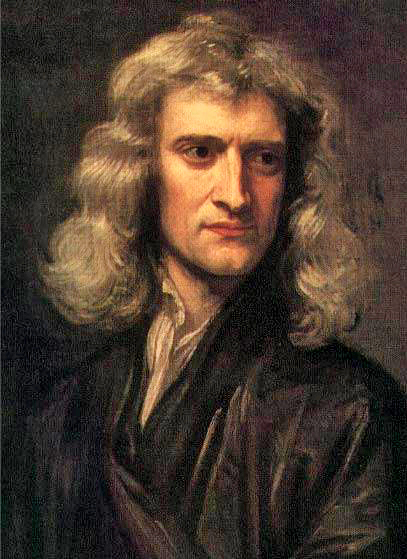
Isaac Newton photo
Isaac Newton: 189   frasi 37   Mi piace

Isaac Newton frasi celebri

Isaac Newton frase: “Ciò che sappiamo è una goccia, ciò che ignoriamo è un oceano.”

“Ciò che sappiamo è una goccia, ciò che ignoriamo è un oceano.”

Origine: Citato in Daniele Cipollini, Dopo il bosone di Higgs, quali grandi domande ci restano? http://daily.wired.it/news/scienza/2012/07/06/misteri-scienza-354678.html, Daily.wired.it, 6 luglio 2012.

“Non credo che ciò [l'universo] si possa spiegare solo con cause naturali, e sono costretto a imputarlo alla saggezza e all'ingegnosità di un essere intelligente.”

da una lettera a Richard Bentley, 10 dicembre 1692
Origine: Citato in Andrea Bacci e Carmen Tunno, L'umanità del tempo, Armando Editore, 2010, p. 37.

“[A proposito del gioco in borsa] So calcolare i movimenti dei corpi celesti, non la pazzia della gente.”

citato in Sergio Ricossa, Straborghese, Editoriale Nuova, Milano, 1980

Isaac Newton Frasi e Citazioni

Questa traduzione è in attesa di revisione. È corretto?

“Il moto delle comete è estremamente regolare e obbedisce alle stesse leggi del moto dei pianeti.”

Origine: Citato in AA.VV., Il libro dell'astronomia, traduzione di Roberto Sorgo, Gribaudo, 2017, p. 73. ISBN 9788858018347

Isaac Newton: Frasi in inglese

“In the beginning of the year 1665 I found the method of approximating Series and the Rule for reducing any dignity of any Binomial into such a series. The same year in May I found the method of tangents of Gregory and Slusius, and in November had the direct method of Fluxions, and the next year in January had the Theory of Colours, and in May following I had entrance into the inverse method of Fluxions. And the same year I began to think of gravity extending to the orb of the Moon, and having found out how to estimate the force with which [a] globe revolving within a sphere presses the surface of the sphere, from Kepler's Rule of the periodical times of the Planets being in a sesquialterate proportion of their distances from the centers of their orbs I deduced that the forces which keep the Planets in their Orbs must [be] reciprocally as the squares of their distances from the centers about which they revolve: and thereby compared the force requisite to keep the Moon in her orb with the force of gravity at the surface of the earth, and found them answer pretty nearly. All this was in the two plague years of 1665 and 1666, for in those days I was in the prime of my age for invention, and minded Mathematicks and Philosophy more than at any time since. What Mr Hugens has published since about centrifugal forces I suppose he had before me. At length in the winter between the years 1676 and 1677 I found the Proposition that by a centrifugal force reciprocally as the square of the distance a Planet must revolve in an Ellipsis about the center of the force placed in the lower umbilicus of the Ellipsis and with a radius drawn to that center describe areas proportional to the times. And in the winter between the years 1683 and 1684 this Proposition with the Demonstration was entered in the Register book of the R. Society. And this is the first instance upon record of any Proposition in the higher Geometry found out by the method in dispute. In the year 1689 Mr Leibnitz, endeavouring to rival me, published a Demonstration of the same Proposition upon another supposition, but his Demonstration proved erroneous for want of skill in the method.”

(ca. 1716) A Catalogue of the Portsmouth Collection of Books and Papers Written by Or Belonging to Sir Isaac Newton https://books.google.com/books?id=3wcjAAAAMAAJ&pg=PR18 (1888) Preface
Also partially quoted in Sir Sidney Lee (ed.), The Dictionary of National Biography Vol.40 http://books.google.com/books?id=NycJAAAAIAAJ (1894)

“In my Judgment no Lines ought to be admitted into plain Geometry besides the right Line and the Circle.”

Isaac Newton libro Arithmetica Universalis

p, 125
Arithmetica Universalis (1707)

“The predictions of things to come relate to the state of the Church in all ages: and amongst the old Prophets, Daniel is most distinct in order of time, and easiest to be understood: and therefore in those things which relate to the last times, he must be made the key to the rest.”

Vol. I, Ch. 1: Introduction concerning the Compilers of the books of the Old Testament
Observations upon the Prophecies of Daniel, and the Apocalypse of St. John (1733)
Contesto: The authority of Emperors, Kings, and Princes, is human. The authority of Councils, Synods, Bishops, and Presbyters, is human. The authority of the Prophets is divine, and comprehends the sum of religion, reckoning Moses and the Apostles among the Prophets; and if an Angel from Heaven preach any other gospel, than what they have delivered, let him be accursed. Their writings contain covenant between God and his people, with instructions for keeping this covenant; instances of God’s judgments upon them that break it: and predictions of things to come. While the people of God keep the covenant they continue to be his people: when they break it they cease to be his people or church, and become the Synagogue of Satan, who say they are Jews and are not. And no power on earth is authorized to alter this covenant.
The predictions of things to come relate to the state of the Church in all ages: and amongst the old Prophets, Daniel is most distinct in order of time, and easiest to be understood: and therefore in those things which relate to the last times, he must be made the key to the rest.

“I have studied these things — you have not.”

Reported as Newton's response, whenever Edmond Halley would say anything disrespectful of religion, by Sir David Brewster in The Life of Sir Isaac Newton (1831). This has often been quoted in recent years as having been a statement specifically defending Astrology. Newton wrote extensively on the importance of Prophecy, and studied Alchemy, but there is little evidence that he took favourable notice of astrology http://www.staff.science.uu.nl/~gent0113/astrology/newton.htm. In a footnote, Brewster attributes the anecdote to the astronomer Nevil Maskelyne who is said to have passed it on to Oxford professor Stephen Peter Rigaud http://books.google.co.uk/books?id=gLcVAAAAYAAJ&pg=PA301&lpg=PA301&dq=brewster+newton+%22I+have+studied%22&source=bl&ots=dEwk6nHcSa&sig=F2uReuXjRWwL3w647pfaU1PlbC0&hl=en&sa=X&ei=fqu5UpzkAvOA7Qap9oGoDQ&ved=0CGoQ6AEwBw#v=onepage&q=brewster%20newton%20%22I%20have%20studied%22&f=false

“Through algebra you easily arrive at equations, but always to pass therefrom to the elegant constructions and demonstrations which usually result by means of the method of porisms is not so easy, nor is one's ingenuity and power of invention so greatly exercised and refined in this analysis.”

The Mathematical Papers of Isaac Newton (edited by Whiteside), Volume 7; Volumes 1691-1695 / pg. 261. http://books.google.com.br/books?id=YDEP1XgmknEC&printsec=frontcover
Geometriae (Treatise on Geometry)

“The alternation of motion is ever proportional to the motive force impressed; and is made in the direction of the right line in which that force is impressed.”

Isaac Newton libro Philosophiae Naturalis Principia Mathematica

Laws of Motion, II
Philosophiae Naturalis Principia Mathematica (1687)

“Hypotheses non fingo.”

Isaac Newton libro Philosophiae Naturalis Principia Mathematica

I frame no hypotheses.

A famous statement in the "General Scholium" of the third edition, indicating his belief that the law of universal gravitation was a fundamental empirical law, and that he proposed no hypotheses on how gravity could propagate.

Variant translation: I feign no hypotheses.

As translated by Alexandre Koyré (1956)

I have not as yet been able to discover the reason for these properties of gravity from phenomena, and I do not feign hypotheses. For whatever is not deduced from the phenomena must be called a hypothesis; and hypotheses, whether metaphysical or physical, or based on occult qualities, or mechanical, have no place in experimental philosophy. In this philosophy particular propositions are inferred from the phenomena, and afterwards rendered general by induction.

As translated by I. Bernard Cohen and Anne Whitman (1999)
Philosophiae Naturalis Principia Mathematica (1687)

“To every action there is always opposed an equal reaction; or, the mutual actions of two bodies upon each other are always equal, and directed to contrary parts.”

Isaac Newton libro Philosophiae Naturalis Principia Mathematica

Laws of Motion, III
Philosophiæ Naturalis Principia Mathematica (1687)

“Who is a liar, saith John, but he that denyeth that Jesus is the Christ? He is Antichrist that denyeth the Father & the Son. And we are authorized also to call him God: for the name of God is in him.”

Exod. 23.21. And we must believe also that by his incarnation of the Virgin he came in the flesh not in appearance only but really & truly , being in all things made like unto his brethren (Heb. 2 17) for which reason he is called also the son of man.
Drafts on the history of the Church (Section 3). Yahuda Ms. 15.3, National Library of Israel, Jerusalem, Israel. 2006 Online Version at Newton Project http://www.newtonproject.sussex.ac.uk/view/texts/normalized/THEM00220

“The Ellipse is the most simple of the Conic Sections, most known, and nearest of Kin to a Circle, and easiest describ'd by the Hand in plano.”

Isaac Newton libro Arithmetica Universalis

Though many prefer the Parabola before it, for the Simplicity of the Æquation by which it is express'd. But by this Reason the Parabola ought to be preferr'd before the Circle it self, which it never is. Therefore the reasoning from the Simplicity of the Æquation will not hold. The modern Geometers are too fond of the Speculation of Æquations.
Arithmetica Universalis (1707)

“Is not the Heat of the warm Room convey'd through the Vacuum by the Vibrations of a much subtiler Medium than Air, which after the Air was drawn out remained in the Vacuum?”

Isaac Newton libro Opticks, or a Treatise of the Reflections, Refractions, Inflections and Colours of Light

And is not this Medium the same with that Medium by which Light is refracted and reflected and by whose Vibrations Light communicates Heat to Bodies, and is put into Fits of easy Reflexion and easy Transmission? ...And do not hot Bodies communicate their Heat to contiguous cold ones, by the Vibrations of this Medium propagated from them into the cold ones? And is not this Medium exceedingly more rare and subtile than the Air, and exceedingly more elastick and active? And doth it not readily pervade all Bodies? And is it not (by its elastick force) expanded through all the Heavens?
Query 18
Opticks (1704)

Autori simili

Blaise Pascal photo
Blaise Pascal 139
matematico, fisico, filosofo e teologo francese
Johann Gottfried Herder photo
Johann Gottfried Herder 4
filosofo e teologo tedesco
Galileo Galilei photo
Galileo Galilei 39
scienziato italiano
Cartesio photo
Cartesio 46
filosofo e matematico francese
John Locke photo
John Locke 13
filosofo e fisico britannico
Gottfried Wilhelm von Leibniz photo
Gottfried Wilhelm von Leibniz 29
matematico e filosofo tedesco
Erasmo da Rotterdam photo
Erasmo da Rotterdam 53
teologo, umanista e filosofo olandese
Jeremy Bentham photo
Jeremy Bentham 13
filosofo e giurista inglese
Francesco Bacone photo
Francesco Bacone 39
filosofo, politico e giurista inglese
Paracelso photo
Paracelso 14
medico, alchimista e astrologo svizzero