“Il genere umano | Non può sopportare troppa realtà.”
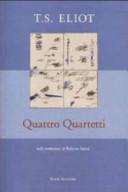
Thomas Stearns Eliot libro Quattro quartetti
da Burnt Norton
Quattro quartetti
Origine: Citato in Casoli, p. 634.
Thomas Stearns Eliot è stato un poeta, saggista, critico letterario e drammaturgo statunitense naturalizzato britannico.
Premiato nel 1948 con il Nobel per la letteratura, è stato autore di diversi poemi, alcuni dei quali destinati al teatro: Il canto d'amore di J. Alfred Prufrock, La terra desolata, Gli uomini vuoti, Ash Wednesday, Quattro quartetti, Assassinio nella cattedrale e The Cocktail Party. È stato autore inoltre del saggio Tradition and the Individual Talent.
Eliot si trasferì dagli Stati Uniti d'America nel Regno Unito nel 1914 e nel 1927 divenne suddito britannico.

“Il genere umano | Non può sopportare troppa realtà.”
Thomas Stearns Eliot libro Quattro quartetti
da Burnt Norton
Quattro quartetti
Origine: Citato in Casoli, p. 634.
Origine: Tentatore: da Assassinio nella cattedrale, prima parte, p. 45.
Thomas Stearns Eliot libro Quattro quartetti
Quattro quartetti
Origine: Citato nel film Una canzone per Bobby Long (2004): «Userò le gloriose parole di Thomas Eliot: "Noi non cesseremo l'esplorazione, e la fine di tutto il nostro esplorare sarà giungere laddove noi siamo partiti e conoscere quel posto per la prima volta."»
Thomas Stearns Eliot libro Quattro quartetti
2004, p. 159 http://books.google.it/books?id=EaMzmV9r9fMC&pg=PA159 <br class="br">Quattro quartetti
Cori da «La Rocca»
Mercoledì delle Ceneri
“In un minuto c'è il tempo per decisioni e scelte che il minuto successivo rovescerà.”
Thomas Stearns Eliot Il canto d'amore di J. Alfred Prufrock
Il canto d'amore di J. Alfred Prufrock
“Il grande poeta, nello scrivere se stesso, scrive il suo tempo.”
Origine: Da Shakespeare e lo stoicismo di Seneca.
“Ho misurato la mia vita a cucchiaini di caffè.”
Thomas Stearns Eliot Il canto d'amore di J. Alfred Prufrock
Il canto d'amore di J. Alfred Prufrock
Incipit di alcune opere, La Terra Desolata, Roberto Sanesi
“Il fiume è dentro di noi, il mare tutto intorno a noi.”
Thomas Stearns Eliot libro Quattro quartetti
Quattro quartetti
Mercoledì delle Ceneri
“Datta, dayadhvam, damyata
(Give, sympathize, control)”
The Waste Land and Other Poems
“Avrei potuto essere un paio di ruvidi artigli | Che corrono sul fondo di mari silenziosi.”
Thomas Stearns Eliot Il canto d'amore di J. Alfred Prufrock
I should have been a pair of raggled claws | Scuttling across floors of silent seas.
Il canto d'amore di J. Alfred Prufrock
Mario Praz
Incipit di alcune opere, Citazioni sull'opera
Tradizione e talento individuale
“L'arte non progredisce mai, ma […] il materiale dell'arte non è mai affatto lo stesso.”
Tradizione e talento individuale
“È la Chiesa che ha abbandonato l'umanità, o è l'umanità che ha abbandonato la Chiesa?”
Origine: Cori da «La Rocca», VII
“I poeti immaturi imitano; i maturi rubano.”
Origine: Questa citazione potrebbe derivare da una frase precedente di William Henry Davenport Adams (1892): «I grandi poeti imitano e migliorano, mentre quelli piccoli rubano e si rovinano.» Nel 1959 comparve per la prima volta una frase simile in cui si faceva riferimento agli artisti e non ai poeti nello specifico: «Gli artisti immaturi prendono in prestito; gli artisti maturi rubano.» Versioni leggermente diverse di questa citazione sono state in seguito attribuite a Picasso (1988), Stravinskij (1967) e Faulkner (1974).
Origine: Da The Sacred Wood: Essays on Poetry and Criticism (1920) in Saggi elisabettiani, traduzione di Alfredo Obertello, Bompiani, 1947.
Origine: Da Shakespeare e lo stoicismo di Seneca.
Origine: Da Il bosco sacro, traduzione di Luciano Anceschi, Muggiani, 1946.
“Prega per noi ora e nell'ora della nostra nascita.”
Origine: Da Animula. Citato in Casoli, p. 620.
Origine: Citato in Reginaldo M. Pizzorni, Diritto, etica e religione: il fondamento metafisico del diritto secondo Tomaso d'Acquino, Edizioni Studio Domenicano, 2006, p. 427.
Mercoledì delle Ceneri
Origine: Da L'uso della poesia e l'uso della critica, 1933, Introduzione (4 settembre 1932) http://www.kore.it/CAFFE/poesia/eliot.pdf, p. 1.
“Only those who will risk going too far can possibly find out how far one can go.”
Preface to Transit of Venus: Poems by Harry Crosby (1931)
“Where is the wisdom we have lost in knowledge?
Where is the knowledge we have lost in infomation?”
Choruses from The Rock (1934)
Variante: Where is the Life we have lost in living?
Where is the wisdom we have lost in knowledge?
Where is the knowledge we have lost in information?
Contesto: O perpetual revolution of configured stars,
O perpetual recurrence of determined seasons,
O world of spring and autumn, birth and dying!
The endless cycle of idea and action,
Endless invention, endless experiment,
Brings knowledge of motion, but not of stillness;
Knowledge of speech, but not of silence;
Knowledge of words, and ignorance of The Word.
All our knowledge brings us nearer to our ignorance,
All our ignorance brings us nearer to death,
But nearness to death no nearer to God.
Where is the Life we have lost in living?
Where is the wisdom we have lost in knowledge?
Where is the knowledge we have lost in information?
The cycles of Heaven in twenty centuries
Brings us farther from God and nearer to the Dust.
T.S. Eliot libro The Hollow Men
Variante: Between the desire
And the spasm
Between the potency
And the existence
Between the essence
And the descent
Falls the Shadow
Origine: The Hollow Men (1925)
“For last year's words belong to last year's language
And next year's words await another voice.”
T.S. Eliot libro Quattro quartetti
Variante: For last year's words belong to last year's language
And next year's words await another voice.
And to make an end is to make a beginning."
()
Origine: Four Quartets
T.S. Eliot libro Tradition and the Individual Talent
Tradition and the Individual Talent (1919)
T.S. Eliot libro The Hollow Men
The Hollow Men (1925)
Origine: The Use of Poetry and the Use of Criticism
T.S. Eliot Il canto d'amore di J. Alfred Prufrock
The Love Song of J. Alfred Prufrock (1915)
Contesto: Do I dare
Disturb the universe?
In a minute there is time
For decisions and revisions which a minute will reverse.
For I have known them all already, known them all: —
Have known the evenings, mornings, afternoons,
I have measured out my life with coffee spoons;
I know the voices dying with a dying fall
Beneath the music from a farther room.
“Unreal friendship may turn to real
But real friendship, once ended, cannot be mended”
T.S. Eliot Murder in the Cathedral
Origine: Murder in the Cathedral
“Speech without word and
Word of no speech
Grace to the Mother
For the Garden
Where all love ends.”
Ash-Wednesday (1930)
Contesto: Lady of silences
Calm and distressed
Torn and most whole
Rose of memory
Rose of forgetfulness
Exhausted and life-giving
Worried reposeful
The single Rose
Is now the Garden
Where all loves end
Terminate torment
Of love unsatisfied
The greater torment
Of love satisfied
End of the endless
Journey to no end
Conclusion of all that
Is inconclusible
Speech without word and
Word of no speech
Grace to the Mother
For the Garden
Where all love ends.
T.S. Eliot libro Tradition and the Individual Talent
Tradition and the Individual Talent (1919)
Contesto: The historical sense involves a perception, not only of the pastness of the past, but of its presence; the historical sense compels a man to write not merely with his own generation in his bones, but with a feeling that the whole of the literature of Europe from Homer and within it the whole of the literature of his own country has a simultaneous existence and composes a simultaneous order. This historical sense, which is a sense of the timeless as well as of the temporal and of the timeless and of the temporal together, is what makes a writer traditional. And it is at the same time what makes a writer most acutely conscious of his place in time, of his contemporaneity.
T.S. Eliot libro Tradition and the Individual Talent
Tradition and the Individual Talent (1919)
Contesto: What happens when a new work of art is created, is something that happens simultaneously to all the works of art which preceded it. The existing monuments form an ideal order among themselves, which is modified by the introduction of the new (the really new) work of art among them. The existing order is complete before the new work arrives; for order to persist after the supervention of novelty, the whole existing order must be, if ever so slightly, altered; and so the relations, proportions, values of each work of art toward the whole are readjusted; and this is conformity between the old and the new.
T.S. Eliot The Cocktail Party
Origine: The Cocktail Party
T.S. Eliot libro Tradition and the Individual Talent
Tradition and the Individual Talent (1919)
Origine: Selected Essays
T.S. Eliot The Family Reunion
Origine: The Family Reunion
T.S. Eliot libro Tradition and the Individual Talent
Tradition and the Individual Talent (1919)
Contesto: The bad poet is usually unconscious where he ought to be conscious, and conscious where he ought to be unconscious. Both errors tend to make him "personal." Poetry is not a turning loose of emotion, but an escape from emotion; it is not the expression of personality, but an escape from personality. But, of course, only those who have personality and emotions know what it means to want to escape from these things.
T.S. Eliot libro The Waste Land
Origine: The Waste Land (1922), Line 359 et seq.
Eliot's note: Stimulated by Shackleton's Antarctic expedition where the explorers at the extremity of their strength believed there was another who walked with them across South Georgia!
T.S. Eliot libro Old Possum's Book of Practical Cats
The Ad-dressing of Cats
Old Possum's Book of Practical Cats (1939)
Choruses from The Rock (1934)


