“Perdona i tuoi nemici, ma non dimenticarti mai i loro nomi.”
Origine: Citato in Gino e Michele, Matteo Molinari, Le Formiche: anno terzo, Zelig Editore, 1995, § 1953.
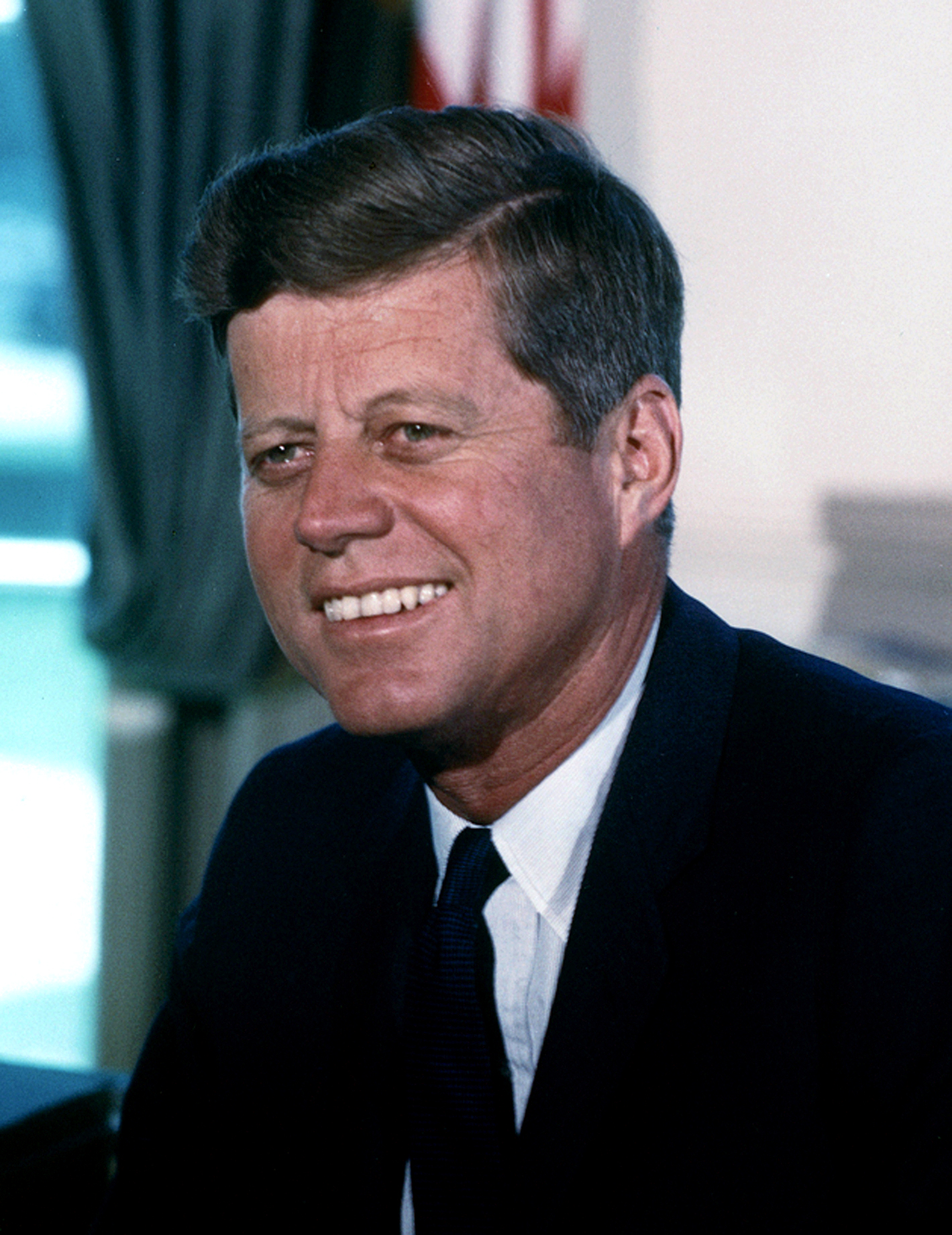
John Fitzgerald Kennedy, comunemente chiamato John F. Kennedy, John Kennedy o solo JFK, , è stato un politico statunitense e il 35º presidente degli Stati Uniti d'America.
Candidato del Partito Democratico, vinse le elezioni presidenziali del 1960 diventando il 35º presidente degli Stati Uniti d'America, carica che ha mantenuto dal 20 gennaio 1961 fino al suo assassinio nel 1963, quando gli subentrò il vicepresidente Lyndon B. Johnson.
Kennedy, di origine irlandese, noto anche con il diminutivo "Jack", è stato il primo presidente degli Stati Uniti d'America di religione cattolica. Fu anche il primo presidente statunitense a essere nato nel XX secolo e il più giovane a morire ricoprendo la carica . La sua breve presidenza, in epoca di guerra fredda, fu segnata da alcuni eventi molto rilevanti: la crisi di Berlino del 1961 con la costruzione del Muro, la corsa alla Luna, la conquista dello spazio, lo sbarco nella baia dei Porci, la crisi dei missili di Cuba, gli antefatti della guerra del Vietnam e l'affermarsi del movimento per i diritti civili degli afroamericani.
Kennedy fu assassinato il 22 novembre 1963 a Dallas, in Texas. Lee Harvey Oswald fu accusato dell'omicidio e fu a sua volta ucciso, due giorni dopo, da Jack Ruby, prima che potesse essere processato. La Commissione Warren concluse che Oswald aveva agito da solo; tuttavia nel 1979 la United States House Select Committee on Assassinations dichiarò che l'atto di Oswald era stato probabilmente frutto di una cospirazione. La questione se Oswald avesse o meno agito da solo rimane dibattuta, con l'esistenza di numerose teorie cospirazioniste. L'assassinio di Kennedy fu un evento focale nella storia degli Stati Uniti per l'impatto che ebbe sulla nazione e sulla politica del Paese. La figura di Kennedy continua tuttora a ricevere stima e apprezzamento.
“Perdona i tuoi nemici, ma non dimenticarti mai i loro nomi.”
Origine: Citato in Gino e Michele, Matteo Molinari, Le Formiche: anno terzo, Zelig Editore, 1995, § 1953.
“Non chiedete cosa possa fare il paese per voi: chiedete cosa potete fare voi per il paese.”
dal discorso inaugurale del proprio mandato, 20 gennaio 1961
dal discorso http://www.jfklibrary.org/Research/Ready-Reference/JFK-Speeches/Commencement-Address-at-American-University-June-10-1963.aspx alla American University, 10 giugno 1963
dal discorso http://www.jfklibrary.org/Research/Ready-Reference/JFK-Speeches/The-President-and-the-Press-Address-before-the-American-Newspaper-Publishers-Association.aspx presso l'Hotel Waldorf-Astoria di New York, 27 aprile 1961
19 maggio 1962; citato in Marilyn, p. 369
“La vittoria ha moltissimi padri, la sconfitta è orfana.”
Origine: Citato in Dizionario mondiale di Storia, Rizzoli Larousse, Milano, 2003, p. 656. ISBN 88-525-0077-4
dal discorso alla Rice University, 12 settembre 1962
“La guerra non ci si propone più come un'alternativa razionale.”
dal messaggio all'ONU del 25 settembre 1961
citato in Arthur Schlesinger Jr., I mille giorni di John F. Kennedy, p. 101
“Mio padre [Joseph P. Kennedy] mi ha detto che tutti gli uomini di affari sono figli di puttana.”
citato in Edward Klein, La maledizione dei Kennedy, p. 64
Origine: Citato in Giovanni Sabbatucci e Vittorio Vidotto, <nowiki></nowiki>Il mondo contemporaneo. Dal 1848 a oggi<nowiki></nowiki>, Editori Laterza, Roma, 2008, <nowiki>ISBN 978-88-420-8741-0</nowiki>, pag. 542
dal discorso http://www.jfklibrary.org/Research/Ready-Reference/JFK-Speeches/Remarks-at-the-Rudolph-Wilde-Platz-June-26-1963.aspx a Berlino Ovest, 26 giugno 1963
“Il conformismo è il carceriere della libertà e il nemico dello sviluppo.”
dal messaggio all'ONU http://www.jfklibrary.org/Research/Ready-Reference/JFK-Speeches/Address-Before-the-General-Assembly-of-the-United-Nations-September-25-1961.aspx del 25 settembre 1961
“Io sono un idealista senza illusioni.”
Origine: Citato in Enzo Biagi, Buoni cattivi: esiste ancora una morale valida per tutti?, BUR, Milano, 1991, p. 15. ISBN 88-17-11549-5
“L'umanità deve porre fine alla guerra, o la guerra porrà fine all'umanità.”
dal messaggio all'ONU del 25 settembre 1961
“L'uomo è ancora il più straordinario dei computer.”
da un discorso del 21 maggio 1963
citato in Guida completa a Frank Sinatra
dalla tesi di laurea di Kennedy, pubblicata come saggio dal titolo Why England Slept nel 1940; citato in Arthur Schlesinger Jr., I mille giorni di John F. Kennedy, p. 105
dal diario tenuto durante il suo soggiorno in Europa nel 1938, citato in Arthur Schlesinger Jr., I mille giorni di John F. Kennedy, p. 102
“Non voglio la capote sulla macchina, tutte la texane devono vedere che bella ragazza è Jackie.”
Origine: Detto al suo collaboratore più stretto, Kenneth O'Donnell, a proposito della sua visita alla città texana di Dallas, che avrebbe avuto luogo di lì a due giorni. Citato in Edward Klein, La maledizione dei Kennedy, p. 183.
“Le migliori manovre strategiche avvengono sempre per caso.”
citato in Arthur Schlesinger Jr., I mille giorni di John F. Kennedy, p. 93
Citato in Edward Klein, La maledizione dei Kennedy, p. 31
“Cuba non deve essere abbandonata ai comunisti.”
citato in AA.VV., Il libro della storia, traduzione di Roberto Sorgo, Gribaudo, 2018, p. 315. ISBN 9788858016572
Origine: John F. Kennedy 1917-63: Chronology-documents-bibliographical aids
“Children are the world's most valuable resource and its best hope for the future.”
Re: United States Committee for UNICEF (25 July 1963); Box 11, President's Outgoing Executive Correspondence Series, White House Central Chronological File, Presidential Papers, Papers of John F. Kennedy http://www.jfklibrary.org/Research/Research-Aids/Ready-Reference/JFK-Quotations.aspx <br class="br">1963
1963, Speech at Amherst College
Contesto: If art is to nourish the roots of our culture, society must set the artist free to follow his vision wherever it takes him. We must never forget that art is not a form of propaganda; it is a form of truth.
Contesto: If art is to nourish the roots of our culture, society must set the artist free to follow his vision wherever it takes him. We must never forget that art is not a form of propaganda; it is a form of truth. And as Mr. MacLeish once remarked of poets, there is nothing worse for our trade than to be in style. In free society art is not a weapon and it does not belong to the spheres of polemic and ideology. Artists are not engineers of the soul. It may be different elsewhere. But democratic society — in it, the highest duty of the writer, the composer, the artist is to remain true to himself and to let the chips fall where they may. In serving his vision of the truth, the artist best serves his nation. And the nation which disdains the mission of art invites the fate of Robert Frost's hired man, the fate of having "nothing to look backward to with pride, and nothing to look forward to with hope."
John F. Kennedy: "Remarks on the 20th Anniversary of the Voice of America" (26 February 1962) http://www.presidency.ucsb.edu/ws/index.php?pid=9075&st=&st1=<!-- Online by Gerhard Peters and John T. Woolley, The American Presidency Project --> <br class="br">1962 <br class="br">Contesto: We welcome the views of others. We seek a free flow of information across national boundaries and oceans, across iron curtains and stone walls. We are not afraid to entrust the American people with unpleasant facts, foreign ideas, alien philosophies, and competitive values. For a nation that is afraid to let its people judge the truth and falsehood in an open market is a nation that is afraid of its people.
John F. Kennedy libro Profiles in Courage
1963, American University speech
Variante: For in the final analysis, our most basic common link, is that we all inhabit this small planet, we all breathe the same air, we all cherish our children's futures, and we are all mortal.
Origine: Profiles in Courage
Contesto: In short, both the United States and its allies, and the Soviet Union and its allies, have a mutually deep interest in a just and genuine peace and in halting the arms race. Agreements to this end are in the interests of the Soviet Union as well as ours — and even the most hostile nations can be relied upon to accept and keep those treaty obligations, and only those treaty obligations, which are in their own interest. So, let us not be blind to our differences — but let us also direct attention to our common interests and to the means by which those differences can be resolved. And if we cannot end now our differences, at least we can help make the world safe for diversity. For, in the final analysis, our most basic common link is that we all inhabit this small planet. We all breathe the same air. We all cherish our children's future. And we are all mortal.
Remarks at Amherst College (26 October 1963) http://millercenter.org/president/speeches/speech-3379 <br class="br">1963, Speech at Amherst College
1963, Address in the Assembly Hall at the Paulskirche in Frankfurt
Variante: Change is the law of life. And those who look only to the past or the present are certain to miss the future.
Documents on International Affairs, 1963, Royal Institute of International Affairs, ed. Sir John Wheeler Wheeler-Bennett, p. 36.
1962, Address at Independence Hall
Pierre Salinger, With Kennedy (1966), Chapter 1: Lancer to Wayside, page 1 http://books.google.de/books?id=vx45mXCc4JoC&pg=PA1&lpg=PA1&dq=If+anyone+is+crazy+enough+to+want+to+kill+a+president+of+the+United+States,+he+can+do+it.+All+he+must+be+prepared+to+do+is+give+his+life+for+the+president%E2%80%99s.&source=bl&ots=Bom2TtsfyN&sig=WyeTm82PlS5xBDf7-sIY6xehqbo&hl=de&sa=X&ei=OewXUqv8JJSihgf07IHICA&ved=0CDAQ6AEwADgU#v=onepage&q=If%20anyone%20is%20crazy%20enough%20to%20want%20to%20kill%20a%20president%20of%20the%20United%20States%2C%20he%20can%20do%20it.%20All%20he%20must%20be%20prepared%20to%20do%20is%20give%20his%20life%20for%20the%20president%E2%80%99s.&f=false <br class="br">Attributed
1962, Second Letter to Nikita Khrushchev
"Special message to Congress: Program for Economic Recovery and Growth (17)", (2 February 1961) http://www.jfklibrary.org/Research/Research-Aids/Ready-Reference/JFK-Quotations.aspx <br class="br">1961
1963, Address in the Assembly Hall at the Paulskirche in Frankfurt
1963, Address in the Assembly Hall at the Paulskirche in Frankfurt
Remarks at the Unidad Independencia Housing Project, City of Mexico (269)" (30 June 1962) http://www.jfklibrary.org/Research/Research-Aids/Ready-Reference/JFK-Quotations.aspx <br class="br">1962
1960, Sport at the New Frontier: The Soft American
Quoted in A Thousand Days: John F. Kennedy in the White House, Arthur Schlesinger (Boston: Houghton Mifflin Company, 1965), page 1017. http://www.jfklibrary.org/Research/Research-Aids/Ready-Reference/JFK-Quotations.aspx According to a footnote in Schlesinger's manuscript (1st draft, page 1378), this was stated on February 13, 1961. <br class="br">Attributed
1962, Second Letter to Nikita Khrushchev
Radio and television report to the American people on civil rights (11 June 1963)]
1963, Civil Rights Address
1963, Speech at Amherst College
Contesto: The men who create power make an indispensable contribution to the Nation's greatness, but the men who question power make a contribution just as indispensable, especially when that questioning is disinterested, for they determine whether we use power or power uses us.
Origine: 1962, Cuban Missile Crisis speech


