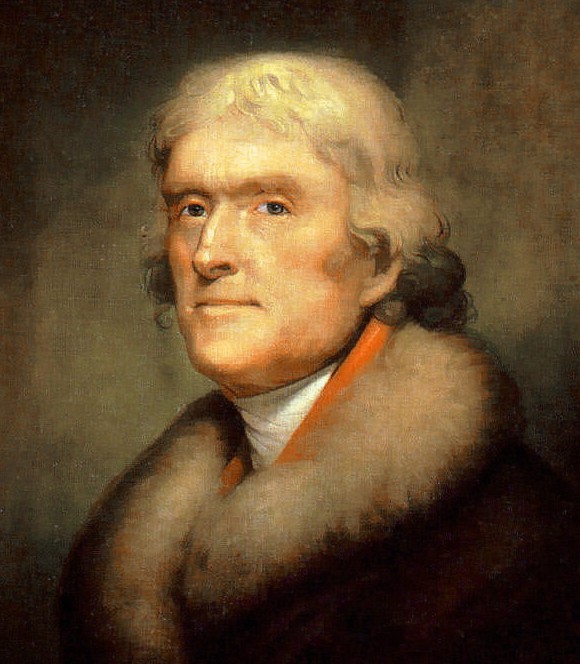
Thomas Jefferson frasi celebri
Origine: Citato in Dizionario mondiale di Storia, Rizzoli Larousse, Milano, 2003, p. 649. ISBN 88-525-0077-4
da una lettera a John Taylor http://www.britannica.com/presidents/article-9116907, 28 maggio 1816
Thomas Jefferson Frasi e Citazioni
Origine: Citato in Summary View of the Rights of British America (1774); The Writings of Thomas Jefferson (19 Vols., 1905) edito da Andrew A. Lipscomb e Albert Ellery Bergh, Vol. 1, p. 211.
“Attribuire ad ognuno la direzione di ciò che il suo occhio riesce a sorvegliare.”
dalla lettera a Joseph C. Cabell, 2 febbraio 1816; in Antologia degli scritti politici, p. 109
Origine: Questo precetto è considerato l'anticipazione del principio di sussidiarietà adottato dall'Unione Europea a partire dal Trattato di Maastricht del 1992.
Origine: Citato in Michael J. Gelb, Il genio che c'è in te.
da una lettera a William Stevens Smith, 13 novembre 1787; citato in Adriano Sofri, Tiranno: quando si mette a morte il despota, la Repubblica, 7 novembre 2006, p. 53
citato in un articolo di Curzio Maltese, la Repubblica, 25 giugno 2007
Origine: Citato in Maurice Denuzière, Louisiana, traduzione di Augusto Donaudy, Rizzoli, Milano, 1980.
dalla lettera a Isaac Mc Pherson del 13 agosto 1813
Thomas Jefferson: Frasi in inglese
Letter to Lieutenant Governor Levi Lincoln of Massachusetts (November 13, 1808) concerning a petition from the island of Nantucket for food during the American embargo.
1800s, Second Presidential Administration (1805-1809)
Letter to colonel Randolph as quoted in The Dark Side of Thomas Jefferson http://www.smithsonianmag.com/history/the-dark-side-of-thomas-jefferson-35976004/, by Henry Wiencek, Smithsonian Magazine, (October 2012) <br class="br">Attributed
Letter to Colonel Edward Carrington, Paris, (16 January 1787)
1780s
“Botany is the school for patience, and it’s amateurs learn resignation from daily disappointments.”
Thomas Jefferson, in letter to Madame de Tessé (25 Apr 1788). In Thomas Jefferson Correspondence: Printed from the Originals (1916), 7.
Posthumous publications, On botany
Letter to John W. Eppes (28 May 1807) https://founders.archives.gov/documents/Jefferson/99-01-02-5646 <br class="br">1800s, Second Presidential Administration (1805-1809)
. <br class="br">Letter to George Logan (12 November 1816). Published in The Works of Thomas Jefferson in Twelve Volumes http://oll.libertyfund.org/ToC/0054.php, Federal Edition, Paul Leicester Ford, ed., New York: G. P. Putnam's Sons, 1904, Vol. 12 http://oll.libertyfund.org/Texts/Jefferson0136/Works/0054-12_Bk.pdf, pp. 43 <br class="br">1810s
Letter to John Adams http://www.masshist.org/database/transcription.cfm?transcriptDir=masshist&transcript=L5058.xml&queryID=1797 (13 November 1818) regarding the death of Abigail Adams <br class="br">1810s
Letter from the commissioners (John Adams, Thomas Jefferson) to John Jay, 28 March 1786, in Thomas Jefferson Travels: Selected Writings, 1784-1789, by Anthony Brandt, pp. 104-105 http://books.google.com/books?id=SY_3VKP0SEkC&pg=PA104&dq=%22Ambassador+Answered%22 <br class="br">1780s <br class="br">Contesto: We took the liberty to make some enquiries concerning the ground of their pretensions to make war upon nations who had done them no injury, and observed that we considered all mankind as our friends who had done us no wrong, nor had given us any provocation. The Ambassador [of Tripoli] answered us that it was founded on the Laws of their Prophet, that it was written in their Koran, that all nations who should not have acknowledged their authority were sinners, that it was their right and duty to make war upon them wherever they could be found, and to make slaves of all they could take as Prisoners, and that every Musselman who should be slain in battle was sure to go to Paradise.
Letter to Thomas Law (13 June 1814)
1810s
Letter to John Wyche (19 May 1809)
1800s, Post-Presidency (1809)
ME 13:364
1810s, Letters to John Wayles Eppes (1813)
1820s, Letter to A. Coray (1823)
Referring to the Virginia Act for Religious Freedom, in his Autobiography (1821)
1820s
Letter to William Hunter (11 March 1790)
1790s
control <br class="br">In a letter to James Dinsmore as quoted in The Dark Side of Thomas Jefferson http://www.smithsonianmag.com/history/the-dark-side-of-thomas-jefferson-35976004/, by Henry Wiencek, Smithsonian Magazine, (October 2012) <br class="br">Attributed
Louisiana Treaty of Cession, Art. III (30 April 1803)
1800s, First Presidential Administration (1801–1805)
Letter to William Charles Jarvis (28 September 1820)
1820s
Letter to Thomas Cooper (3 November 1822), published in The Works of Thomas Jefferson in Twelve Volumes http://oll.libertyfund.org/ToC/0054.php, Federal Edition, Paul Leicester Ford, ed., New York: G. P. Putnam's Sons, 1904, Vol. 12 http://oll.libertyfund.org/Texts/Jefferson0136/Works/0054-12_Bk.pdf, p. 272 <br class="br">1820s
Vol. 1 Whether Christianity is Part of the Common Law (1764) Broken link http://oll.libertyfund.org/Texts/Jefferson0136/Works/0054-01_Bk.pdf. Published in The Works of Thomas Jefferson in Twelve Volumes http://oll.libertyfund.org/ToC/0054.php, Federal Edition, Paul Leicester Ford, ed., New York: G. P. Putnam's Sons, 1904, p. 459 <br class="br">1760s
ME 13:423
1810s, Letters to John Wayles Eppes (1813)
The earliest known appearance of this statement is from 1895 (Joshua Douglass, "Bimetallism and Currency", American Magazine of Civics, 7:256). It is apparently a combination of paraphrases or approximate quotations from three separate letters of Jefferson (longer excerpts in sourced section):
I sincerely believe, with you, that banking institutions are more dangerous than standing armies...
Letter to John Taylor (1816)
The bank mania...is raising up a moneyed aristocracy in our country which has already set the government at defiance...
Letter to Josephus B. Stuart (1817)
Bank paper must be suppressed, and the circulating medium must be restored to the nation to whom it belongs.
Letter to John W. Eppes (1813)
Misattributed
“When public opinion changes, it is with the rapidity of thought.”
Letter to Colonel Charles Yancey http://oll.libertyfund.org/?option=com_staticxt&staticfile=show.php%3Ftitle=807&chapter=88152&layout=html&Itemid=27 (6 January 1816) ME 14:384 <br class="br">1810s
Letter to Albert Gallatin, 1802. ME 10:323
Posthumous publications, On financial matters
“…the more a subject is understood, the more briefly it may be explained.”
1810s, Letter to Joseph Milligan (6 April 1816)
Letter to Roger C. Weightman, on the decision for Independence made in 1776, often quoted as if in reference solely to the document the Declaration of Independence (24 June 1826)
1820s
Letter to Edward Coles (25 August 1814)
1810s
The Anas (February 1, 1800). Published in The Works of Thomas Jefferson in Twelve Volumes http://oll.libertyfund.org/ToC/0054.php, Federal Edition, Paul Leicester Ford, ed., New York: G. P. Putnam's Sons, 1904, Vol. 1 http://oll.libertyfund.org/Texts/Jefferson0136/Works/0054-01_Bk.pdf, pp. 352–353 <br class="br">1800s
Article No. 20 https://books.google.com/books?id=WbFznb7PSGsC&printsec=frontcover&source=gbs_ge_summary_r&cad=0#v=onepage&q&f=false <br class="br">1770s, Declaration of Independence (1776), Earlier drafts
“There can be no safer deposit on earth than the Treasury of the United States.”
Letter to Gilbert du Motier, marquis de Lafayette (1825) ME 19:281
Posthumous publications, On financial matters


