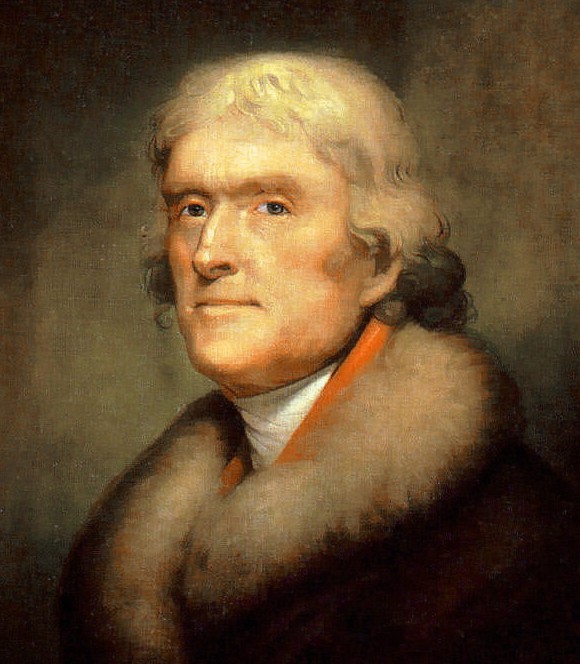
Thomas Jefferson frasi celebri
Origine: Citato in Dizionario mondiale di Storia, Rizzoli Larousse, Milano, 2003, p. 649. ISBN 88-525-0077-4
da una lettera a John Taylor http://www.britannica.com/presidents/article-9116907, 28 maggio 1816
Thomas Jefferson Frasi e Citazioni
Origine: Citato in Summary View of the Rights of British America (1774); The Writings of Thomas Jefferson (19 Vols., 1905) edito da Andrew A. Lipscomb e Albert Ellery Bergh, Vol. 1, p. 211.
“Attribuire ad ognuno la direzione di ciò che il suo occhio riesce a sorvegliare.”
dalla lettera a Joseph C. Cabell, 2 febbraio 1816; in Antologia degli scritti politici, p. 109
Origine: Questo precetto è considerato l'anticipazione del principio di sussidiarietà adottato dall'Unione Europea a partire dal Trattato di Maastricht del 1992.
Origine: Citato in Michael J. Gelb, Il genio che c'è in te.
da una lettera a William Stevens Smith, 13 novembre 1787; citato in Adriano Sofri, Tiranno: quando si mette a morte il despota, la Repubblica, 7 novembre 2006, p. 53
citato in un articolo di Curzio Maltese, la Repubblica, 25 giugno 2007
Origine: Citato in Maurice Denuzière, Louisiana, traduzione di Augusto Donaudy, Rizzoli, Milano, 1980.
dalla lettera a Isaac Mc Pherson del 13 agosto 1813
Thomas Jefferson: Frasi in inglese
Letter to Albert Gallatin, 1803. http://www.yamaguchy.netfirms.com/7897401/jefferson/gallatin.html ME 10:439 <br class="br">Posthumous publications, On financial matters
Letter to James Monroe, 1815. ME 14:228
Posthumous publications, On financial matters
Letter to Samuel Kercheval (1816)
1810s
Variante: Lay down true principles and adhere to them inflexibly. Do not be frightened into their surrender by the alarms of the timid, or the croakings of wealth against the ascendency of the people.
“Were we directed from Washington when to sow and when to reap, we should soon want bread.”
Autobiography (1821), reprinted in Basic Writings of Thomas Jefferson, ed. Philip S. Foner, New York: Wiley Book Company (1944} p. 464
1820s
“Yet the hour of emancipation is advancing, in the march of time. It will come.”
1810s, Letter to Edward Coles (1814)
This is a misquotation of a prayer from the 1928 Book of Common Prayer (ministry should be industry and arrogance should be arrogancy). This was a revision from an earlier edition. The original form, written by George Lyman Locke, appeared in the 1885 edition. In 1994 William J. Federer attributed it to Jefferson in America's God and Country: Encyclopedia of Quotations, pp. 327-8. See the Thomas Jefferson Encyclopedia http://www.monticello.org/site/research-and-collections/national-prayer-peace. <br class="br">Misattributed
1820s, Letter to A. Coray (1823)
Not found in any of Thomas Jefferson's writings. This may be a conflation of Jefferson's "chains of the Constitution" comment with Ayn Rand's statement in her essay, Man's Rights: "There are two potential violators of man’s rights: the criminals and the government. The great achievement of the United States was to draw a distinction between these two — by forbidding to the second the legalized version of the activities of the first." http://www.monticello.org/site/jefferson/two-enemies-people-are-criminals-and-governmentquotation <br class="br">Misattributed
“The earth belongs to the living, not to the dead.”
24 June 1813
1810s, Letters to John Wayles Eppes (1813)
Letter to John Randolph (1 December 1803), published in The Works of Thomas Jefferson in Twelve Volumes http://oll.libertyfund.org/ToC/0054.php, Federal Edition, Paul Leicester Ford, ed., New York: G. P. Putnam's Sons, 1904, Vol. 109 http://files.libertyfund.org/files/806/0054-10_Bk.pdf, pp. 54 <br class="br">1800s, First Presidential Administration (1801&ndash;1805)
Letter to John Adams (11 January 1817), published in The Works of Thomas Jefferson in Twelve Volumes http://oll.libertyfund.org/ToC/0054.php, Federal Edition, Paul Leicester Ford, ed., New York: G. P. Putnam's Sons, 1904, Vol. 12 http://oll.libertyfund.org/Texts/Jefferson0136/Works/0054-12_Bk.pdf, pp. 48–49 <br class="br">1810s
Thomas Jefferson's Seventh State of the Union Address (27 October 1807). Description of the negotiations and rejected treaty of James Monroe and William Pinkney with Britain over maritime rights, and subsequent negotiations over the British sinking of the American ship Chesapeake, leading to an American embargo (The Embargo Act).
1800s, Second Presidential Administration (1805-1809)
In letter to plantation manager, as quoted in The Dark Side of Thomas Jefferson http://www.smithsonianmag.com/history/the-dark-side-of-thomas-jefferson-35976004/, by Henry Wiencek, Smithsonian Magazine, (October 2012) <br class="br">Attributed
Letter to Isaac McPherson (13 August 1813)
1810s
“Delay is preferable to error.”
Letter to George Washington (16 May 1792)
1790s
As quoted in The Life and Writings of Thomas Jefferson : Including All of His Important Utterances on Public Questions (1900) by Samuel E. Forman, p. 429
Posthumous publications
Letter to Albert Gallatin, 1815. http://www.yamaguchy.netfirms.com/7897401/jefferson/gallatin1.html ME 14:356 <br class="br">Posthumous publications, On financial matters
Letter to Albert Gallatin, 1803. ME 10:437
Posthumous publications, On financial matters
ME 13:426
1810s, Letters to John Wayles Eppes (1813)
Jefferson's Farm Book as quoted in The Dark Side of Thomas Jefferson http://www.smithsonianmag.com/history/the-dark-side-of-thomas-jefferson-35976004/, by Henry Wiencek, Smithsonian Magazine, (October 2012) <br class="br">Attributed
Letter to Danbury Baptist Association, CT. (1 January 1802) This statement is the origin of the often used phrase "separation of Church and State".
1800s, First Presidential Administration (1801–1805)
Letter to John Adams (5 July 1814). Published in The Works of Thomas Jefferson in Twelve Volumes http://oll.libertyfund.org/ToC/0054.php, Federal Edition, Paul Leicester Ford, ed., New York: G. P. Putnam's Sons, 1904, Vol. 11 http://oll.libertyfund.org/Texts/Jefferson0136/Works/0054-11_Bk.pdf, pp. 397–398 <br class="br">1810s
Letter to William C. Rives (1819) ME 15:232
Posthumous publications, On financial matters
1810s, Letter to Albert Gallatin (16 June 1817)
Attributed to Jefferson by Daniel Webster in a letter of 15 June 1852 addressed to Professor Pease, recalling a Sunday spent with Jefferson more than a quarter of a century before.
Attributed
Letter http://books.google.com/books?vid=0Fz_zz_wSWAiVg9LI1&id=vvVVhCadyK4C&pg=PA192&vq=%22impeachment+is+an+impracticable+thing%22&dq=%22jeffersons+works%22 to Thomas Ritchie (25 December 1820) <br class="br">1820s
1800s, First Inaugural Address (1801)


