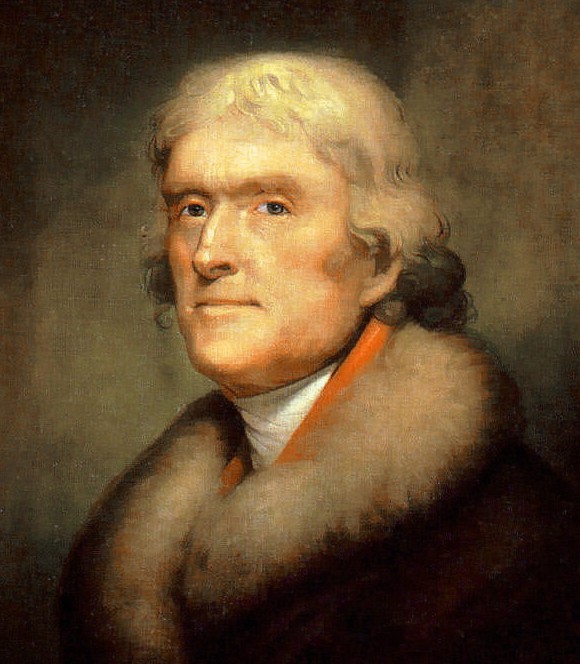
Thomas Jefferson frasi celebri
Origine: Citato in Dizionario mondiale di Storia, Rizzoli Larousse, Milano, 2003, p. 649. ISBN 88-525-0077-4
da una lettera a John Taylor http://www.britannica.com/presidents/article-9116907, 28 maggio 1816
Thomas Jefferson Frasi e Citazioni
Origine: Citato in Summary View of the Rights of British America (1774); The Writings of Thomas Jefferson (19 Vols., 1905) edito da Andrew A. Lipscomb e Albert Ellery Bergh, Vol. 1, p. 211.
“Attribuire ad ognuno la direzione di ciò che il suo occhio riesce a sorvegliare.”
dalla lettera a Joseph C. Cabell, 2 febbraio 1816; in Antologia degli scritti politici, p. 109
Origine: Questo precetto è considerato l'anticipazione del principio di sussidiarietà adottato dall'Unione Europea a partire dal Trattato di Maastricht del 1992.
Origine: Citato in Michael J. Gelb, Il genio che c'è in te.
da una lettera a William Stevens Smith, 13 novembre 1787; citato in Adriano Sofri, Tiranno: quando si mette a morte il despota, la Repubblica, 7 novembre 2006, p. 53
citato in un articolo di Curzio Maltese, la Repubblica, 25 giugno 2007
Origine: Citato in Maurice Denuzière, Louisiana, traduzione di Augusto Donaudy, Rizzoli, Milano, 1980.
dalla lettera a Isaac Mc Pherson del 13 agosto 1813
Thomas Jefferson: Frasi in inglese
Letter to Horatio G. Spafford (17 March 1814)
1810s
Declaration of the Causes and Necessity of Taking Up Arms (1775); Jefferson composed the first draft of this document, but the final work was done by John Dickinson, working with his original draft. Full text online http://www.nationalcenter.org/1775DeclarationofArms.html <br class="br">1770s
Letter to John Adams, 5 May 1817, in The Writings of Thomas Jefferson (Lipscomb-Bergh edition, 1903), Volume XV, p. 109
1810s
Letter to Marquis de la Fayette http://www.constitution.org/tj/jeff10.txt (November 4, 1823); in: The Writings of Thomas Jefferson, Memorial Edition (ME) (Lipscomb and Bergh, editors), 20 Vols., Washington, D.C., 1903-04, Volume 15, page 491 <br class="br">1820s
Letter to Benjamin Hawkins (13 August 1786) Lipscomb & Bergh ed. 5:390
1780s
I pray you therefore to accept my thanks for the many instances you have enabled me to observe of respectable intelligence in that race of men, which cannot fail to have effect in hastening the day of their relief; [...]. <br class="br"> Letter to Henri Grégoire http://memory.loc.gov/cgi-bin/query/r?ammem/mtj:@field(DOCID+@lit(tj110052)) (25 February 1809), as quoted in The Works of Thomas Jefferson in Twelve Volumes. Federal Edition. Collected and Edited by Paul Leicester Ford. Also quoted in The Science and Politics of Racial Research by William H. Tucker (1994), p. 11 <br class="br">1800s, Second Presidential Administration (1805-1809)
Statement during an early stage of the War of 1812, in a letter to William Duane (4 August 1812)
1810s
1770s, A Summary View of the Rights of British America (1774)
Letter to William Short http://www.monticello.org/site/jefferson/when-government-fears-people-there-libertyquotation (1825) <br class="br">1820s
Letter to John Taylor (26 November 1798), shortened in The Money Masters to "I wish it were possible to obtain a single amendment to our Constitution … taking from the federal government their power of borrowing".
Posthumous publications, On financial matters
Letter to Maria Jefferson Eppes (8 March 1809)
1800s, Post-Presidency (1809)
Autobiography (1821) in notes describing some of the debates of 1779 on slavery.
1820s
“One loves to possess arms, though they hope never to have occasion for them.”
Letter to George Washington (1796); published in The Writings of Thomas Jefferson, 20 Vols., Washington, D.C., (1903-04), 9:341
1790s
Special Message to Congress on the Burr Conspiracy, declaring his former Vice President an illegal conspirator and a fugitive from justice (22 January 1807)
1800s, Second Presidential Administration (1805-1809)
Letter to Larkin Smith (1809)
1800s, Post-Presidency (1809)
Letter http://www.stephenjaygould.org/ctrl/jefferson_adams.html to John Adams (11 April 1823) (Scan at The Library of Congress) http://memory.loc.gov/master/mss/mtj/mtj1/053/0800/0844.jpg <br class="br">1820s
Letter to José Correia da Serra (1814) ME 14:224
Posthumous publications, On financial matters
According to the Jefferson Library, this is among the many statements misattributed to Jefferson. http://wiki.monticello.org/mediawiki/index.php/Category:Spurious_Quotations <br class="br">Misattributed
Hints to Americans travelling in Europe, letter to John Rutledge, Jr. (June 19, 1788); in The Papers of Thomas Jefferson, ed. Julian P. Boyd (1956), vol. 13, p. 269
1780s
“Let the eye of vigilance never be closed.”
Letter to Spencer Roane (9 March 1821)
1820s
Letter to Josephus B. Stuart (May 10, 1817) ME 15:112; reported in The Writings of Thomas Jefferson, ed. Andrew A. Lipscomb (1904), vol. 15, p. 112
Posthumous publications, On financial matters
Letter to John Adams (12 September 1821)
1820s
ME http://www.yamaguchy.netfirms.com/7897401/jefferson/eppes2.html 13:431 <br class="br">1810s, Letters to John Wayles Eppes (1813)
Letter to James Madison (July 31, 1788); reported in Memoir, correspondence, and miscellanies from the papers of Thomas Jefferson, Volumes 1-2 (1829), p. 343
1780s
Letter to Dr. Maese, 1809. ME 12:231
1800s, Post-Presidency (1809)
“Paper is poverty,… it is only the ghost of money, and not money itself.”
Letter to Colonel Edward Carrington (27 May 1788) ME 7:36
1780s
On the Missouri Compromise, in a letter to John Holmes (22 April 1820), published in The Writings of Thomas Jefferson: 1816-1826 (1899) edited by Paul Leicester Ford, v. 10, p. 157; also quoted by Martin Luther King, Jr. in his Emancipation Proclamation Centennial Address http://www.nps.gov/anti/historyculture/mlk-ep.htm at the New York Civil War Centennial Commission’s Emancipation Proclamation Observance, New York City (12 September 1962) <br class="br">1820s
Letter to Thomas Cooper, 1814. ME 14:189
Posthumous publications, On financial matters
Letter to Abbe Salimankis (1810) ME 12:379 The Writings of Thomas Jefferson "Memorial Edition" (20 Vols., 1903-04) edited by Andrew A. Lipscomb and Albert Ellery Bergh, Vol. 12, p. 379; also quoted at "Thomas Jefferson on Politics & Government: Money & Banking" at University of Virginia http://etext.virginia.edu/jefferson/quotations/jeff1325.htm <br class="br">Posthumous publications, On financial matters


