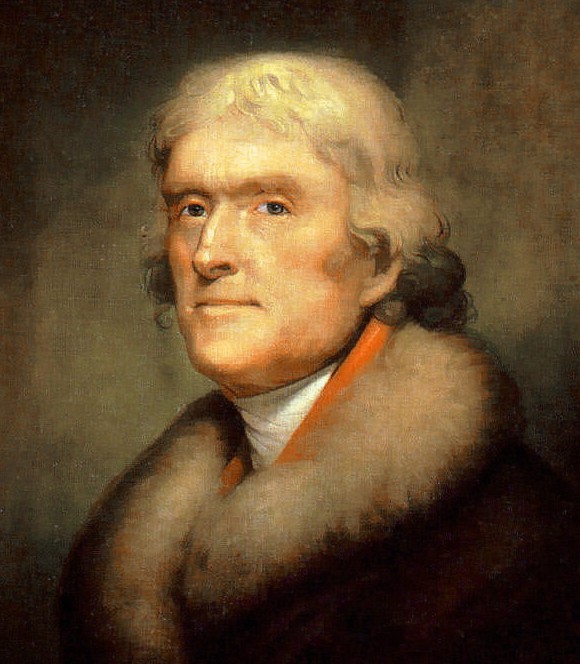
Thomas Jefferson frasi celebri
Origine: Citato in Dizionario mondiale di Storia, Rizzoli Larousse, Milano, 2003, p. 649. ISBN 88-525-0077-4
da una lettera a John Taylor http://www.britannica.com/presidents/article-9116907, 28 maggio 1816
Thomas Jefferson Frasi e Citazioni
Origine: Citato in Summary View of the Rights of British America (1774); The Writings of Thomas Jefferson (19 Vols., 1905) edito da Andrew A. Lipscomb e Albert Ellery Bergh, Vol. 1, p. 211.
“Attribuire ad ognuno la direzione di ciò che il suo occhio riesce a sorvegliare.”
dalla lettera a Joseph C. Cabell, 2 febbraio 1816; in Antologia degli scritti politici, p. 109
Origine: Questo precetto è considerato l'anticipazione del principio di sussidiarietà adottato dall'Unione Europea a partire dal Trattato di Maastricht del 1992.
Origine: Citato in Michael J. Gelb, Il genio che c'è in te.
da una lettera a William Stevens Smith, 13 novembre 1787; citato in Adriano Sofri, Tiranno: quando si mette a morte il despota, la Repubblica, 7 novembre 2006, p. 53
citato in un articolo di Curzio Maltese, la Repubblica, 25 giugno 2007
Origine: Citato in Maurice Denuzière, Louisiana, traduzione di Augusto Donaudy, Rizzoli, Milano, 1980.
dalla lettera a Isaac Mc Pherson del 13 agosto 1813
Thomas Jefferson: Frasi in inglese
See the Positive Atheism http://www.positiveatheism.org/hist/quotes/jeffphony.htm site on the extreme unlikelihood of this quote being authentic. It actually contains some known phrases of Jefferson's, but they are compounded with almost certainly false statements into a highly misrepresentative whole. Jefferson's own opinions on Jesus, God, Christianity and general opinions about them were far more complex than is indicated in this statement. <br class="br">Misattributed
Letter to M. L'Hommande, (1787), as quoted in The Jeffersonian Cyclopedia (1900), edited by John P. Foley, p. 500
1780s
ME 13:277
1810s, Letters to John Wayles Eppes (1813)
ME 13:431
1810s, Letters to John Wayles Eppes (1813)
1770s, A Summary View of the Rights of British America (1774)
“As pure a son of liberty as I have ever known.”
Statement about Tadeusz Kościuszko, in a letter to Horatio Gates (1798)
1790s
Letter http://etext.virginia.edu/jefferson/quotations/jeff1340.htm to James Madison (6 September 1789) ME 7:455, Papers 15:393 <br class="br">1780s
“There is not a sprig of grass that shoots uninteresting to me.”
Thomas Jefferson Letter (23 Dec 1790) to Martha Jefferson Randolph. Collected in B.L. Rayner (ed.), Sketches of the Life, Writings, and Opinions of Thomas Jefferson (1832), 192.
Posthumous publications, On botany
Thomas Jefferson, Letter (24 Mar 1824) to Mr. Woodward. Collected in The Writings of Thomas Jefferson: Correspondence (1854), 339.
Posthumous publications, On botany
Letter http://www.stephenjaygould.org/ctrl/jefferson_jadms.html to John Adams (15 August 1820) <br class="br">1820s
Thomas Jefferson's First State of the Union Address (8 December 1801)
1800s, First Presidential Administration (1801–1805)
Letter to Thomas Cooper, 1814. ME 14:61
Posthumous publications, On financial matters
Letter to Jean Baptiste de Ternant, 1791. ME 8:247
Posthumous publications, On financial matters
Letter to Benjamin Waterhouse (19 July 1822), published in The Works of Thomas Jefferson in Twelve Volumes http://oll.libertyfund.org/ToC/0054.php, Federal Edition, Paul Leicester Ford, ed., New York: G. P. Putnam's Sons, 1904, Vol. 12 http://oll.libertyfund.org/Texts/Jefferson0136/Works/0054-12_Bk.pdf, p. 244 <br class="br">1820s
“The good old Dominion, the blessed mother of us all.”
"Thoughts on Lotteries" (1826)
1820s
Letter to John Holmes (22 April 1820)
1820s
Letter to the Abbé Arnoux (19 July 1787) https://founders.archives.gov/documents/Jefferson/01-15-02-0275 <br class="br">1780s
Letter to Elias Shipman and others of New Haven (12 July 1801). Often misquoted as, "few die and none resign".
1800s, First Presidential Administration (1801–1805)
Thomas Jefferson's Eighth State of the Union Address (8 November 1808)
1800s, Second Presidential Administration (1805-1809)
Letter https://web.archive.org/web/19991115034104/http://odur.let.rug.nl/~usa/P/tj3/writings/brf/jefl64.htm to William Stephens Smith (13 November 1787), quoted in Padover's Jefferson On Democracy <br class="br">1780s
“If a law is unjust, a man is not only right to disobey it, he is obligated to do so.”
Not attributed to Jefferson until the 21st century. May be a loose paraphrasing of a passage from Declaration of Independence (1776): "But when a long train of abuses and usurpations, pursuing invariably the same Object evinces a design to reduce them under absolute Despotism, it is their right, it is their duty, to throw off such Government, and to provide new Guards for their future security."
Misattributed
Variante: When injustice becomes law, resistance becomes duty.
Memoirs, Correspondence and Private Papers of Thomas Jefferson (1829) edited by Thomas Jefferson Randolph, p. 70
Posthumous publications
Letter to Albert Gallatin, 1803. ME 10:437
Posthumous publications, On financial matters
“I believe… that every human mind feels pleasure in doing good to another.”
Letter to John Adams (1816)
1810s
1770s, A Summary View of the Rights of British America (1774)
First attributed to Jefferson in 1945, this does not appear in any known Jefferson document. When governments fear the people, there is liberty... http://wiki.monticello.org/mediawiki/index.php/When_governments_fear_the_people,_there_is_liberty...(Quotation), Thomas Jefferson Encyclopedia. It first appears in 1914, in [Barnhill, John Basil, John Basil Barnhill, Indictment of Socialism No. 3, Barnhill-Tichenor Debate on Socialism, http://debs.indstate.edu/b262b3_1914.pdf, PDF, 2008-10-16, 1914, National Rip-Saw Publishing, Saint Louis, Missouri, p. 34] <br class="br">Misattributed <br class="br">Variante: Where the people fear the government you have tyranny. Where the government fears the people you have liberty.
On slavery, in a letter to John Holmes (22 April 1820)
1820s


