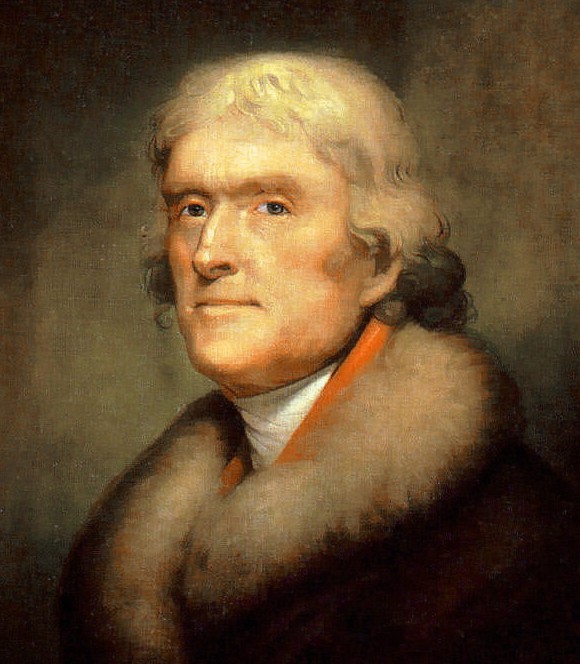
Thomas Jefferson frasi celebri
Origine: Citato in Dizionario mondiale di Storia, Rizzoli Larousse, Milano, 2003, p. 649. ISBN 88-525-0077-4
da una lettera a John Taylor http://www.britannica.com/presidents/article-9116907, 28 maggio 1816
Thomas Jefferson Frasi e Citazioni
Origine: Citato in Summary View of the Rights of British America (1774); The Writings of Thomas Jefferson (19 Vols., 1905) edito da Andrew A. Lipscomb e Albert Ellery Bergh, Vol. 1, p. 211.
“Attribuire ad ognuno la direzione di ciò che il suo occhio riesce a sorvegliare.”
dalla lettera a Joseph C. Cabell, 2 febbraio 1816; in Antologia degli scritti politici, p. 109
Origine: Questo precetto è considerato l'anticipazione del principio di sussidiarietà adottato dall'Unione Europea a partire dal Trattato di Maastricht del 1992.
Origine: Citato in Michael J. Gelb, Il genio che c'è in te.
da una lettera a William Stevens Smith, 13 novembre 1787; citato in Adriano Sofri, Tiranno: quando si mette a morte il despota, la Repubblica, 7 novembre 2006, p. 53
citato in un articolo di Curzio Maltese, la Repubblica, 25 giugno 2007
Origine: Citato in Maurice Denuzière, Louisiana, traduzione di Augusto Donaudy, Rizzoli, Milano, 1980.
dalla lettera a Isaac Mc Pherson del 13 agosto 1813
Thomas Jefferson: Frasi in inglese
“Resistance to tyranny is obedience to God.”
Variation: Disobedience to tyranny is obedience to God. <br class="br">This statement has often been attributed to Jefferson and sometimes to English theologian William Tyndale, or Susan B. Anthony, who used it, but cited it as an "old revolutionary maxim" — it was widely used as an abolitionist and feminist slogan in the 19th century. Benjamin Franklin proposed in August 1776 a very similar quote (Rebellion to Tyrants is Obedience to God) as the motto on the Great Seal of the United States http://www.greatseal.com/committees/firstcomm/reverse.html. The earliest definite citations of a source yet found in research for Wikiquote indicates that the primary formulation was declared by Massachusetts Governor Simon Bradstreet after the overthrow of Dominion of New England Governor Edmund Andros in relation to the "Glorious Revolution" of 1688, as quoted in Official Report of the Debates and Proceedings in the State Convention: assembled May 4th, 1853 (1853) by the Massachusetts Constitutional Convention, p. 502. It is also quoted as a maxim that arose after the overthrow of Andros in A Book of New England Legends and Folk Lore (1883) by Samuel Adams Drake. p. 426 <br class="br">Misattributed
On his profits from slavery as quoted in The Dark Side of Thomas Jefferson http://www.smithsonianmag.com/history/the-dark-side-of-thomas-jefferson-35976004/, by Henry Wiencek, Smithsonian Magazine, (October 2012) <br class="br">Attributed
“The price of freedom is eternal vigilance.”
Often attributed to Jefferson, no original source for this has been found in his writings, and the earliest established source for similar remarks are those of John Philpot Curran in a speech upon the Right of Election (1790), published in Speeches on the late very interesting State trials (1808):<br>: "It is the common fate of the indolent to see their rights become a prey to the active. The condition upon which God hath given liberty to man is eternal vigilance; which condition if he break, servitude is at once the consequence of his crime and the punishment of his guilt."<br><br>*In a biography of Major General James Jackson published in 1809, author Thomas Charlton wrote that one of the obligations of biographers of famous people is<br><br>:"fastening upon the minds of the American people the belief, that 'the price of liberty is eternal vigilance' " (in Thomas Usher Pulaski Charlton, The life of Major General James Jackson https://books.google.com.br/books?id=cEcSAAAAYAAJ&pg=PA85&redir_esc=y#v=onepage&q&f=false; F.Randolph, & Co., 1809, p. 85). <br class="br">Misattributed <br class="br">Variante: "Eternal vigilance is the price of liberty; power is ever stealing from the many to the few" (from a speech by Wendell Phillips at the Massachusetts Anti-Slavery Society on January 28, 1852; quoted by John Morley, ed., The Fortnightly https://books.google.com.br/books?id=VfjRAAAAMAAJ&pg=PA67&lpg=PA67&dq=%E2%80%9CEternal+vigilance+is+the+price+of+liberty.%E2%80%9D+phillips+speech+anti-slavery&source=bl&ots=H2f8ckIw9o&sig=EukDrduBdK-oQSeY_Gf-VFQ6M54&hl=en&ei=SaxmTN-0H4P98AbioIi0BA&sa=X&oi=book_result&ct=result&redir_esc=y#v=onepage&q=%E2%80%9CEternal%20vigilance%20is%20the%20price%20of%20liberty.%E2%80%9D%20phillips%20speech%20anti-slavery&f=false, Volume VIII, Chapman and Hall, 1870, p. 67).
As quoted in The Dark Side of Thomas Jefferson http://www.smithsonianmag.com/history/the-dark-side-of-thomas-jefferson-35976004/, by Henry Wiencek, Smithsonian Magazine, (October 2012) <br class="br">Attributed
6 November 1813, ME 13:431: The Writings of Thomas Jefferson "Memorial Edition" (20 Vols., 1903-04) edited by Andrew A. Lipscomb and Albert Ellery Bergh, Vol. 13, p. 431
1810s, Letters to John Wayles Eppes (1813)
1780s, Letter to Edward Rutledge (1787)
1810s, Letter to Joseph Milligan (6 April 1816)
1780s, Letter to Peter Carr (1787)
1810s, Letter to Edward Coles (1814)
The Writings of Thomas Jefferson (1853-1854), edited by H. A. Washington, Vol. 7, pp. 210, 257
Posthumous publications
This quotation first appeared in Dreams Come Due: Government and Economics as if Freedom Mattered (New York: Simon & Schuster, 1986), p. 312, written under the pseudonym of John Galt. It is there attributed to Jefferson, but is not found anywhere in his works. See the Thomas Jefferson Encyclopedia http://www.monticello.org/site/jefferson/democracy-will-cease-to-exist-quotation. <br class="br">Misattributed
Respectfully Quoted says this is "obviously spurious", noting that the OED's earliest citation for the word "deflation" is from 1920. The earliest known appearance of this quote is from 1935 (Testimony of Charles C. Mayer, Hearings Before the Committee on Banking and Currency, House of Representatives, Seventy-fourth Congress, First Session, on H.R. 5357, p. 799)
Misattributed
“Let those flatter, who fear: it is not an American art.”
Summary View of the Rights of British America (1774)
1770s
1780s, Letter to Peter Carr (1787)
Letter to Thomas Cooper, 1814. ME 14:190
Posthumous publications, On financial matters
“Equal rights for all, special privileges for none.”
Not attribution to Jefferson earlier than William Jennings Bryan's Baltimore address of January 20, 1900 <br class="br"> California Digital Newspaper Collection, Los Angeles Herald http://cdnc.ucr.edu/cgi-bin/cdnc?a=d&d=LAH19000121.2.94.; appears in proximity to a reference to Jefferson in the 1878 "Notes of a Voyage to California Via Cape Horn", reprinting a 1850 Sacramento advertisment <br class="br"> via Google Books http://books.google.com/books?id=Cis3Ni8wJkgC&pg=PA280 Samuel Curtis Upham, "Notes of a Voyage to California Via Cape Horn: Together with Scenes in El Dorado, in the Year 1849-'50, with an Appendix Containing Reminiscences: Together with the Articles of Association and Roll of Members of "The Associated Pioneers of the Territorial Days of California".. Earliest known variant is from the August 31, 1844 issue of "Niles' National Register", authored by the committee of William C. Bryant, George P. Barker, John W. Edmonds, David Dudley Field, Theodore Sedgwick, Thomas W. Tucker, and Isaac Townsend. <br class="br"> via Google Books http://books.google.com/books?id=M1oUAAAAYAAJ&pg=PA438. <br class="br">Misattributed
“The best government is that which governs least.”
Motto of United States Magazine and Democratic Review. First used in introductory essay by editor John L. O'Sullivan in the premier issue (October, 1837, p. 6 http://books.google.com/books?id=HGtJAAAAMAAJ&pg=PA6&dq=%22governs+least%22). Attributed to Jefferson by Henry David Thoreau, this statement is cited in his essay on civil disobedience, but the quote has not been found in Jefferson's own writings. It is also commonly attributed to Thomas Paine, perhaps because of its similarity in theme to many of his well-documented expressions such as "Society in every state is a blessing, but government even in its best state is but a necessary evil; in its worst state an intolerable one." <br class="br">Misattributed <br class="br">Variante: "That government is best which governs least"; reported in Paul F. Boller, Jr., and John George, They Never Said It: A Book of Fake Quotes, Misquotes, & Misleading Attributions (1989), p. 56
Thomas Jefferson libro Jefferson Bible
Letter to Charles Thomson (9 January 1816), on his The Life and Morals of Jesus of Nazareth http://etext.lib.virginia.edu/etcbin/toccer-new2?id=JefJesu.sgm&images=images/modeng&data=/texts/english/modeng/parsed&tag=public&part=all (the "Jefferson Bible"), which omits all Biblical passages asserting Jesus' virgin birth, miracles, divinity, and resurrection. Published in The Works of Thomas Jefferson in Twelve Volumes http://oll.libertyfund.org/ToC/0054.php, Federal Edition, Paul Leicester Ford, ed., New York: G. P. Putnam's Sons, 1904, Vol. 11 http://oll.libertyfund.org/Texts/Jefferson0136/Works/0054-11_Bk.pdf, pp. 498–499 <br class="br">1810s
Letter to Abigail Smith Adams http://memory.loc.gov/master/mss/mtj/mtj1/006/1200/1251.jpg from Paris while a Minister to France (22 February 1787), referring to Shay's Rebellion. "Jefferson's Service to the New Nation," Library of Congress http://www.loc.gov/teachers/classroommaterials/connections/thomas-jefferson/history4.html <br class="br">1780s
“We confide in our strength, without boasting of it; we respect that of others, without fearing it.”
Letter to William Carmichael and William Short (1793)
1790s
1782, reported in Henry Brougham, Baron Brougham and Vaux, Historical Sketches of Statesmen who Flourished in the Time of George III (1845), Vol. II, p. 62.
1780s
Letter to Edward Dowse (19 April 1803)
1800s, First Presidential Administration (1801–1805)
1780s, Letter to John Jay (1786)
Letter to John Adams (1819) http://www.yamaguchy.netfirms.com/7897401/jefferson/1819.html ME 15:224 <br class="br">Posthumous publications, On financial matters
Draft of proposed Amendment to the Constitution by Jefferson, who thought an amendment would be necessary to authorize the Louisiana Purchase to be incorporated into the United States (August 1803)
1800s, First Presidential Administration (1801–1805)
Letter to Thomas Law, 1813. FE 9:433
Posthumous publications, On financial matters
1810s, Letter to H. Tompkinson (AKA Samuel Kercheval) (1816)
“The system of banking we have both equally and ever reprobated.”
Letter to John Taylor (28 May 1816) ME 15:18: The Writings of Thomas Jefferson "Memorial Edition" (20 Vols., 1903-04) edited by Andrew A. Lipscomb and Albert Ellery Bergh, Vol. 15, p. 18
1810s
Contesto: The system of banking we have both equally and ever reprobated. I contemplate it as a blot left in all our Constitutions, which, if not covered, will end in their destruction, which is already hit by the gamblers in corruption, and is sweeping away in its progress the fortunes and morals of our citizens. Funding I consider as limited, rightfully, to a redemption of the debt within the lives of a majority of the generation contracting it; every generation coming equally, by the laws of the Creator of the world, to the free possession of the earth he made for their subsistence, unincumbered by their predecessors, who, like them, were but tenants for life.


