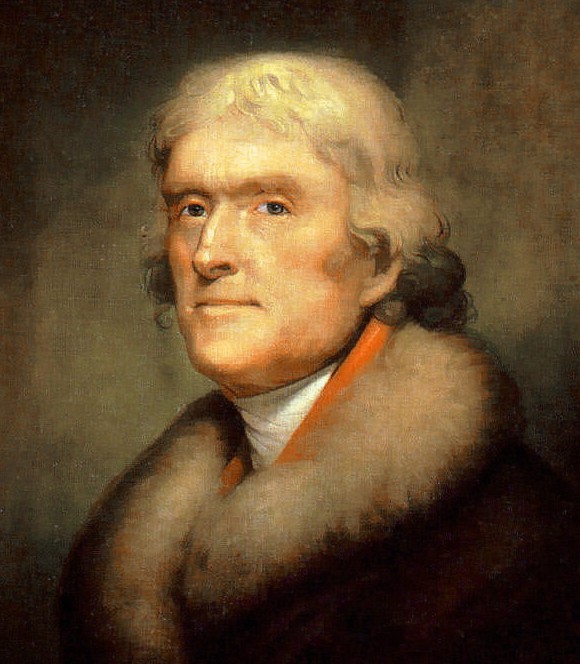
Thomas Jefferson frasi celebri
Origine: Citato in Dizionario mondiale di Storia, Rizzoli Larousse, Milano, 2003, p. 649. ISBN 88-525-0077-4
da una lettera a John Taylor http://www.britannica.com/presidents/article-9116907, 28 maggio 1816
Thomas Jefferson Frasi e Citazioni
Origine: Citato in Summary View of the Rights of British America (1774); The Writings of Thomas Jefferson (19 Vols., 1905) edito da Andrew A. Lipscomb e Albert Ellery Bergh, Vol. 1, p. 211.
“Attribuire ad ognuno la direzione di ciò che il suo occhio riesce a sorvegliare.”
dalla lettera a Joseph C. Cabell, 2 febbraio 1816; in Antologia degli scritti politici, p. 109
Origine: Questo precetto è considerato l'anticipazione del principio di sussidiarietà adottato dall'Unione Europea a partire dal Trattato di Maastricht del 1992.
Origine: Citato in Michael J. Gelb, Il genio che c'è in te.
da una lettera a William Stevens Smith, 13 novembre 1787; citato in Adriano Sofri, Tiranno: quando si mette a morte il despota, la Repubblica, 7 novembre 2006, p. 53
citato in un articolo di Curzio Maltese, la Repubblica, 25 giugno 2007
Origine: Citato in Maurice Denuzière, Louisiana, traduzione di Augusto Donaudy, Rizzoli, Milano, 1980.
dalla lettera a Isaac Mc Pherson del 13 agosto 1813
Thomas Jefferson: Frasi in inglese
1780s, Letter to Peter Carr (1785)
Letter to Andrew Jackson (3 December 1806)
1800s, Second Presidential Administration (1805-1809)
Letter to William Short (13 April 1820)
1820s
On the Louisiana Purchase, Letter to John Breckinridge (12 August 1803)
1800s, First Presidential Administration (1801–1805)
Letter to William H. Crawford, 1815. ME 14:242
Posthumous publications, On financial matters
“No government ought to be without censors; and where the press is free no one ever will.”
Letter to George Washington (9 September 1792)
1790s
Letter to David Baillie Warden (25 February 1809)
1800s, Second Presidential Administration (1805-1809)
Letter to Albert Gallatin (13 December 1803) http://etext.virginia.edu/jefferson/biog/lj34.htm ME 10:437 : The Writings of Thomas Jefferson "Memorial Edition" (20 Vols., 1903-04) edited by Andrew A. Lipscomb and Albert Ellery Bergh, Vol. 10, p. 437 <br class="br">1800s, First Presidential Administration (1801&ndash;1805)
Letter to General Alexander Smyth, on the book of Revelation (or The Apocalypse of St. John the Divine) (17 January 1825) http://www.cbsnews.com/stories/2005/02/04/opinion/main671823.shtml <br class="br">1820s
. <br class="br">Letter to Thomas Leiper (11 January 1809). Published in The Works of Thomas Jefferson in Twelve Volumes http://oll.libertyfund.org/ToC/0054.php, Federal Edition, Paul Leicester Ford, ed., New York: G. P. Putnam's Sons, 1904, Vol. 11 http://oll.libertyfund.org/Texts/Jefferson0136/Works/0054-11_Bk.pdf, pp. 89 <br class="br">1800s, Second Presidential Administration (1805-1809)
1770s, A Summary View of the Rights of British America (1774)
1820s, Letter to A. Coray (1823)
Letter to Robert Skipwith (3 August 1771) http://oll.libertyfund.org/Texts/Jefferson0136/Works/0054-02_Bk.html#hd_lf054.2.head.010 ; also in The Writings of Thomas Jefferson (19 Vols., 1905) edited by Andrew A. Lipscomb and Albert Ellery Bergh, Vol. 4, p. 239 http://books.google.com/books?vid=OCLC61981280&id=YjaXnbNMaccC&pg=RA6-PA239&lpg=RA6-PA239&dq=Bergh+%22volumes+of+ethics,+and+divinity%22 <br class="br">1770s
Letter http://www.stephenjaygould.org/ctrl/jefferson_adams.html to John Adams (11 April 1823) (Scan at The Library of Congress) http://memory.loc.gov/master/mss/mtj/mtj1/053/0800/0841.jpg <br class="br">1820s
Advising the origination of an annual fund from surplus revenue.
1800s, Second Inaugural Address (1805)
Letter to Joel Barlow (8 October 1809); Jefferson here expresses an aversion to supporting the "fixed opinion" that blacks were not equal to whites in general mental capacities, which he asserts in his Notes on the State of Virginia he had advanced as "a suspicion only".
1800s, Post-Presidency (1809)
Letter to William Green Mumford (18 June 1799) http://www.princeton.edu/~tjpapers/munford/munford.html <br class="br">1790s
There are no indications that Jefferson ever stated anything like this; slight variants of this statement seem to have become widely attributed to Jefferson only since its appearance in three books of 2004: The Adventures of Jonathan Gullible: A Free Market Odyssey (2004) by Ken Schoolland, p. 235; Damn-ocracy — Government From Hell!: The Political, Economic And Money System (2004) by Wendall Dennis and Reason And Reality : A Novel (2004) by Mishrilal Jain, p. 232; see also info at Thomas Jefferson Encyclopedia http://wiki.monticello.org/mediawiki/index.php/Democracy_is_nothing_more_than_mob_rule. <br class="br">Misattributed
Letter to http://press-pubs.uchicago.edu/founders/documents/v1ch15s32.html James Madison (28 October 1785) <br class="br">1780s
“There is not a truth existing which I fear or would wish unknown to the whole world.”
Letter to Henry Lee (15 May 1826)
1820s
“What all agree upon is probably right; what no two agree in most probably is wrong.”
Letter to John Adams (11 January 1817) This statement has been referred to as "Jefferson's Axiom"
1810s
Thomas Jefferson's Sixth State of the Union Address (2 December 1806). Advising the origination of an annual fund to be spent through new constitutional powers (by new amendments) from projected surplus revenue.
1800s, Second Presidential Administration (1805-1809)
“The second office of the government is honorable and easy, the first is but a splendid misery.”
Letter to Elbridge Gerry (13 May 1797)
1790s
ME 13:277
1810s, Letters to John Wayles Eppes (1813)
“Knowing that religion does not furnish grosser bigots than law, I expect little from old judges.”
Letter to Thomas Cooper (1810)
1810s
Account of a conversation with Col. Richard M. Johnson in 1809, as recounted in A Biographical Sketch of Col. Richard M. Johnson of Kentucky, p.12 (Saxton & Miles, New York, 1843)
1800s, Post-Presidency (1809)
1770s, Declaration of Independence (1776)
“[I]f ever there was a holy war, it was that which saved our liberties and gave us independence.”
Letter to John W. Eppes (6 November 1813). Reported in Albert Ellery Bergh, The Writings of Thomas Jefferson (1907), p. 430
1810s
Letter https://founders.archives.gov/documents/Jefferson/98-01-02-1712 to William Roscoe (27 December 1820) <br class="br">1820s


