“Perdona i tuoi nemici, ma non dimenticarti mai i loro nomi.”
Origine: Citato in Gino e Michele, Matteo Molinari, Le Formiche: anno terzo, Zelig Editore, 1995, § 1953.
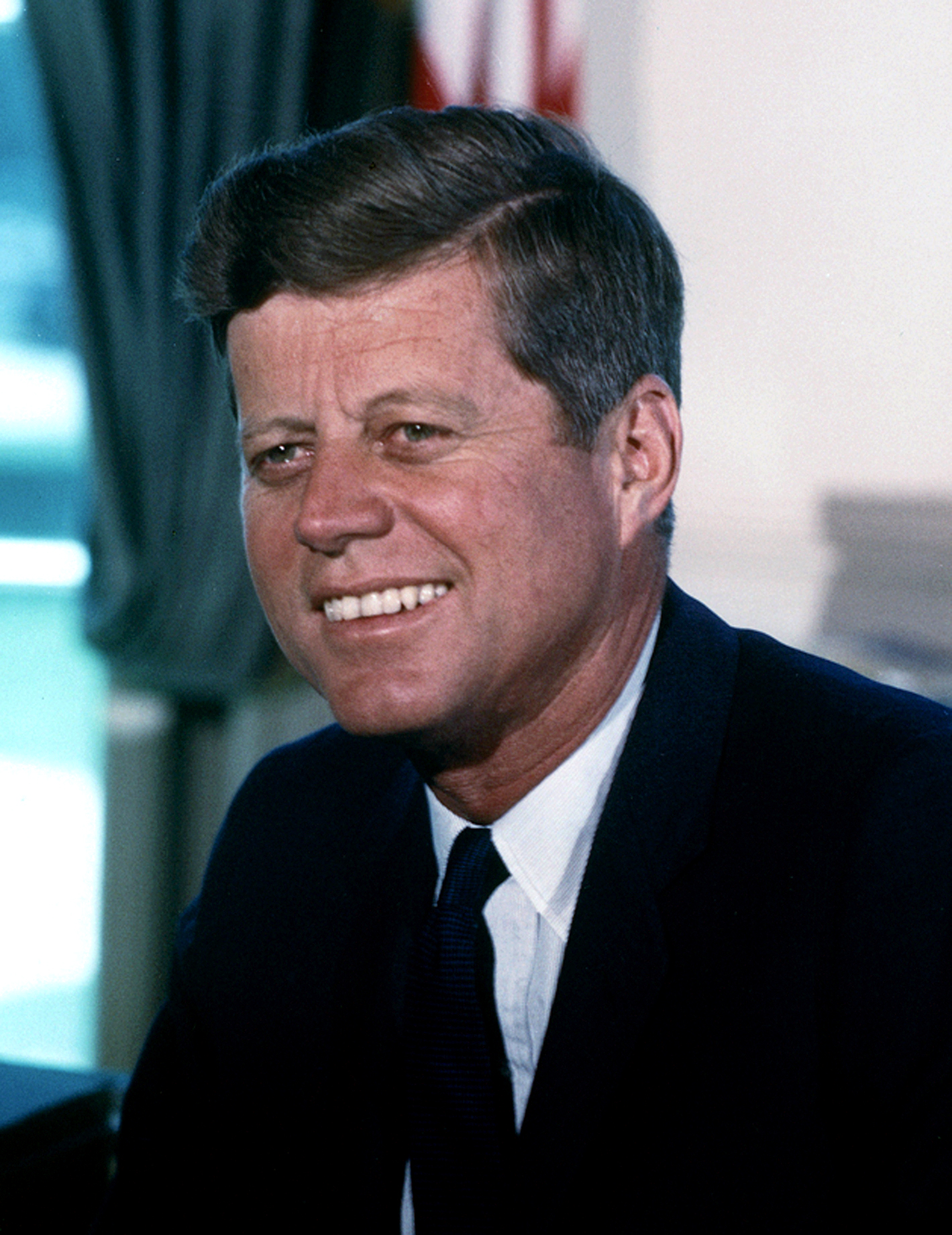
John Fitzgerald Kennedy, comunemente chiamato John F. Kennedy, John Kennedy o solo JFK, , è stato un politico statunitense e il 35º presidente degli Stati Uniti d'America.
Candidato del Partito Democratico, vinse le elezioni presidenziali del 1960 diventando il 35º presidente degli Stati Uniti d'America, carica che ha mantenuto dal 20 gennaio 1961 fino al suo assassinio nel 1963, quando gli subentrò il vicepresidente Lyndon B. Johnson.
Kennedy, di origine irlandese, noto anche con il diminutivo "Jack", è stato il primo presidente degli Stati Uniti d'America di religione cattolica. Fu anche il primo presidente statunitense a essere nato nel XX secolo e il più giovane a morire ricoprendo la carica . La sua breve presidenza, in epoca di guerra fredda, fu segnata da alcuni eventi molto rilevanti: la crisi di Berlino del 1961 con la costruzione del Muro, la corsa alla Luna, la conquista dello spazio, lo sbarco nella baia dei Porci, la crisi dei missili di Cuba, gli antefatti della guerra del Vietnam e l'affermarsi del movimento per i diritti civili degli afroamericani.
Kennedy fu assassinato il 22 novembre 1963 a Dallas, in Texas. Lee Harvey Oswald fu accusato dell'omicidio e fu a sua volta ucciso, due giorni dopo, da Jack Ruby, prima che potesse essere processato. La Commissione Warren concluse che Oswald aveva agito da solo; tuttavia nel 1979 la United States House Select Committee on Assassinations dichiarò che l'atto di Oswald era stato probabilmente frutto di una cospirazione. La questione se Oswald avesse o meno agito da solo rimane dibattuta, con l'esistenza di numerose teorie cospirazioniste. L'assassinio di Kennedy fu un evento focale nella storia degli Stati Uniti per l'impatto che ebbe sulla nazione e sulla politica del Paese. La figura di Kennedy continua tuttora a ricevere stima e apprezzamento.
“Perdona i tuoi nemici, ma non dimenticarti mai i loro nomi.”
Origine: Citato in Gino e Michele, Matteo Molinari, Le Formiche: anno terzo, Zelig Editore, 1995, § 1953.
“Non chiedete cosa possa fare il paese per voi: chiedete cosa potete fare voi per il paese.”
dal discorso inaugurale del proprio mandato, 20 gennaio 1961
dal discorso http://www.jfklibrary.org/Research/Ready-Reference/JFK-Speeches/Commencement-Address-at-American-University-June-10-1963.aspx alla American University, 10 giugno 1963
dal discorso http://www.jfklibrary.org/Research/Ready-Reference/JFK-Speeches/The-President-and-the-Press-Address-before-the-American-Newspaper-Publishers-Association.aspx presso l'Hotel Waldorf-Astoria di New York, 27 aprile 1961
19 maggio 1962; citato in Marilyn, p. 369
“La vittoria ha moltissimi padri, la sconfitta è orfana.”
Origine: Citato in Dizionario mondiale di Storia, Rizzoli Larousse, Milano, 2003, p. 656. ISBN 88-525-0077-4
dal discorso alla Rice University, 12 settembre 1962
“La guerra non ci si propone più come un'alternativa razionale.”
dal messaggio all'ONU del 25 settembre 1961
citato in Arthur Schlesinger Jr., I mille giorni di John F. Kennedy, p. 101
“Mio padre [Joseph P. Kennedy] mi ha detto che tutti gli uomini di affari sono figli di puttana.”
citato in Edward Klein, La maledizione dei Kennedy, p. 64
Origine: Citato in Giovanni Sabbatucci e Vittorio Vidotto, <nowiki></nowiki>Il mondo contemporaneo. Dal 1848 a oggi<nowiki></nowiki>, Editori Laterza, Roma, 2008, <nowiki>ISBN 978-88-420-8741-0</nowiki>, pag. 542
dal discorso http://www.jfklibrary.org/Research/Ready-Reference/JFK-Speeches/Remarks-at-the-Rudolph-Wilde-Platz-June-26-1963.aspx a Berlino Ovest, 26 giugno 1963
“Il conformismo è il carceriere della libertà e il nemico dello sviluppo.”
dal messaggio all'ONU http://www.jfklibrary.org/Research/Ready-Reference/JFK-Speeches/Address-Before-the-General-Assembly-of-the-United-Nations-September-25-1961.aspx del 25 settembre 1961
“Io sono un idealista senza illusioni.”
Origine: Citato in Enzo Biagi, Buoni cattivi: esiste ancora una morale valida per tutti?, BUR, Milano, 1991, p. 15. ISBN 88-17-11549-5
“L'umanità deve porre fine alla guerra, o la guerra porrà fine all'umanità.”
dal messaggio all'ONU del 25 settembre 1961
“L'uomo è ancora il più straordinario dei computer.”
da un discorso del 21 maggio 1963
citato in Guida completa a Frank Sinatra
dalla tesi di laurea di Kennedy, pubblicata come saggio dal titolo Why England Slept nel 1940; citato in Arthur Schlesinger Jr., I mille giorni di John F. Kennedy, p. 105
dal diario tenuto durante il suo soggiorno in Europa nel 1938, citato in Arthur Schlesinger Jr., I mille giorni di John F. Kennedy, p. 102
“Non voglio la capote sulla macchina, tutte la texane devono vedere che bella ragazza è Jackie.”
Origine: Detto al suo collaboratore più stretto, Kenneth O'Donnell, a proposito della sua visita alla città texana di Dallas, che avrebbe avuto luogo di lì a due giorni. Citato in Edward Klein, La maledizione dei Kennedy, p. 183.
“Le migliori manovre strategiche avvengono sempre per caso.”
citato in Arthur Schlesinger Jr., I mille giorni di John F. Kennedy, p. 93
Citato in Edward Klein, La maledizione dei Kennedy, p. 31
“Cuba non deve essere abbandonata ai comunisti.”
citato in AA.VV., Il libro della storia, traduzione di Roberto Sorgo, Gribaudo, 2018, p. 315. ISBN 9788858016572
"Remarks at the White House to Members of the American Legion (70)" (1 March 1962) http://www.jfklibrary.org/Research/Research-Aids/Ready-Reference/JFK-Quotations.aspx <br class="br">1962
1961, Inaugural Address
1963, Limited Nuclear Test Ban Treaty speech
1960, Sport at the New Frontier: The Soft American
1960, Speech at East Los Angeles College Stadium, Los Angeles, California
1963, Address at Vanderbilt University
1961, Address at the University of Washington
1960, Speech to the Greater Houston Ministerial Association
“We have become more and more not a nation of athletes but a nation of spectators.”
"Remarks at National Football Foundation and Hall of Fame Banquet (496)," December 5 1961. Public Papers of the Presidents: John F. Kennedy, 1961. http://www.jfklibrary.org/Research/Research-Aids/Ready-Reference/JFK-Quotations.aspx <br class="br">1961
1962, First letter to Nikita Khrushchev
1963, Address at Vanderbilt University
1962, Second State of the Union Address
At the signing of a charter establishing the German Peace Corps, Bonn, West Germany (24 June 1963);
Origine: http://www.jfklibrary.org/Research/Research-Aids/Ready-Reference/JFK-Quotations.aspx According to the John F. Kennedy Presidential Library & Museum] President Kennedy got his facts wrong. Dante never made this statement. The closest to what President Kennedy meant is in the Inferno where the souls in the ante-room of hell, who "lived without disgrace and without praise," and the coward angels, who did not rebel but did not resist the cohorts of Lucifer, are condemned to being whirled through the air by great winds while being stung by wasps and horseflies. Dante placed those who "non furon ribelli né fur fedeli" — were neither for nor against God, in a special region near the mouth of Hell; the lowest part of Hell, a lake of ice, was for traitors.
Origine: https://web.archive.org/web/20201213100425/https://www.jfklibrary.org/learn/about-jfk/life-of-john-f-kennedy/fast-facts-john-f-kennedy/john-f-kennedys-favorite-quotations-dantes-inferno According to the John F. Kennedy Presidential Library & Museum in the undated article "John F. Kennedy's Favorite Quotations: Dante's Inferno"
President Kennedy's quote was based upon an interpretation of Dante's Inferno. As Robert Kennedy explained in 1964, "President Kennedy's favorite quote was really from Dante, 'The hottest places in Hell are reserved for those who in time of moral crisis preserve their neutrality.'" This supposed quotation is not actually in Dante's work, but is based upon a similar one. In the Inferno, Dante and his guide Virgil, on their way to Hell, pass by a group of dead souls outside the entrance to Hell. These individuals, when alive, remained neutral at a time of great moral decision. Virgil explains to Dante that these souls cannot enter either Heaven or Hell because they did not choose one side or another. They are therefore worse than the greatest sinners in Hell because they are repugnant to both God and Satan alike, and have been left to mourn their fate as insignificant beings neither hailed nor cursed in life or death, endlessly travailing below Heaven but outside of Hell. This scene occurs in the third canto of the Inferno.
Origine: http://www.bartleby.com/73/1211.html According to Bartleby.com
Kennedy's remark may have been inspired by the passage from Dante Alighieri’s La Comedia Divina “Inferno,” canto 3, lines 35–42 (1972) passage as translated by Geoffrey L. Bickersteth: "by those disbodied wretches who were loth when living, to be either blamed or praised. [...] Fear to lose beauty caused the heavens to expel these caitiffs; nor, lest to the damned they theng ave cause to boast, receives them the deep hell." A more modern-sounding translation from the foregoing Dante’s Inferno passage was translataed 1971 by Mark Musa thus: “They are mixed with that repulsive choir of angels … undecided in neutrality. Heaven, to keep its beauty, cast them out, but even Hell itself would not receive them for fear the wicked there might glory over them.”
1963, Civil Rights Address
“Secondly, what does justice require? In the end, it requires liberty.”
1963, Address at the Free University of Berlin
1963, Third State of the Union Address
Origine: "Remarks in New York City to the National Convention of the Catholic Youth Organization (463)," (15 November 1963) http://www.jfklibrary.org/Research/Research-Aids/Ready-Reference/JFK-Quotations.aspx
1962, Second Letter to Nikita Khrushchev
Robert F. Kennedy, in a speech in the US Senate (9 May 1966)
Misattributed
1964 Memorial Edition, p. 264 http://www.jfklibrary.org/Research/Research-Aids/Ready-Reference/JFK-Quotations/Profiles-in-Courage-quotations.aspx <br class="br">Pre-1960, Profiles in Courage (1956)
Message to the Inter-American Economic and Social Conference at Punta del Este, Uruguay (5 August 1961) http://www.presidency.ucsb.edu/ws/?pid=8271 <br class="br">1961
"Address in Chicago at a dinner of the Democratic Party of Cook County (155)," (28 April 1961) http://www.jfklibrary.org/Research/Research-Aids/Ready-Reference/JFK-Quotations.aspx <br class="br">1961
1963, President John F. Kennedy's last formal speech and public words
1960, The New Frontier
Speech at Democratic Rally, George Washington High School Stadium, Alexandria, Virginia (24 August 1960) http://www.presidency.ucsb.edu/ws/?pid=74188 <br class="br">1960
1960, Sport at the New Frontier: The Soft American


